

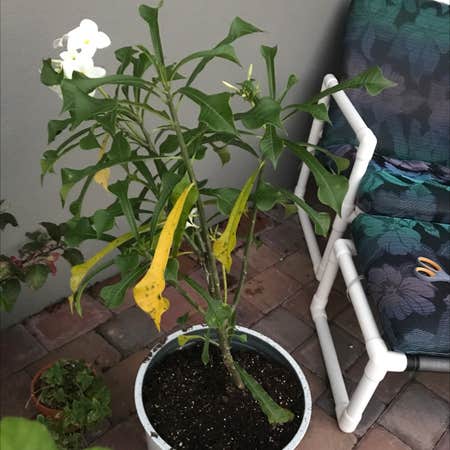


Fiddle Leaf Plumeria
Also known as
Bridal boquet, Golden arrow, Gilded spoon, Sri supakorn and Pink pudica
Taxonomy

Plumeria pudica
Plumeria
Apocynaceae
Gentianales

How to care for Fiddle Leaf Plumeria
How often to water your Fiddle Leaf Plumeria

every 12
Fiddle Leaf Plumeria needs 0.5 cups of water every 12 when it doesn’t get direct sunlight and is potted in a 5" pot.
Use our water calculator to personalize watering recommendations to your environment or download Greg for more advanced recommendations for all of your plants.

Water 0.5 cups every
12
Finding light for Fiddle Leaf Plumeria in your home

a window
Fiddle Leaf Plumeria love being close to bright, sunny windows 😎.
Place it less than 1ft from a south-facing window to maximize the potential for growth.
Fiddle Leaf Plumeria does not tolerate low-light 🚫.
Select your region to see how the current weather in your area affects the placement of Fiddle Leaf Plumeria in your home 🏡.
How to fertilize Fiddle Leaf Plumeria

Most potting soils come with ample nutrients which plants use to produce new growth.
By the time your plant has depleted the nutrients in its soil it’s likely grown enough to need a larger pot anyway.
To replenish this plant's nutrients, repot your Fiddle Leaf Plumeria after it doubles in size or once a year—whichever comes first.
-
Okayokay, you are clearly happier with your side light source than your overhead ones… did you really have to have a growth spurt just to grow sideways? Sad leaves are from last year, it just never went fully dormant. Realized I initially tagged the wrong plant and accidentally deleted the original photo while fixing, this is after repositioning and shoving it up against the wall, but it was growing parallel to the floor. #Plumeria
-
Super cute! #PeaceLily
-
What do i fertalize with? #RedFrangipani
-
a post-rain plumeria visitor! they let me come over and say hi and posed for a picture ☺️🦎 #HappyPlants #PlantsMakePeopleHappy
-
an afternoon visit to my #plumeria sapling! #HappyPlants #PlantsMakePeopleHappy #PlantsMakeLizardsHappyToo
-
i love seeing new leaves come in on my plumeria sapling! 🥹🤍 #HappyPlants #FreshLeafFriday
-
I took a picture of my frangipani as soon as I put it in the soil. This app identified it as red Fragapane. How can I tell? #RedFrangipani
-
Drooping and dropping browning leaves Just brought him home and a day or two after his leaves are yellowing/browning, drooping, and dropping. Anybody have experience with a Plumeria?
-
I pruned my #Plumeria at the beginning of May. It didn’t do well after last winter and I was worried about whether it would grow again. The first 2 photos are from Tuesday, and the other 3 were taken today. I can’t believe how much growth it’s gotten just since Tuesday! 😍🥰
-
Noticed a couple of ants on my outdoor potted plumeria. I’m reading they won’t harm the plant. Is this true? #RedFrangipani


Care Summary for Fiddle Leaf Plumeria

Fiddle Leaf Plumeria
 Greg recommends:
 Water
Water
0.5 cups every 12 days
 Placement
< 1ft from a window
 Nutrients
Repot after 2x growth
Based on the 4” pot your plant is in, and that it doesn’t get direct sunlight.
 Trending in your area








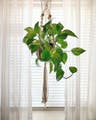
 Similar to Fiddle Leaf Plumeria


✨ Discover rare plants

Orange Lipstick Plant

Tuber Fleeceflower

Vatricania guentheri

Tillandsia caerulea A…
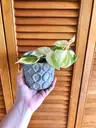
Philodendron 'Gabby'

Anthurium 'Fantasy Lo…
Linnaei Kunth

Betel

Aeonium 'Blushing Bea…

Echeveria 'Joan Danie…

Begonia lubbersii

Radiator Plant

Miss All-American Bea…

Picasso's Paintbrush

Peperomia 'Harmony's …

Electric Blue Gecko
