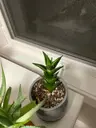
Agave Titanota
Also known as
Rancho Tambor Agave, Rancho Tambor Agave, Chalk Agave and Agave Black & Blue
Taxonomy

Agave titanota
Agave
Asparagaceae
Asparagales

How to care for Agave Titanota
How often to water your Agave Titanota

every 12
Agave Titanota needs 0.5 cups of water every 12 when it doesn’t get direct sunlight and is potted in a 5" pot.
Use our water calculator to personalize watering recommendations to your environment or download Greg for more advanced recommendations for all of your plants.

Water 0.5 cups every
12
Finding light for Rancho Tambor Agave in your home

a window
Agave Titanota love being close to bright, sunny windows 😎.
Place it less than 1ft from a south-facing window to maximize the potential for growth.
Agave Titanota does not tolerate low-light 🚫.
Select your region to see how the current weather in your area affects the placement of Agave Titanota in your home 🏡.
How to fertilize Agave Titanota

Most potting soils come with ample nutrients which plants use to produce new growth.
By the time your plant has depleted the nutrients in its soil it’s likely grown enough to need a larger pot anyway.
To replenish this plant's nutrients, repot your Agave Titanota after it doubles in size or once a year—whichever comes first.
-
Look what I got! You were right it’s a really cool book. Lots of good information. I’m not sure I want to do decorating with succulents, but who knows. I might be taking a pottery class so I could make some terra-cotta pots in the future. Then I might think about the decorating part of this book.  #TheWateringHole tags: @MarionsOasis @Just1More @Sassylimey @Ms.Persnickety @TidyTigerpear @DreamMachine @BEsucculent @kaleena @MamaLinne @debbiedo @BonusTaraire85 @Idplantthat @mtplantlady @BabeVila @RefinedSandwort @LaLaslovlies @FitBrowallia @JenniferNoel @CutePolypremum @AC73LoveCats @SweetAzurebluet @IWantThatPlant @ILoveMyPlants @princesspitstop @Jho @Dawgfreak @Luckeecharm1 @MockingJay @HolyLacealoe @stephongreg @Ponytailmom @SunflowerSunset @PrizedShadscale @Popcornjoness @BuffCaperspurge @Preciousplants1 @baobab_zig @GreenPurpose @antsinurplants @LucidAgapanthus @ShadowBoxrBaby @Forbes57 @TRose @CactusAdjacent # #succulents #succulentLove #sedum #echeveria #kalanchoe #aloe #crassula #euphorbia #cotyledon #dudleya #Bredasdorp #agave #simpervivum #Salicornia #hatiora #epiphyllum #portulacaria #Austrocylindropuntia #graptopetalum #graptosedum #aizoaceae #aristaloe #lithops #ariocarpus #pachyphytum #curio #gasteria #tephrocactus #faucaria #frangipangi #othonna #Anacampseros #sesuvivum #dracanea #haworthia #stapelia #curio #ceropegia #senecio #aeonium #Zamioculcas
-
Not sure what’s going on she’s droopy all of a sudden. Suggestions? Tx #Agave
-
Yellow Parry’s Agave #Agave 4 pups are yellowing after repotting? What to do? Mother
-
my agave is looking brown and drooping in the middle. it's in succulent soil with a drainage hole in an outside porch and I'm watering it the recommended amount. should I just limit it's water intake? #Agave
-
Eeekkk!! It's finally happening!!! My first bloom from my Echeveria!! I've had her about 3.5 to 4 years 🥰 I'm so happy but also so scared. Does this mean she's going to die now? #happyplants #bloomingsuccs #echeveria #greggang
-
#Agave Is the leaves drooping and some turning yellow on the ends normal (excuse the few broken ones that broke when moving her outside for some sun, she’s a bit on the heavy side and a awkward pot for picking up). She has new leave growth and a cute little pup (when and what do I do for the little guy)?
-
Round 2 of the oasis expansion and garden start-up has been ordered - all of round 1 should be here by the time the weekend's out, so expect baby pics soon~ 💕 #PlantsMakePeopleHappy #PlantAddict #NewPlant #OasisExpansion #GardenWork #PlantBinge #Gasteria #Agave #Aloe #PurplePassion #GoldfishPlant #Vegetables #Herbs #PlanetDesert #HirtsGardens #Etsy #LazyGardens #LadyNature
-
I’ve got a #HitchhikingSucculent in my Victoria Agave! 🥹 Does this make my #Agave a #propogationstation? 🤣🤣🤣 Can you see it? 🫶🏽🌿 #ShowThemIfYouGotThem #HappyPlants #PlantsMakePeopleHappy #PlantAddict #JustJokes #NewGrowth #PlantTherapy #TexasGregGang #CentralTexasGang #SanAntonioGregGang
-
My newest #succulents 💚💕 Who has one of these varieties? Which is your favorite? 🙂 #ghostplant #echeveria #agave #sedum This morning while having #coffeewithsucculents I began potted my newest stem & offset propigations in their new pots! 🥰 #stemcutting They looks so cute, I can't decide which is my favorite! Which is your top pick? 😉 #succulentlove #newplants #succulentsquad #happyplants #greggang #greggers #plantsmakepeoplehappy #lovesuccs #plantaddict
-
Oh no, not me trying to sneak in these two beauties this morning when I suddenly got caught trying to be slick… My daughter sold me out. She said, “Mom, I brought in the essentials from your car but what about the other plants?” DH sits up straight, asking “What other plants?” You guys, I only brought in the one from Austin Succulents yesterday but these two were on my wishlist and I picked them up Thursday while purchasing Blue Flame Agave for my other house. He knew about those but not about the #AgaveVictoriaeReginae #QueenVictoriaAgave that was on my #PlantWishList. He thinks we have a jungle at our house and we do but… but! They’re so pretty!!! Just look at that architecture! My plants are in the garage. I’m uploading them once I finish my coffee but look at the stock images of the mature ones! How does one say “No, I’m good…” to this kind of plant majesty??? Was it worth gettin caught? I think so but what do YOU think? Would you do it just to grow these? #PlantAddict #PlantsMakePeopleHappy #Agave #AgaveLove #HappyPlants #PlantTherapy #CreatingMyOwnDesert #CentralTexasGang #GoForBroke #StillThriving


Care Summary for Agave Titanota

Agave Titanota
 Greg recommends:
 Water
Water
0.5 cups every 12 days
 Placement
< 1ft from a window
 Nutrients
Repot after 2x growth
Based on the 4” pot your plant is in, and that it doesn’t get direct sunlight.
 Trending in your area










 Similar to Agave Titanota


✨ Discover rare plants

Betel

Stomatium acutifolium

Miss All-American Bea…

Euphorbia

Rainbow Echeveria

Anthurium 'Fantasy Lo…

Orange Lipstick Plant

Echeveria 'Joan Danie…

Christmas Candle

Black Monkey Thorn Tr…

Bonsai Crassula
Philodendron 'Gabby'

Eden Climbing Rose

Euphorbia baioensis

Picasso's Paintbrush

Haworthia emelyae com…

Caladium