

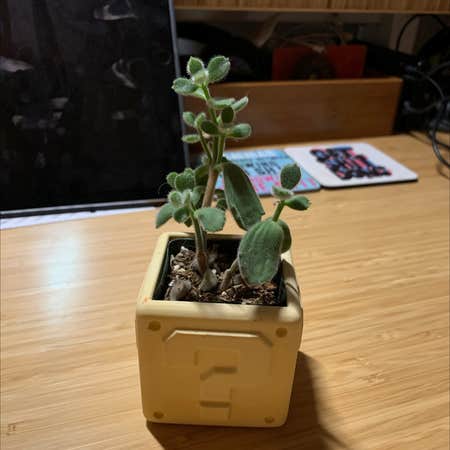


Coleus hadiensis
Also known as
Plectranthus hadiensis
Taxonomy

Coleus hadiensis
Coleus
Lamiaceae
Lamiales

How to care for Coleus hadiensis
How often to water your Coleus hadiensis

every 9
Coleus hadiensis needs 0.5 cups of water every 9 when it doesn’t get direct sunlight and is potted in a 5" pot.
Use our water calculator to personalize watering recommendations to your environment or download Greg for more advanced recommendations for all of your plants.

Water 0.5 cups every
9
Finding light for None in your home

a window
Coleus hadiensis may have difficulty thriving, and will drop leaves 🍃, without ample sunlight.
Place it less than 3 feet from a south-facing window to maximize the potential for growth.
Select your region to see how the current weather in your area affects the placement of Coleus hadiensis in your home 🏡.
How to fertilize Coleus hadiensis

Most potting soils come with ample nutrients which plants use to produce new growth.
By the time your plant has depleted the nutrients in its soil it’s likely grown enough to need a larger pot anyway.
To replenish this plant's nutrients, repot your Coleus hadiensis after it doubles in size or once a year—whichever comes first.
-
Gates, Ahava and River are looking beautiful #happyplants #plantsmakepeoplehappy #plantaddict #newgrowth #planttherapy #tradescantiazebrina #coleus #riverwalkcoleus #luckybamboo
-
Virus?? My plant had a fungus gnat issue which I assumed to be the problem but I haven’t seen any gnats in a few weeks and I’m worried if she may have a virus? Most of the leaves die before reaching a good size and the plant is leggy. it’s a chocolate cherry coleus and about 6 feet from a west window.. Leaves are losing color and some are deformed. Could it be a virus or is it simply the gnats making my plant weak? (Ignore the brown stuff it’s just cinnamon.) The plant has also gained about an inch in height but the new growth is very unhealthy looking too and I’m wondering if I should cut it. #PlantAddict #PlantsMakePeopleHappy #PlantTherapy #NewPlantMom #PlantCorner #PestControl #TropicalPlants #help #helpneeded #diagnose #Coleus
-
Does anyone know what this white stuff is that's on my coleus?? It's mostly on this one stem part, but a couple of leaves have it, too. TIA #Coleus
-
#HappyPlants #PlantsMakePeopleHappy #PlantAddict #NewGrowth #PropagationStation Happy Monday! Just wanted to share some of my latest plants. My #Coleus survived the winter and are absolutely unbelievable. I’m not sure he or she will want to go back outside this summer😉My experiment with attempting to root a baby rubber plant cutting in a make shift humidity chamber is looking successful so far #Pepermonia as are the water props but they are coming along slowly. 😜Lastly, it’s my Flame Violet. She’s is growing an awesome Orange flower #Peperomia #AfricanViolet #FlameViolet #PlantTherapy #
-
New plant alert🚨! Everyone meet Eve the new addition to my family! 😁 #newplant #coleus #happyplants #plantlove #plantmoms #tropicalplants #plantsmakepeoplehappy #plantaddict #indoorplants #growlights
-
#coleus
-
Starburst is really bursting! Growth from mid July to August! #Coleus #TrustyRustyColeus #happyplants #newgrowth
-
Plant things 🌿🍄👩🏻🌾🦋🌻 1. New succulent from my mom, “narrow leaf chalk sticks” 2. Fungi finds from the yard, we’ve had lots of rain the past week and the yard was full of them. 3. Two twin butterflies on the new black eyed Susan’s we planted this weekend. 4. My cat Dinky lounging above my mom’s coleus plant. (she grows them from seed every year.) 5. Morning glory blooms at my moms that she also grew from seed! #HappyPlants #NewGrowth #SucculentSquad #SucculentLove #NarrowLeafChalksticks #OutdoorGrowing #OutsidePlants #pollinatorgarden #pollinators #CatsOfGreg #PetsAndPlants #PlantsMakePeopleHappy #Coleus #MornGloryVine #PetsOfGreg #Fungi #mushrooms
-
#NorthTexasGregGang #Coleus What is happening here?? I have made sure not to over water and this pot is in the shade with minimal direct sun if any it’s minimal morning sun. #PlantsMakePeopleHappy #Coleus #PlantTherapy #plantdoctor
-
This plant seems to be doing really well except it’s lost a lot of it’s color?! It gets plenty of light I’m not sure why? #Coleus


Care Summary for Coleus hadiensis

Coleus hadiensis
 Greg recommends:
 Water
Water
0.5 cups every 9 days
 Placement
< 3ft from a window
 Nutrients
Repot after 2x growth
Based on the 4” pot your plant is in, and that it doesn’t get direct sunlight.
 Trending in your area











 Similar to Coleus hadiensis

✨ Discover rare plants

Raphionacme flanaganii

Radiator Plant

Pink Ruby Sedevaria
Rosularia platyphylla

Cereus peruvianus 'Pa…

Parrot Pitcher Plant

Aglaonema 'Green Bowl'

Croton Nervia

Sedeveria 'Blue Elf'
Philodendron 'Silver …
Ace of Spades

Stomatium acutifolium

Hoya pottsii 'Khao Ya…

Large Leaf Elephant B…
Stanhopea tigrina
Astroloba congesta

Hoya kalimantan
