

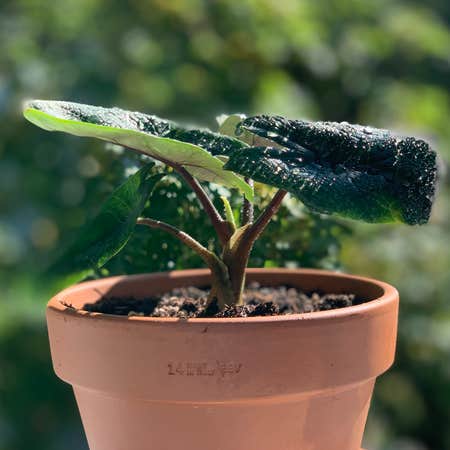


Alocasia Scalprum
About Alocasia Scalprum
Alocasias, commonly known as Elephant Ears, are some of the most common houseplants although their leaves can reach enormous sizes when grown outdoors! 🐘 They typically only support a few leaves at a time (more, when they get more sun!) so don't be concerned if you see an old leaf begin to retire after a new one emerges. They grow out of underground corms which are similar to bulbs, so next time you repot keep an eye out for baby Alocasias! They contain calcium oxalate crystals so be sure to keep them out of reach if you have children or pets! ⚠️
Taxonomy

Alocasia scalprum
Alocasia
Araceae
Alismatales
Also known as
Samar lance, Alocasie Samar Lance and Alocasia Samar Lance

How to care for Alocasia Scalprum
How often to water your Alocasia Scalprum

every 9
Alocasia Scalprum needs 0.5 cups of water every 9 when it doesn’t get direct sunlight and is potted in a 5" pot.
Use our water calculator to personalize watering recommendations to your environment or download Greg for more advanced recommendations for all of your plants.

Water 0.5 cups every
9
Finding light for Alocasia Scalprum in your home

a window
Alocasia Scalprum may have difficulty thriving, and will drop leaves 🍃, without ample sunlight.
Place it less than 3 feet from a south-facing window to maximize the potential for growth.
Select your region to see how the current weather in your area affects the placement of Alocasia Scalprum in your home 🏡.
How to fertilize Alocasia Scalprum

Most potting soils come with ample nutrients which plants use to produce new growth.
By the time your plant has depleted the nutrients in its soil it’s likely grown enough to need a larger pot anyway.
To replenish this plant's nutrients, repot your Alocasia Scalprum after it doubles in size or once a year—whichever comes first.
-
#AlocasiaScalprum After a rep, my leaves are turning under, like curving. What is the matter? Thanks I've watered the plant slightly But have seen no changes. #AlocasiaScalprum
-
This Scalprum is just about ready for a new jar! He’s getting too magnificent 💕 I love it when corms work out
-
It was a big day in NYC, gang! My alocasia scalprum was freed from her soil and transferred to leca semi hydro. I discovered that she had pretty good roots still (didn’t find any rot), there were actually two separate plants stuck together, and there were a few corms! The corms are kind of small; not sure if they are viable but they popped off as I was cleaning the roots. Going to try to root them next.. currently in a shallow tray with water and covered with a cloche. 🤞 #AlocasiaAddicts #AlocasiaScalprum #corms #semihydroponics
-
What is this on my Scalpum?? #AlocasiaScalprum Good morning plant family!!!! So I got up early this morning to water plants and when I got to my Scalprum I saw this. I saw it growing but thought it was a new leaf. Should I cut it off?
-
I just got my alocasia, the stem feels viable but the leaf is completely crunchy. Can I save her? #AlocasiaScalprum
-
So proud of my #Alocasia scalprum Yeah, guess I'm becoming the Alocasia guy. This one has been growing and growing... fast. She REALLY enjoys humidity and is REALLY sensitive - and she lets you know. Yesterday she was all down but today it finally rained (80% humidity! yay!!!!!) and she's all perked up. I just love the pattern. The leaves are growing in size, too (she grew a new one that, in two weeks, is bigger than all others), and she seems to like me. I, for one, like her very much :) #HappyPlants #PlantsMakePeopleHappy #PlantAddict #PlantAddict #NewGrowth #PlantTherapy #FreshLeafFriday
-
And the second #PlantMail of the day is one I personally had never seen before... meet my new #Alocasia scalprum! I just love this pattern on the leaves! She's still a baby so I'm gonna get to watch her grow! She's native to the Phillipines and I guess I'm into Alocasias now lol Anyway, another beauty! #HappyPlants #PlantsMakePeopleHappy #PlantAddict #PlantTherapy #RarePlants #FreshLeafFriday
-
I think he's gonna make it :) #alocasiaaddicts #alocasia #leca #newgrowth
-
Leca rehab for my alocasia scalprum is paying off. Should have its very first leaf open soon! #newgrowth #lecaleague #leca #alocasia #happyplants
-
Got this new baby yesterday! Any tips are welcome!


Care Summary for Alocasia Scalprum

Alocasia Scalprum
 Greg recommends:
 Water
Water
0.5 cups every 9 days
 Placement
< 3ft from a window
 Nutrients
Repot after 2x growth
Based on the 4” pot your plant is in, and that it doesn’t get direct sunlight.
 Trending in your area

Tradescantia Zebrina

Blue-Stem Yucca

Marijuana

Majesty Palm

Dwarf Umbrella Tree

Blushing Bride Air Pl…

Golden Barrel Cactus
Polka Dot Plant

African Violet

Emerald Ripple Pepero…

Venus Fly Trap

Kentia Palm
Cornstalk Dracaena

Cylindrical Snake Pla…

Hens and Chicks

Ghost Plant
Lady Finger Cactus
Phalaenopsis Orchid
 Similar to Alocasia Scalprum


✨ Discover rare plants

Echeveria Arrow

Picasso's Paintbrush
Philodendron 'Gabby'

Kilimanjaro Plant

Cereus peruvianus 'Pa…

Anthurium 'Fantasy Lo…
Rosularia platyphylla

Caladium

Begonia lubbersii

Ruby Ball

Hoya sipitangensis
Ace of Spades

Scotch Moss

Maroon Pitcher Plant

Tuber Fleeceflower
Skeleton Key Pothos

Royal Flush Split Rock
