


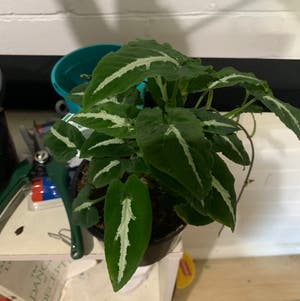
Syngonium wendlandii

4.5 out of 5 (2 experiences)
 Survivor
 Browns easily
About Syngonium wendlandii
Syngonium podophyllum is a popular, easy-to-care-for houseplant with beautiful arrowhead shaped leaves. You’ll often see these plants grown in their juvenile stage, but given something to climb on and abundant sunlight you may see them mature into their adult stage! The leaf shape changes as they mature and may even appear to split into three individual leaves. In the wild they can climb up to 65 feet tall. Be sure to handle them with care, as their sap contains oxalic acid which can be very irritating to the skin and eyes. 👀
Taxonomy

Syngonium wendlandii
Syngonium
Araceae
Alismatales
Also known as
Silver Goosefoot Plant, Syngonium wedlandii, Syngonium wenlandii, Syngonium Green Velvet, Black Velvet, Black Velvet Plant and Scrambled Eggs

How to care for Syngonium wendlandii
How often to water your Syngonium wendlandii

every 9
Syngonium wendlandii needs 0.5 cups of water every 9 when it doesn’t get direct sunlight and is potted in a 5" pot.
Use our water calculator to personalize watering recommendations to your environment or download Greg for more advanced recommendations for all of your plants.

Water 0.5 cups every
9
Finding light for Syngonium wendlandii in your home

a window
Syngonium wendlandii can tolerate being far from a window and light source.
Place it less than 6 feet from a south-facing window to ensure it receives enough light to survive 💪.
Select your region to see how the current weather in your area affects the placement of Syngonium wendlandii in your home 🏡.
How to fertilize Syngonium wendlandii

Most potting soils come with ample nutrients which plants use to produce new growth.
By the time your plant has depleted the nutrients in its soil it’s likely grown enough to need a larger pot anyway.
To replenish this plant's nutrients, repot your Syngonium wendlandii after it doubles in size or once a year—whichever comes first.
-
I seen this plant on a 50% off wrack in my favorite plant shop. It wasn’t doing well but I thought it would be a fun little plant project. I’ve never heard of a Syngonium ‘Mickey’ before! It’s supposed to get really pink! I’m excited to watch this one grow! #HappyPlants #PlantsMakePeopleHappy #PlantAddict #NewGrowth #PlantTherapy #syngonium #syngoniumpodophyllum #mickey #sungoniummickey #syngoniumpodophyllummickey #BeforeAndAfter
-
Which type of pot is best for my pink syngonium? #Syngonium
-
There are tiny brown spots on the white areas of the leaves, please help, just brought home from local nursery today. They aren’t pests from what I can see, they do not rub off etc. already tried to clean the leaf #Syngonium
-
Humidity Huddle while watering today!! #HappyPlants #Fittonia #Syngonium #Aglaonema #PlantsMakePeopleHappy #NewGrowth #PlantTherapy #GrowLights #PlantCorner #philodendron #PlantLove #humidityhuddle @Maddsplantz
-
Miss Wendii growing her very first water roots after 10 days in LECA #GrowingInLeca #leca #SyngoniumWendlandii #RootPorn #WaterRoots
-
Should my plant have white lines on the leaves? #Syngonium I've had my syngonium plant for a while now and it's doing really well! 😍 It's gotten really big and seems healthy. Except it doesn't have white lines on the leaves like all the pictures... Should I be worried? ☹️
-
Is this the milk confetti of my dreams?? @lifeis2short 💙 A little late for #freshleaffriday as usual, but look at this stunner 🤩 The variegation is crazy!! There's a speckled half moon right there!! #happyplants #plantsmakepeoplehappy #plantaddict #newgrowth #syngonium #syngoniumsquad
-
This little pink Syngonium followed me home… can I keep her? 😁 #HappyPlants #PlantsMakePeopleHappy #PlantAddict #PlantAddict #Syngonium #SyngoniumSquad #PinkSyngonium
-
I think aurea maybe one of my fav var i just love both my aurea syngos so very much #HappyPlants #PlantsMakePeopleHappy #PlantAddict #Syngonium #SyngoniumSquad #aureasyngonium
-
Splotchy leaves My Syngonium Wendlandii has a few leaves that look like this. She’s in leca and has developed water roots. Any idea what could be wrong?


Care Summary for Syngonium wendlandii

Syngonium wendlandii
 Greg recommends:
 Water
Water
0.5 cups every 9 days
 Placement
< 6ft from a window
 Nutrients
Repot after 2x growth
Based on the 4” pot your plant is in, and that it doesn’t get direct sunlight.
What other plant parents say
Survivor 2
Browns easily 1
 Easy to propagate 1


 03/24/2021
Look. This was my first syngonium. I have another now, called confetti. It is my fault this this one sort of died because whilst it was inside it was in a bit too much direct sun. It has new green leaves again now. Thank you Greg for your help with this one!
Browns easily
Survivor
Easy to propagate
 Trending in your area








 Similar to Syngonium wendlandii





✨ Discover rare plants

Raphionacme flanaganii

Betel

Picasso's Paintbrush

Parrot Pitcher Plant

Anthurium 'Fantasy Lo…

Dinteranthus microspe…

Fernleaf Lavendar

Euphorbia baioensis

Electric Blue Gecko

Crassula 'Purple Drag…

Miss All-American Bea…

Munstead Lavender

Radiator Plant

Cleistocactus icosago…

Hoya pottsii 'Khao Ya…

Stomatium acutifolium
