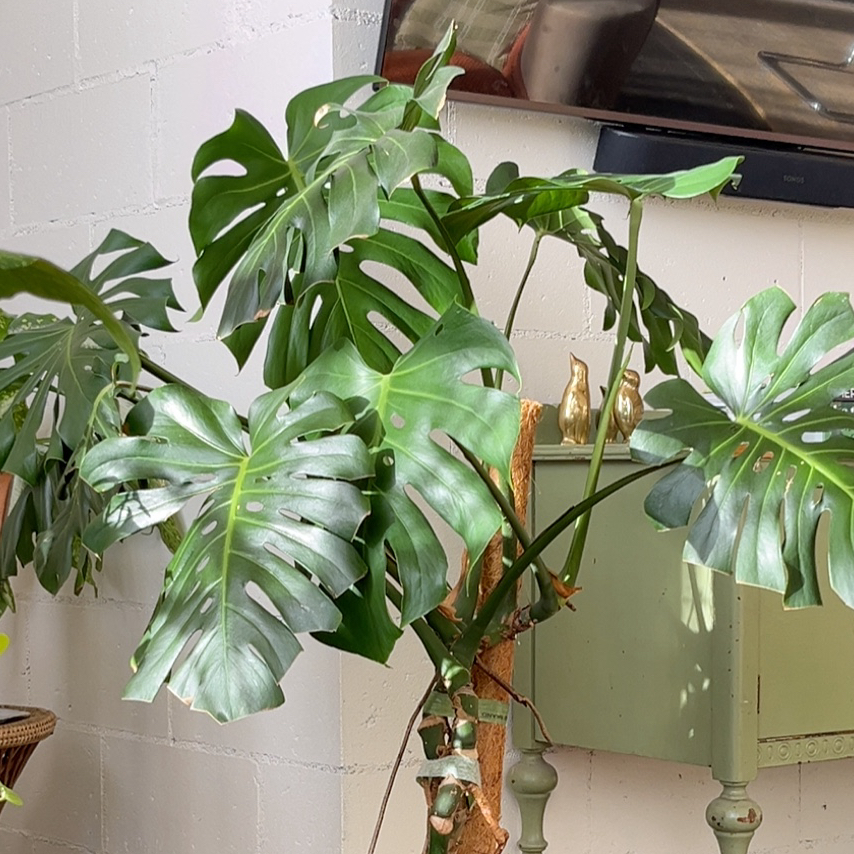
Monstera

What's Wrong with My Monstera?

Monstera deliciosa
Reviewed by Kiersten Rankel M.S.
Quick Answer
1.
Most Monstera problems trace back to watering.
Check the soil first. It tells you more than the leaves do.
2.
Check light and humidity if watering looks right.
Low light or dry air is behind most curling, crispy tips, and pest outbreaks.
3.
Watch the newest unfurling leaf, not the oldest.
If it's coming out healthy, the plant is still fighting and problems are usually fixable.
Stay on top of plant care
Get seasonal reminders for watering and fertilizing โ€” personalized for your plants.
Try Greg Free

Common Monstera Problems

Yellow leaves

Overwatering

Monstera roots evolved clinging to rainforest bark, not sitting in waterlogged soil. When they suffocate and rot, the plant pulls nutrients back from the oldest leaves first. Yellowing moves up from the bottom.

1. Stop watering immediately
2. Unpot and inspect the roots, cutting brown or mushy sections back to firm white tissue
3. Repot in a chunky mix with perlite or bark for drainage
4. Wait a full week before the first small drink
Underwatering

A Monstera's wide leaves transpire fast. When the pot runs dry, moisture gets pulled back from the oldest leaves. They yellow and crisp at the edges before newer growth shows stress.

1. Water thoroughly until it drains from the bottom
2. If very dry, bottom-soak the pot for 20 minutes, then top-water
3. Tighten the gap between waterings slightly going forward
Normal leaf drop

A healthy Monstera sheds its oldest, smallest leaves as it pushes out bigger, more fenestrated ones. If only the lowest one or two are yellowing and the rest of the plant looks fine, no action needed.

Mushy stem

Root rot climbing up

Rot from waterlogged soil has climbed through Monstera's nodes, the growth points where new leaves and aerial roots emerge. Once the stem is mushy past the base, the rootball is gone. This is time-critical.

1. Cut a section from the highest firm, green part of the stem, just below a node
2. Let the cut end callus for a day or two
3. Root the cutting in water or fresh chunky mix
4. Discard the original rootball

Curling leaves

Low humidity

Monstera evolved in humid rainforest understory and wants 50-60%+ humidity indoors. In drier air, leaves curl inward to conserve moisture. Crispy brown edges usually appear at the same time.

Run a humidifier nearby, aiming for 50-60%+. Grouping the plant with other plants also raises local humidity. Skip misting, which is short-lived and can invite fungal spots.
Underwatering

Bone-dry soil triggers cupping. Monstera's broad leaves reduce their exposed surface area to limit water loss, so curling shows up visibly before many houseplants would react. The curl progresses from the tips inward.

Check the soil. If it is dry several inches down, water thoroughly until it drains through. Shorten the interval between waterings slightly going forward.

Black spots on leaves

Fungal or bacterial leaf spot

Round black spots ringed with yellow halos are classic leaf-spot disease. Monstera's wide leaves pool water in the fenestration splits after overhead watering or misting, creating prime conditions for fungal and bacterial growth. It spreads leaf-to-leaf if untreated.

1. Prune off affected leaves and throw them away
2. Improve airflow by spacing the plant away from walls and crowded neighbors
3. Water at the base only, never on the leaves
4. Apply a copper-based fungicide if new spots keep appearing

Pests

Spider mites

Fine webbing on leaf undersides and between stems, plus stippled or speckled leaves. Dry indoor air invites them, and Monstera's thick leaves can hide an infestation until webbing appears around the nodes.

1. Rinse the plant under a strong shower to knock mites off
2. Wipe leaves top and bottom with insecticidal soap or 70% isopropyl
3. Repeat every 3-4 days for two weeks
4. Raise local humidity, since mites struggle in moist air
Mealybugs

White cottony clumps in leaf axils and around the nodes where aerial roots emerge. They suck sap and leave sticky honeydew trailing down the stem.

1. Dab each cluster with a cotton swab dipped in 70% isopropyl
2. Follow up with an insecticidal soap spray over the whole plant
3. Check weekly for a month, since they are persistent
Fungus gnats

Small black flies that lift off when you water or brush the soil. Their larvae live in the top inch of damp substrate, and the moisture that chunky aroid mixes hold creates pockets where they breed.

1. Let the top inch of soil dry fully between waterings
2. Add sticky traps near the soil surface to catch adults
3. Top-dress with mosquito bits to kill larvae in the soil

Preventing Monstera Problems

A few consistent habits prevent most of what goes wrong.
Weekly Check
1
Water when the top 1-2 inches of soil feel dry.
Tying the rhythm to the soil instead of the calendar prevents both overwatering and underwatering, which together cause most Monstera deaths.
2
Use a chunky aroid mix in a pot with a drainage hole.
Bark, perlite, and coco chunks give Monstera roots the air gaps they need. Standing water at the bottom is how root rot starts.
3
Keep humidity at 50-60%+ with a humidifier or by grouping plants.
This prevents curling, crispy edges, and most spider mite invasions before they start.
4
Water at the base of the plant, not on the leaves.
Dry leaves resist the fungal and bacterial leaf spot that Monstera's wide, fenestrated surface is prone to.
5
Quarantine new plants for two weeks before placing them near your Monstera.
Most pest outbreaks arrive on a new plant. Two weeks of isolation is enough to catch mealybugs, spider mites, and fungus gnats before they spread.
Stay on top of plant care
Get seasonal reminders for watering and fertilizing โ€” personalized for your plants.
Try Greg Free

About This Article

Kiersten Rankel M.S.
Botanical Data Lead at Greg ยท Plant Scientist
About the Author
Kiersten Rankel holds an M.S. in Ecology & Evolutionary Biology from Tulane University. A certified Louisiana Master Naturalist, she has over a decade of experience in science communication, with research spanning corals, cypress trees, marsh grasses, and more. At Greg, she curates species data and verifies care recommendations against botanical research.
See Kiersten Rankel's full background on LinkedIn.
Editorial Process
Diagnostic logic for Monstera deliciosa problems verified against Greg's botanical database, cross-referenced with USDA hardiness zone data and published horticultural research.
78,379+ Greg users growing this plant
USDA hardiness zones 10aโ€“12b