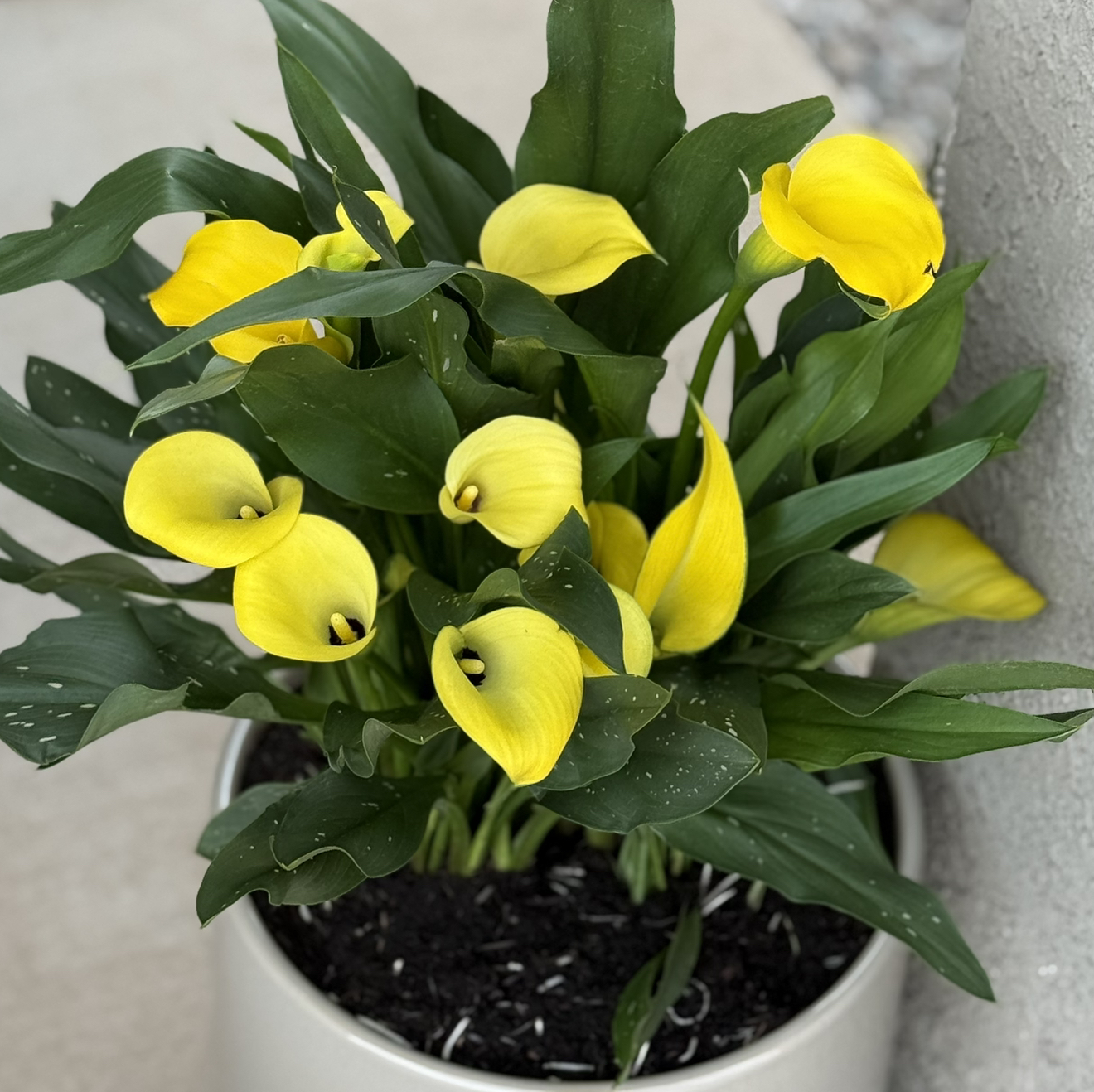
What's Wrong with My Calla Lily?

Common Calla Lily Problems
Yellow leaves
Calla Lily's rhizome stores nutrients and moisture, but it sits just below the soil surface and suffocates quickly in waterlogged conditions. Rotting roots stop delivering nutrients and the plant draws them back from the oldest leaves first, so yellowing starts at the outer leaves and works inward.
Calla Lily grows from a rhizome that exhausts its stored energy over time, especially if it has never been divided or fertilized. A spent rhizome cannot push nutrients into the leaf canopy efficiently, producing a yellowing that starts diffuse and affects leaves across the whole plant rather than moving from base to tip.
Calla Lily naturally retires its oldest outer leaves as new ones push from the rhizome center. If only one or two outer leaves are yellowing while new growth continues from the center, the plant is cycling normally and no action is needed.
Not flowering
Calla Lily's dramatic spathe takes real energy to produce, and in low light that energy goes into maintaining leaves instead. The plant can look lush and green indoors in a dim corner while producing zero flowers. Bright indirect light indoors, or a spot with partial sun outdoors, is the threshold that tips it into bloom.
Calla Lily evolved in South Africa where summers are wet and winters are dry. It needs a cool, dry dormancy period each year to reset the flower cycle. Without that rest, the rhizome stays in vegetative mode and skips blooming entirely, even if conditions otherwise look ideal.
Brown leaf edges
Calla Lily is semi-aquatic in the wild and its large arrow-shaped leaves transpire heavily. When the soil dries out, the leaf edges are the first to lose moisture, crisping before the blade shows any other stress. The damage is worst on the outer leaves and progresses inward if the drought continues.
Fertilizer salts and minerals from tap water accumulate in the soil over time and burn the leaf edges from the tips inward. Because Calla Lily is a heavy feeder often fertilized frequently, salt buildup happens faster than on many houseplants. The browning looks similar to drought stress but the soil stays moist.
Drooping leaves
Calla Lily's large leaves have high water demand and the plant wilts visibly when the soil dries out. Unlike drought-tolerant species, Calla Lily has no leaf adaptations to slow water loss, so the droop comes on quickly and looks alarming. Recovery usually happens within a couple of hours of a thorough watering.
When the rhizome begins to rot in waterlogged soil, it loses the ability to move water up into the plant even though the soil is wet. The leaves droop the same way they do from thirst, making it easy to misdiagnose. If the soil is already saturated and the plant is still drooping, root damage is the likely cause.
Soft rhizome
Calla Lily's rhizome sits near the soil surface and rots fast when the soil stays saturated. Waterlogging is the primary driver. Cool soil temperatures below 55 degrees Fahrenheit compound the problem by slowing the rhizome's ability to heal and defend itself, but the root cause is always wet soil that does not drain. This is the most serious problem the plant faces.
Pests
Aphids cluster on Calla Lily's tender new growth and the soft underside of young leaves, sucking sap from the emerging flower stalks and leaf petioles. They reproduce fast in warm weather and their feeding distorts new growth before it can unfurl properly.
Spider mites show up as fine webbing on the undersides of Calla Lily's large leaves and a dusty stippled texture across the blade. They thrive in warm, dry indoor conditions and move quickly across the big leaf surface, making an infestation on Calla Lily harder to catch early than on smaller-leaved plants.
Preventing Calla Lily Problems
About This Article
