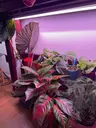
Tiger's Eye Bean
Taxonomy

Phaseolus vulgaris 'Tiger's Eye'
Phaseolus
Fabaceae
Fabales

How to care for Tiger's Eye Bean
How often to water your Tiger's Eye Bean

every 9
Tiger's Eye Bean needs 0.5 cups of water every 9 when it doesn’t get direct sunlight and is potted in a 5" pot.
Use our water calculator to personalize watering recommendations to your environment or download Greg for more advanced recommendations for all of your plants.
Water 0.5 cups every
9
Finding light for Tiger's Eye Bean in your home

a window
Tiger's Eye Bean love being close to bright, sunny windows 😎.
Place it less than 1ft from a south-facing window to maximize the potential for growth.
Tiger's Eye Bean does not tolerate low-light 🚫.
Select your region to see how the current weather in your area affects the placement of Tiger's Eye Bean in your home 🏡.
How to fertilize Tiger's Eye Bean

Most potting soils come with ample nutrients which plants use to produce new growth.
By the time your plant has depleted the nutrients in its soil it’s likely grown enough to need a larger pot anyway.
To replenish this plant's nutrients, repot your Tiger's Eye Bean after it doubles in size or once a year—whichever comes first.
-
Can anybody help me figure out what is eating my bean leaves? I've checked underneath and on top of the leaves but I can't find anything. Not all of my bean plants are being eaten up but I don't know what else to do to keep them organic #CommonBean
-
What has happened to my beans? Too much water? Sun? I just added more soil and nutrients
-
I am doing an experiment for my school Science Fair, I am germinating my Lima Bean seeds.
-
I need to get these starts in a pot, but there are tiny purplish pods starting to sprout at some of the apex’s, should I pinch them off?
-
Some of my Lima Bean Plant leaves are yellowing, anyone know how to help this #help #yellowing #LimaBean
-
Some of my Lima bean leaves are yellowing, any advice? #LimaBean #help #yellowing
-
Why is my leaves turning yellow ? #CommonBean
-
This is my first time attempting to grow green beans. I read to water every 11th day to daily. One already died. I live in Texas so what do you all suggest? #CommonBean
-
My beans plants are losing leaves and turning yellow. Planted with indoor outdoor potting soil. I have seen overwatering/underwatering and nutrients could be reason. How do you tell which one?
-
Indoor black bean plant? So…I dropped a black bean on the ground while cooking and didn’t want to throw it away so I popped it in some soil without thinking and a few weeks later I have this guy 😂 what do I do with this? It’s freezing cold outside. How do I take care of it indoors? I’m guessing it will get a lot bigger?


Care Summary for Tiger's Eye Bean
Tiger's Eye Bean
 Greg recommends:
 Water
Water
0.5 cups every 9 days
 Placement
< 1ft from a window
 Nutrients
Repot after 2x growth
Based on the 4” pot your plant is in, and that it doesn’t get direct sunlight.
 Trending in your area















 Similar to Tiger's Eye Bean
✨ Discover rare plants

Lithops

Euphorbia

Anthurium 'Fantasy Lo…
Philodendron 'Silver …

Bonsai Crassula

Phalaenopsis schiller…

Large Leaf Elephant B…
Skeleton Key Pothos

Scindapsus pictus 'Si…

Blue Moon Wisteria

Tillandsia caerulea A…

Begonia lubbersii

Hoya 'Millie'
Rosularia platyphylla

Pseudorphipsalis 'Blu…

Dinteranthus microspe…

Graptopetalum 'Marqui…