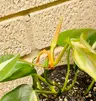
Lantana horrida subsp. tiliifolia
Taxonomy

Lantana horrida subsp. tiliifolia
Lantana
Verbenaceae
Lamiales

How to care for Lantana horrida subsp. tiliifolia
How often to water your Lantana horrida subsp. tiliifolia

every 9
Lantana horrida subsp. tiliifolia needs 0.5 cups of water every 9 when it doesn’t get direct sunlight and is potted in a 5" pot.
Use our water calculator to personalize watering recommendations to your environment or download Greg for more advanced recommendations for all of your plants.
Water 0.5 cups every
9
Finding light for Lantana horrida subsp. tiliifolia in your home

a window
Lantana horrida subsp. tiliifolia love being close to bright, sunny windows 😎.
Place it less than 1ft from a south-facing window to maximize the potential for growth.
Lantana horrida subsp. tiliifolia does not tolerate low-light 🚫.
Select your region to see how the current weather in your area affects the placement of Lantana horrida subsp. tiliifolia in your home 🏡.
How to fertilize Lantana horrida subsp. tiliifolia

Most potting soils come with ample nutrients which plants use to produce new growth.
By the time your plant has depleted the nutrients in its soil it’s likely grown enough to need a larger pot anyway.
To replenish this plant's nutrients, repot your Lantana horrida subsp. tiliifolia after it doubles in size or once a year—whichever comes first.
-
White worm on my lantana First year having outdoor plants, if I cut the area off and use pest control will they be okay? #NewPlantMom #PestControl #OutdoorGrowing #FloweringPlants
-
Are lantana pinnr al #RedSage
-
Hi guys! I need help! I just got my Lantana plant and my boyfriend was in change of of watering it for two week and look! :ooo it was in direct sunlight for a while and it’s all crisp. What can I do!
-
Hi! Help! My lantana tree was vibrant with blooms two weeks ago. Now, it’s blah. What have I done wrong? I would love your advice. #PropagationStation #NewPlantMom #PestControl #BeforeAndAfter #
-
Why is my lantana droopy? The leaves aren’t droopy, it gets full sun, & it’s been blooming but the stalks/stems have been leaning for a bit. Not sure if I just need to support it until it gets more mature… #Lantana #TexasGregGang
-
Do Lantana do better in pots or inground? #RedSage
-
I'm a beginner with this plant. Could someone guide me on what to do and what to avoid, especially regarding watering and sunlight? I've kept it near a window. #RedSage
-
Hi everybody, this potted lantana from Lowe’s was robust and beautiful when I brought her home but she got heat-stressed out on my south-facing lanai (Tampa, FL) yesterday morning. So I brought her inside, gave her the recommended 1 1/2 cup water (soil was dry to touch) and all her curled, drooping leaves went pretty much back to normal. Then, being too scared to put her back outside, today I put her under the purple grow-light for about 3hrs. She didn’t like that AT ALL and we are back to drooping and curling. I googled sudden curling leaves in Lantana and it was talking about too much LIGHT! Is it normal for Lantana to be that fussy? I mean, the state of FL has declared Lantana a noxious invasive WEED, so what’s her problem? Anybody have any ideas?


Care Summary for Lantana horrida subsp. tiliifolia
Lantana horrida subsp. tiliifolia
 Greg recommends:
 Water
Water
0.5 cups every 9 days
 Placement
< 1ft from a window
 Nutrients
Repot after 2x growth
Based on the 4” pot your plant is in, and that it doesn’t get direct sunlight.
 Trending in your area











 Similar to Lantana horrida subsp. tiliifolia
✨ Discover rare plants

Euphorbia baioensis
Astroloba congesta

Maroon Pitcher Plant

Haworthia emelyae com…

Hoya fitchii

Large Leaf Elephant B…

Aglaonema 'Green Bowl'

Chinese Evergreen 'Go…

Scotch Moss

Christmas Candle

Black Monkey Thorn Tr…

Echeveria 'Joan Danie…

Begonia hydrocotylifo…

Aloe 'Lavender Star'

Peperomia 'Harmony's …

Electric Fern

Scindapsus pictus 'Si…