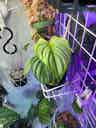
Hoya piestolepis
Taxonomy

Hoya piestolepis
Hoya
Apocynaceae
Gentianales

How to care for Hoya piestolepis
How often to water your Hoya piestolepis

every 12
Hoya piestolepis needs 0.5 cups of water every 12 when it doesn’t get direct sunlight and is potted in a 5" pot.
Use our water calculator to personalize watering recommendations to your environment or download Greg for more advanced recommendations for all of your plants.

Water 0.5 cups every
12
Finding light for Hoya piestolepis in your home

a window
Hoya piestolepis may have difficulty thriving, and will drop leaves 🍃, without ample sunlight.
Place it less than 3 feet from a south-facing window to maximize the potential for growth.
Select your region to see how the current weather in your area affects the placement of Hoya piestolepis in your home 🏡.
How to fertilize Hoya piestolepis

Most potting soils come with ample nutrients which plants use to produce new growth.
By the time your plant has depleted the nutrients in its soil it’s likely grown enough to need a larger pot anyway.
To replenish this plant's nutrients, repot your Hoya piestolepis after it doubles in size or once a year—whichever comes first.
-
Yellowing and dry leaves This is my second post about this Hoya Sunrise. I came to the conclusion that she was underwatered because all her leaves were softening, the soil was dry, and the pot was light. I recently watered her and some of the leaves started to firm up, but then I also noticed more soft, yellowing, as well as dry, leaves. Her soil is already dry again, but here is a picture of the pile of leaves that I just cleaned off. I don’t know what to do! #Hoya
-
Need help identifying Forgot to add and the lable got thrown out but I’m not confident in the identification. Tried to google search and it gave me a whole other plant
-
Is she okay? It’s had these markings on her leaves for a several several months. Thanks in advance. #Hoya
-
Hoya Sunrise Issues The leaves on my Hoya Sunrise have softened over time, and a few have recently turned yellow. I don’t know if this a watering issue or a lighting issue. When I do water it, the water will spill out onto the drip tray and then the plant will absorb it later. That’s why I’ve started bottom watering. This plant gets bright indirect light for part of the morning, and then some grow light beams in the afternoon. What could be wrong? It’s a beautiful plant, and I don’t want to lose too many leaves. #Hoya
-
What are these long spikes coming up?i assume new growth, but looks different than all my other Hoyas. #Hoya
-
Hoya leaves yellowing at base?? Help! I recently got this Hoya and since it’s been with me it’s leaves have started yellowing at the base of the plant. Does anyone know why? I saw this happening and already added fertilizer to helpfully help out the plant, but not sure if it did anything.
-
I just wanted to tell the cool story of my Hoya. So a long time ago during the Great Depression my great grandma got this Hoya. It’s just been living this whole time in my family. This one plant has been propagated so many times. One time we left one of these plants in a basement closet for almost a year and it was still alive!! We didn’t do anything to it we just forgot about it. I think it’s like the easiest plant ever to take care of. It literally can’t die!!
-
White Mold ? Pest? My Hoya has so white spots that look like dust, or mold. I member hearing about this as a pest. If so how do I get rid of it?
-
New plant babies! Hoya and tradescantia Hi all! It’s been a while. Life got tough and busy. But yay, My neighbor surprised me with some recently potted Hoya cuttings. I don’t know much about them but I saw them flowering once and they are amazing. That will be my goal! What are your tips and tricks for care and getting them to bloom? Also got a pretty little tradescantia from Trader Joe’s, lol. I’ve heard they’re fairly easy, anything I should know though that can go wrong?? Thanks a bunch 🥰 #HappyPlants #PlantsMakePeopleHappy #NewPlantMom #Hoya #TradescantiaZebrina #advice #help
-
Why does my plant have these raised thing on her leaf? Is this some kind of disease? Is there something I need to do? The rest of her looks kind of fine… @Hoya #NewPlantMom # @HoyaAddict #Hoya #HoyaKrimsonQueen #HoyaCarnosaTricolor #HoyaHangout


Care Summary for Hoya piestolepis

Hoya piestolepis
 Greg recommends:
 Water
Water
0.5 cups every 12 days
 Placement
< 3ft from a window
 Nutrients
Repot after 2x growth
Based on the 4” pot your plant is in, and that it doesn’t get direct sunlight.
 Trending in your area











 Similar to Hoya piestolepis


✨ Discover rare plants

Pine Cone Plant

Scindapsus pictus 'Si…

Raphionacme flanaganii

Rainbow Echeveria

Pink Ruby Sedevaria

Aeonium 'Blushing Bea…

Pseudorphipsalis 'Blu…
Stanhopea tigrina

Cleistocactus icosago…

Tillandsia caerulea A…

Peperomia 'Harmony's …

Anthurium 'Fantasy Lo…
Carolina Reaper

Aglaonema Spitfire

Parrot Pitcher Plant

Euphorbia baioensis