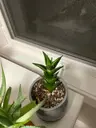
Three-Flowered Cotyledon
Taxonomy

Dudleya tribracteata
Dudleya
Crassulaceae
Saxifragales

How to care for Three-Flowered Cotyledon
How often to water your Three-Flowered Cotyledon

every 12
Three-Flowered Cotyledon needs 0.5 cups of water every 12 when it doesn’t get direct sunlight and is potted in a 5" pot.
Use our water calculator to personalize watering recommendations to your environment or download Greg for more advanced recommendations for all of your plants.
Water 0.5 cups every
12
Finding light for Three-Flowered Cotyledon in your home

a window
Three-Flowered Cotyledon love being close to bright, sunny windows 😎.
Place it less than 1ft from a south-facing window to maximize the potential for growth.
Three-Flowered Cotyledon does not tolerate low-light 🚫.
Select your region to see how the current weather in your area affects the placement of Three-Flowered Cotyledon in your home 🏡.
How to fertilize Three-Flowered Cotyledon

Most potting soils come with ample nutrients which plants use to produce new growth.
By the time your plant has depleted the nutrients in its soil it’s likely grown enough to need a larger pot anyway.
To replenish this plant's nutrients, repot your Three-Flowered Cotyledon after it doubles in size or once a year—whichever comes first.
-
Marilyn Died :( For context, I live at my Dad's every other week during summer. I got a gorgeous bluff lettuce, and I named her Marilyn, and she was doing so well!!! She was absolutely THRIVING!! But one week, I came back from my mom's house, and the top half of her leaves were shriveled and BLACK. The lower half was almost see-through and really brown. I don't know what killed her, and I really want to know the cause so I can keep Walt and Hector safe :( Rip Marilyn, I miss you
-
Can these be propagated? #BluffLettuce
-
Need food #GregPlantShop
-
Watering multiple plants… I made a terrarium today and have three succulents in it. If Greg tells me to water each 1/8 cup, do I water 3/8 cups to the whole thing? I also have three succulents in a small pot. Same question. You can see the little pot three plants in the photo. #plantsmakemehappy
-
What causes the wrinkles?
-
This was a lovely specimen untill Something fell on it Can it be saved or is it ruined
-
She keeps going and going 😊🤩 #WhatTheSuccWednesday #HappyPlants #PlantsMakePeopleHappy
-
My patience is barely hanging on. I really want to see her bloom 🌺 🥹 
-
Not fresh leaf but I haven’t cut it in hopes she’ll flower and I think she’s about to 😏☀️
-
Need help identifying. This was sent to me anonymously, but with no name tag or anything. I found similar on etsy but it's called pretty In pink fairy garden.... any help? #Echeveria #happyplants #plantsmakepeoplehappy #plantaddict #planttherapy #plantmafia #greggang #krunchytime #succulentlove


Care Summary for Three-Flowered Cotyledon
Three-Flowered Cotyledon
 Greg recommends:
 Water
Water
0.5 cups every 12 days
 Placement
< 1ft from a window
 Nutrients
Repot after 2x growth
Based on the 4” pot your plant is in, and that it doesn’t get direct sunlight.
 Trending in your area














 Similar to Three-Flowered Cotyledon


✨ Discover rare plants

Sarcochilus fitzgeral…

Hoya pottsii 'Khao Ya…

Rhipsalis clavata

Kudu Lily

Scotch Moss

Electric Fern
Hoya crassipetiolata

Thelocactus macdowell…

Scindapsus pictus 'Si…

Fagraea ceilanica

Cereus peruvianus 'Pa…

Kilimanjaro Plant

Hoya kalimantan

Caladium

Crassula 'Purple Drag…

Large Leaf Elephant B…