
Oersted's Dumb Cane
Taxonomy

Dieffenbachia oerstedtii
Dieffenbachia
Araceae
Alismatales

How to care for Oersted's Dumb Cane
How often to water your Oersted's Dumb Cane

every 9
Oersted's Dumb Cane needs 0.5 cups of water every 9 when it doesn’t get direct sunlight and is potted in a 5" pot.
Use our water calculator to personalize watering recommendations to your environment or download Greg for more advanced recommendations for all of your plants.
Water 0.5 cups every
9
Finding light for Oersted's Dumb Cane in your home

a window
Oersted's Dumb Cane can tolerate being far from a window and light source.
Place it less than 6 feet from a south-facing window to ensure it receives enough light to survive 💪.
Select your region to see how the current weather in your area affects the placement of Oersted's Dumb Cane in your home 🏡.
How to fertilize Oersted's Dumb Cane

Most potting soils come with ample nutrients which plants use to produce new growth.
By the time your plant has depleted the nutrients in its soil it’s likely grown enough to need a larger pot anyway.
To replenish this plant's nutrients, repot your Oersted's Dumb Cane after it doubles in size or once a year—whichever comes first.
-
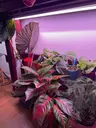
PSA to all my Oklahomies—GO HIT UP CREST FOR $14.99 TROPICALS!!!! I know there must be some Sooners/Cowboys on here, but @Kittylover1612 is the only one that's on my tag list 😣😩😂 They have monstera, dieffenbachia, cordyline, palm, fiddle leaf fig, alocasia, dragon tree, and a few others I can't remember off the top of my head. Ugh, I wanted so many of them but this window is literally the only space in my house to put plants (bigger ones, anyway) and actually be able to enjoy them, so I had to limit myself to one AND IT WAS SO HARD TO CHOOSE! 😭😭 The elephant ears were GORGEOUS, but I just don't have the room 😣😣😣😩😩😩😩😩😩 If anybody has any Oklahoma friends on here please tag them! #happyplants #plantsmakepeoplehappy #plantaddict #newgrowth #propagationstation #succulentlove #planttherapy #growlights #newplantmom #petsandplants #monsteramonday #plantcorner #plantshelfie
-
Why is my Daphne getting stringy? Is she getting to much sunlight? #Dieffenbachia
-
The leaves are looking sad white with brown edges what can I do to help this baby? #Dieffenbachia
-
Why are the leaves turning yellow?? #Dieffenbachia
-
Shakira Shakira is growing so big I had to put on the floor she really looks like a palm tree no worries this not her new home just wanted to show your how big she really is 🌴🤣🤣 #HappyPlants #PlantsMakePeopleHappy #GregGang #GreggersSupportingGreggers #CostaFarms
-
My plant looks like it is dying and one yellow leaf I’m watering it on a regular please give me recommendations #Dieffenbachia
-
Is it poisonous #Dieffenbachia
-
My plant is looking really down. I have been watering her and even changed her soil about 2 weeks back. Can someone give me some tips. I feel like she’s dying on me. #Dieffenbachia
-
Acquired this from a friend a week ago and it is bent and twisted and turning a bit yellow. How can I salvage this?
-
I just got this plant and the leaves are turning yellow what do I need to do to help it live? #Dieffenbachia


Care Summary for Oersted's Dumb Cane
Oersted's Dumb Cane
 Greg recommends:
 Water
Water
0.5 cups every 9 days
 Placement
< 6ft from a window
 Nutrients
Repot after 2x growth
Based on the 4” pot your plant is in, and that it doesn’t get direct sunlight.
 Trending in your area









 Similar to Oersted's Dumb Cane


✨ Discover rare plants

Cleistocactus icosago…
Linnaei Kunth

Large Leaf Elephant B…

Begonia lubbersii

Peperomia 'Harmony's …

Scotch Moss

Electric Blue Gecko

Hoya 'Millie'
Chinese Evergreen 'Ga…

Cereus peruvianus 'Pa…

Euphorbia

Hoya kalimantan

Hoya pottsii 'Khao Ya…

Christmas Candle

Royal Flush Split Rock

Aloe 'Lavender Star'

Fagraea ceilanica
