


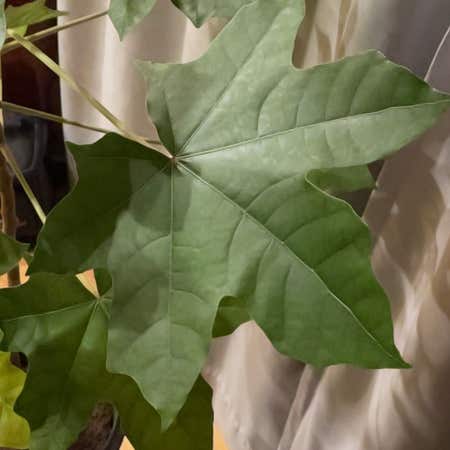
Candlenut Tree
About Candlenut Tree
Candlenut Tree is a super rare houseplant 🌿 that is easy to grow and needs regular watering to thrive. They do best in long-lasting, direct light ☀️ and should be less than 1 foot from a window.
Candlenut Tree belongs to the Aleurites genus, and is native to Tropical Asia and Australia.
⚠️ Candlenut Tree is extremely dangerous if consumed. If you, a family member, or a pet has ingested any amount of plant material contact Poison Control, US (800) 222-1222, or your veterinarian immediately. These plants are not recommended for homes with children, cats, or dogs.
Taxonomy

Aleurites moluccanus
Aleurites
Euphorbiaceae
Malpighiales
Also known as
Indian-walnut, Kukui, candle-nut, candleberry, candlenut, candlenut-tree and lumbangtree

How to care for Candlenut Tree
How often to water your Candlenut Tree

every 9
Candlenut Tree needs 0.5 cups of water every 9 when it doesn’t get direct sunlight and is potted in a 5" pot.
Use our water calculator to personalize watering recommendations to your environment or download Greg for more advanced recommendations for all of your plants.

Water 0.5 cups every
9
Finding light for Candlenut Tree in your home

a window
Candlenut Tree love being close to bright, sunny windows 😎.
Place it less than 1ft from a south-facing window to maximize the potential for growth.
Candlenut Tree does not tolerate low-light 🚫.
Select your region to see how the current weather in your area affects the placement of Candlenut Tree in your home 🏡.
How to fertilize Candlenut Tree

Most potting soils come with ample nutrients which plants use to produce new growth.
By the time your plant has depleted the nutrients in its soil it’s likely grown enough to need a larger pot anyway.
To replenish this plant's nutrients, repot your Candlenut Tree after it doubles in size or once a year—whichever comes first.
Care Summary for Candlenut Tree

Candlenut Tree
 Greg recommends:
 Water
Water
0.5 cups every 9 days
 Placement
< 1ft from a window
 Nutrients
Repot after 2x growth
Based on the 4” pot your plant is in, and that it doesn’t get direct sunlight.
 Trending in your area
Bird of Paradise

False Christmas Cactus

Polka Dot Begonia

Tradescantia Zebrina
Phalaenopsis Orchid
Sweet Basil

Lipstick Echeveria
Green Prayer Plant
Money Tree

Pearl Echeveria

Emerald Ripple Pepero…

Florist Kalanchoe

Zebra Plant
Lucky Bamboo

String of Hearts

String of Bananas

Window Leaf

Small-Leaf Spiderwort
 Similar to Candlenut Tree
✨ Discover rare plants

Chinese Evergreen 'Go…

Peperomia 'Harmony's …

Scotch Moss

Starfish Snake Plant
Stanhopea tigrina
Skeleton Key Pothos

Echeveria Esther

Lithops

Stomatium acutifolium

Burro's Tail

Christmas Candle

Sedeveria 'Blue Elf'
Hoya 'Memoria'

Cleistocactus icosago…

Pine Cone Plant
Anthurium papillilami…
