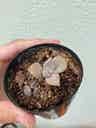
Scindapsus 'Silvery Ann'
Taxonomy

Scindapsus pictus 'Silvery Ann'
Scindapsus
Araceae
Alismatales

How to care for Scindapsus 'Silvery Ann'
How often to water your Scindapsus 'Silvery Ann'

every 9
Scindapsus 'Silvery Ann' needs 0.5 cups of water every 9 when it doesn’t get direct sunlight and is potted in a 5" pot.
Use our water calculator to personalize watering recommendations to your environment or download Greg for more advanced recommendations for all of your plants.

Water 0.5 cups every
9
Finding light for Scindapsus 'Silvery Ann' in your home

a window
Scindapsus 'Silvery Ann' may have difficulty thriving, and will drop leaves 🍃, without ample sunlight.
Place it less than 3 feet from a south-facing window to maximize the potential for growth.
Select your region to see how the current weather in your area affects the placement of Scindapsus 'Silvery Ann' in your home 🏡.
How to fertilize Scindapsus 'Silvery Ann'

Most potting soils come with ample nutrients which plants use to produce new growth.
By the time your plant has depleted the nutrients in its soil it’s likely grown enough to need a larger pot anyway.
To replenish this plant's nutrients, repot your Scindapsus 'Silvery Ann' after it doubles in size or once a year—whichever comes first.
-
What are these stains #satinpothos #help #pestcontrol Since September, it's been getting these spots on its leaves. Some spots are dark, and others look like they've faded. From behind, the leaves look normal. The leaves haven't dried out or anything, but I'm worried it might be a fungus or something else.
-
Curling leaves with browning! I’m new with plants and bought a pothos as my first plant thinking it would be easy… but she’s struggling!! there’s 3 separate plants in this pot, one plant is doing great, another one has a single leaf that is browning and curling around the edges, and the other plant only has one leaf which is also browning and curling. what should I do?? #HappyPlants #PlantsMakePeopleHappy #Pothos #SatinPothos
-
Why is my plant have yellow leaf #SatinPothos
-
Any tips? My grandma gifted me this plant it was a cutting from hers!! It has roots now, and the soil dries pretty fast, I’m thinking repot but really don’t want to kill this one. Her leaves are having some brown spots. Please help :) #SatinPothos
-
Bought at Walmart looking pretty sad but I want to bring it back to life. Please share everything I must do to help her🙏🤞😊 #SatinPothos
-
Stella is looking sad. For several months she has had 2 leaves, with one partially dead. I repotted her today. Hopefully she’ll start growing soon. Should I do anything else?
-
Repotting opinion Hi all I just wanted your opinion on repotting a plant, in that case it’s a Satin pothos. Just for context, it’s an indoor plant, still a baby, I got her about 2 months ago, I didn’t want to repot her because she had space but since she’s been growing a lot ! So my question is: should I love her and leave her there until spring or repot her so she’s comfortable and has sufficient space?
-
How do I get leaves to re-grow on my pothos? My pothos has a huge bald spot on its vine. Will they re-grow and what do I need to do to help.
-
Does anyone know whats wrong with my plant? #SatinPothos
-
What should I change with winter coming up inregards to watering and placement of plant. Should I buy a humidifier since the heater will be on once its gets really cold? #SatinPothos


Care Summary for Scindapsus 'Silvery Ann'

Scindapsus 'Silvery Ann'
 Greg recommends:
 Water
Water
0.5 cups every 9 days
 Placement
< 3ft from a window
 Nutrients
Repot after 2x growth
Based on the 4” pot your plant is in, and that it doesn’t get direct sunlight.
 Trending in your area










 Similar to Scindapsus 'Silvery Ann'


✨ Discover rare plants

Chinese Evergreen 'Go…
Anthurium papillilami…

Munstead Lavender
Astroloba congesta

Lavandula Pedunculata

Betel

Tuber Fleeceflower

Cereus peruvianus 'Pa…

Cleistocactus icosago…

Sarcochilus fitzgeral…

Echeveria 'Joan Danie…

Electric Blue Gecko

Christmas Candle

Pseudorphipsalis 'Blu…

Scotch Moss

Haworthia emelyae com…

Philodendron eximium