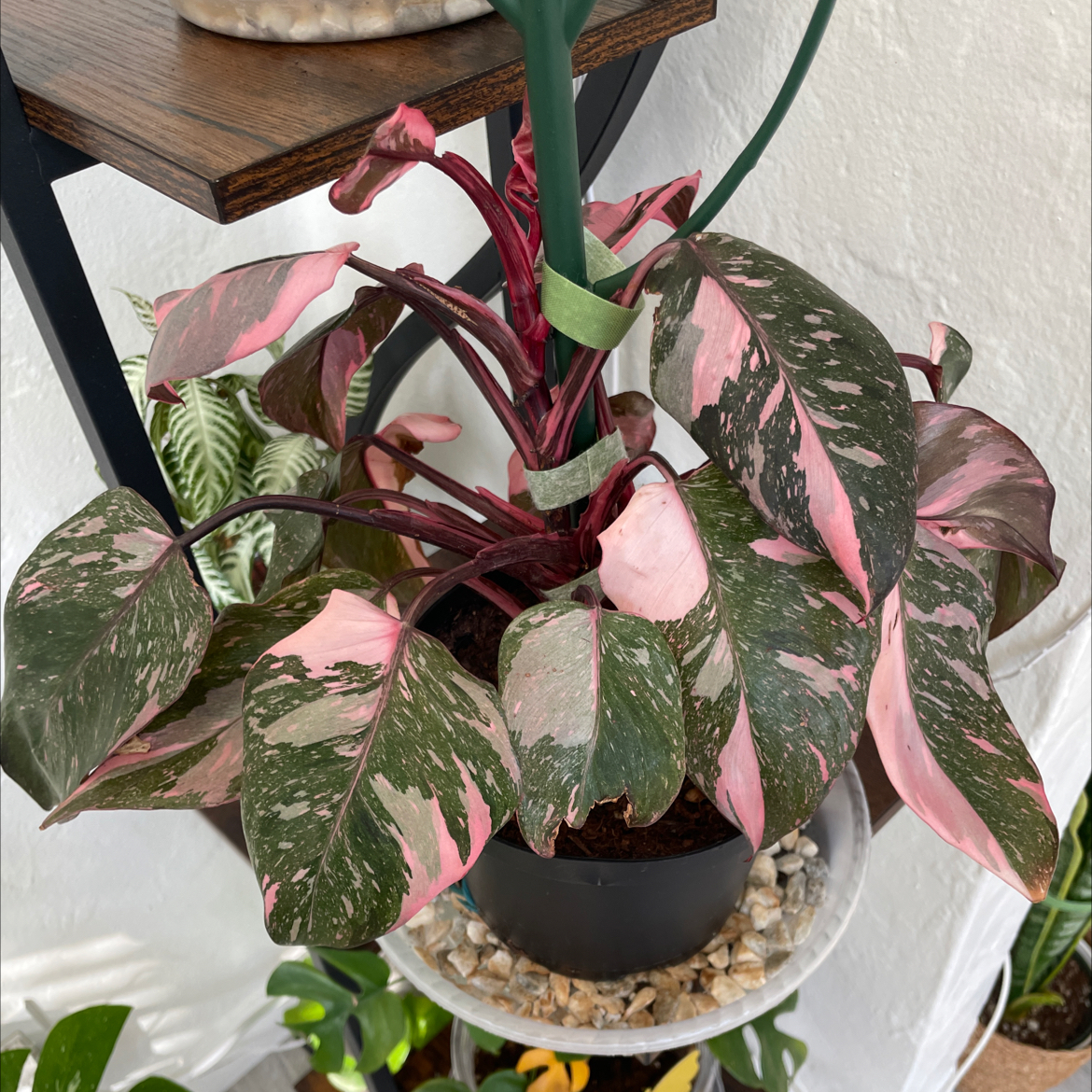
Pink Princess Philodendron

How to Prune Pink Princess Philodendron

Philodendron 'Pink Princess'
Reviewed by Kiersten Rankel M.S.
Quick Answer
Prune your Pink Princess Philodendron in spring or early summer, cutting stems back to just above a node to encourage branching. Prioritize removing stems that have reverted to all-green, since these will outcompete the variegated growth. Never remove more than one-third of the plant at once.

When is the best time to prune?

Pink Princess Philodendron is a tropical climber suited to zones 9–11 outdoors, but most gardeners grow it as a houseplant where spring pruning aligns with its strongest growth push.

US pruning regions map
Pacific
Mar–May
Mountain
Apr–Jun
Midwest
Apr–Jun
Northeast
Apr–Jun
Southeast
Feb–May
Stay on top of plant care
Get seasonal reminders for watering and fertilizing — personalized for your plants.
Try Greg Free

Why Should I Prune My Pink Princess Philodendron?

The Pink Princess is a climbing philodendron that can grow vigorously once it finds its groove. Pruning helps you keep the plant at a manageable size, encourage fuller growth, and protect the variegation that makes this plant special.

The most important pruning task is removing stems that have reverted to solid green. All-green stems grow faster than variegated ones and will take over the plant if left unchecked. Cut them back to the main stem or to a node that still shows pink. This keeps the pink coloring dominant.

For general shaping, cut stems back to just above a node -- the bump on the stem where a leaf attaches. New growth will emerge from that node. If you want the plant to branch rather than vine straight up, pinch the growing tip to encourage side shoots.

Avoid cutting stems that are mostly pink, as these carry the most prized genetics in your plant. Stems that are at least half variegated are worth keeping even if they're getting long.

Know Before You Cut

Difficulty Moderate
Max removal 1/3 of total growth per session
Growth pattern Climbing vine
Tools Sharp pruners or scissors

What Should I Remove?

Cut back all-green reverted stems to a variegated node
Trim stems to just above a node to encourage branching
Pinch growing tips to promote fuller, bushier growth
Remove any yellowing or damaged leaves at the base
Wipe pruner blades clean between cuts to prevent disease
Don't remove stems that are heavily pink or well-variegated
Don't prune more than 1/3 of the plant at one time

How Do I Prune Step by Step?

1
Identify reverted all-green stems
Look closely at each stem. Any stem producing entirely green leaves without pink or white splashes has reverted. Mark these for removal before you start cutting.
2
Remove reverted stems first
Cut each all-green stem back to the main stem or to a node that still shows variegation. Cut as close to the main stem as possible without leaving a stub.
3
Trim overly long variegated stems
For stems that are getting too long, cut just above a node (the bump where a leaf meets the stem). Leave at least two or three leaves on each stem.
4
Pinch growing tips for bushiness
Pinch the soft growing tip off any stem you want to branch. This forces the plant to push out side shoots from nodes lower down on the stem.
5
Clean tools and monitor new growth
Wipe pruner blades with rubbing alcohol after you finish. Watch the cut nodes over the next few weeks -- new growth should emerge within two to four weeks in the active season.

Frequently Asked Questions

Why does my Pink Princess keep losing its pink color?
Reversion happens when the plant produces stems without the genetic expression for variegation. Remove all-green stems promptly so they don't take over, and make sure the plant gets bright indirect light -- low light accelerates reversion.
Can I prune in winter?
Light cleanup is fine in winter, but avoid hard pruning. The plant grows slowly in lower light and takes longer to recover from significant cuts. Spring pruning gives the best results.
What do I do with the cuttings?
Cuttings with at least one node and one leaf root well in water or moist potting mix. If the cutting has pink coloring, it should maintain that variegation -- but all-green cuttings will produce all-green plants.
My Pink Princess has one very long stem. Can I cut it in half?
Yes. Cut the stem just above a node, leaving two or three leaves on the lower part. The lower part will push out new growth from that node, and the cut top can be rooted as a cutting.
Stay on top of plant care
Get seasonal reminders for watering and fertilizing — personalized for your plants.
Try Greg Free

About This Article

Kiersten Rankel M.S.
Botanical Data Lead at Greg · Plant Scientist
About the Author
Kiersten Rankel holds an M.S. in Ecology & Evolutionary Biology from Tulane University. A certified Louisiana Master Naturalist, she has over a decade of experience in science communication, with research spanning corals, cypress trees, marsh grasses, and more. At Greg, she curates species data and verifies care recommendations against botanical research.
See Kiersten Rankel's full background on LinkedIn.
Editorial Process
Pruning guidance verified against Philodendron 'Pink Princess' growth data from Greg's botanical database, cross-referenced with USDA hardiness zone data and published horticultural research.
12,770+ Greg users growing this plant
USDA hardiness zones 9a–11b
Grow plants with confidence