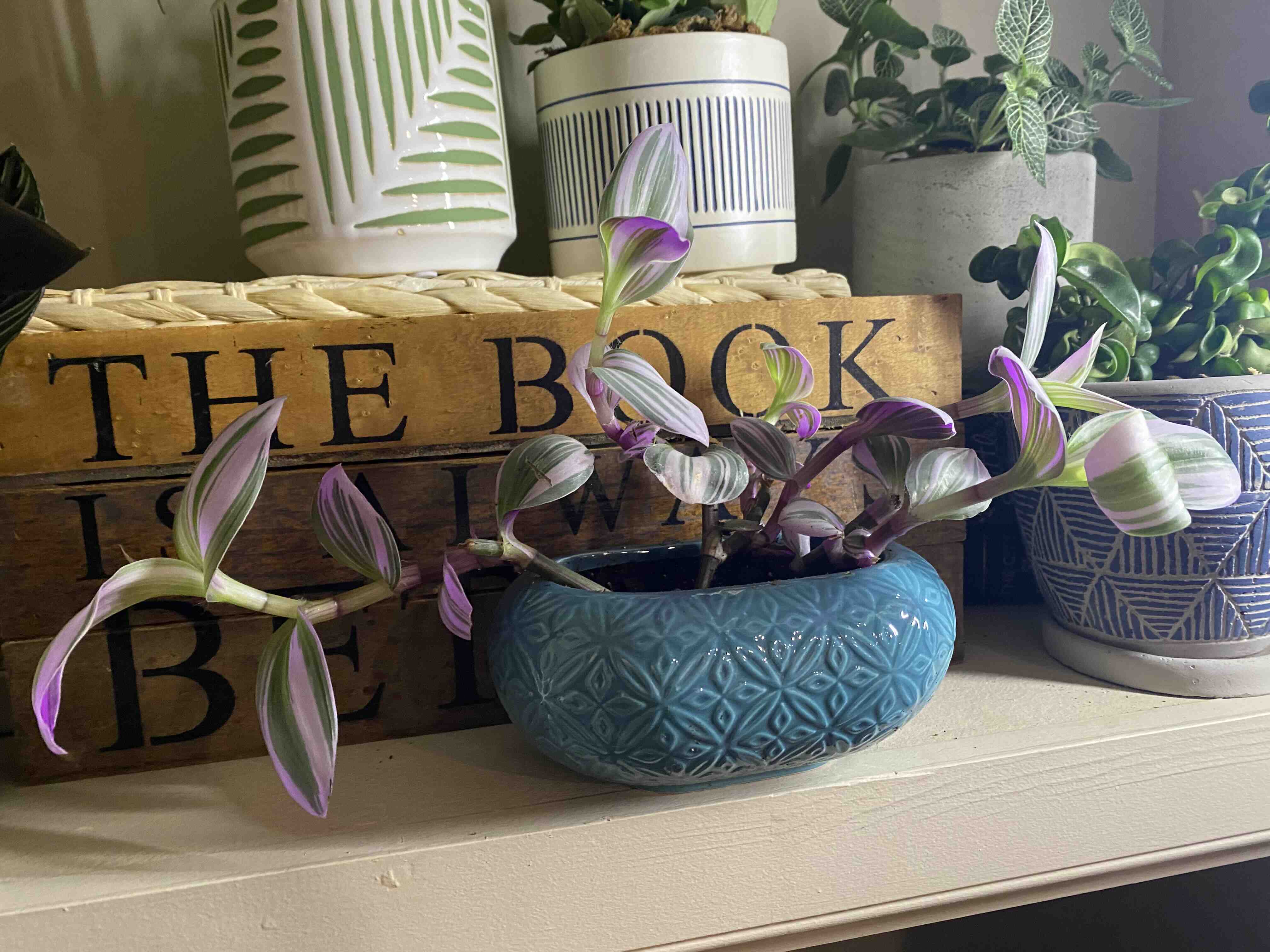
Tradescantia Nanouk

What's Wrong with My Tradescantia Nanouk?

Tradescantia fluminensis 'Nanouk'
Reviewed by Kiersten Rankel M.S.
Quick Answer
1.
Light is behind most problems.
Leggy stems and faded pink-and-cream color both trace back to insufficient light. Nanouk needs more light than most trailing houseplants to hold its signature striped coloring.
2.
Check watering and humidity if light looks right.
Crispy brown edges point to dry air or underwatering. Yellow leaves usually mean overwatering or old leaf turnover. Feel the soil before reaching for the watering can.
3.
New pink-striped tip growth means it's fighting.
Fresh leaves pushing out at the stem tips with vivid pink, green, and cream stripes are the clearest sign your plant is healthy. Strong color means the light level is right.
Stay on top of plant care
Get seasonal reminders for watering and fertilizing โ€” personalized for your plants.
Try Greg Free

Common Tradescantia Nanouk Problems

Leggy stems

Insufficient light

Nanouk is a fast grower that stretches toward any light source when conditions are dim. The trailing stems elongate with wide gaps between leaves and the plant loses its characteristic density fast. Because Nanouk grows so quickly, a dim spot turns into a sparse, stringy plant in a matter of weeks.

1. Move the plant to bright indirect light or a spot with a few hours of gentle direct morning sun
2. Pinch back the longest bare stems just above a leaf node to force branching
3. Stick the trimmings directly into the same pot to fill gaps. Nanouk roots within days
Not enough pinching

Even in good light, Nanouk puts energy into extending its existing stems rather than branching from the base. Without regular pinching, the plant naturally becomes a few long ropes with a bare center. The thick, succulent-ish leaves make pinching obvious and satisfying once you start.

1. Pinch or cut back the growing tips every few weeks, removing the top centimeter or two just above a node
2. Root the pinched tips in water and tuck them back into the pot to keep it full

Faded color

Low light

Nanouk's pink, green, and cream stripes are produced by specialized pigment cells that require bright light to stay saturated. In dim conditions, the plant shifts resources toward chlorophyll and the pink fades to pale green while the cream sections turn dull. This is fully reversible in new growth once light improves, but existing faded leaves will not recolor.

1. Move to a brighter spot, ideally within a meter of a bright window or with a few hours of direct morning sun
2. New growth should come in with vivid color within a few weeks once light improves

Crispy brown edges

Low humidity

Nanouk's thick, succulent-ish leaves hold more moisture than thin-leaved Tradescantias, but the leaf edges are still the first to brown and crisp when humidity drops below 40%. Heated rooms in winter pull moisture out of the foliage faster than the shallow roots can replace it, and the wide leaf margins show the damage first.

1. Move the plant away from heating vents and radiators
2. Run a humidifier nearby or group it with other plants to raise local humidity above 40%
3. The brown edges will not recover, but new growth should come in clean once humidity improves
Underwatering

When the soil goes dry, Nanouk's shallow roots lose water pressure and the leaf edges desiccate and brown. The thick leaves store a little more moisture than other Tradescantias, so the plant holds on slightly longer, but crispy edges alongside dry soil points here. Stems may feel slightly soft and deflated rather than firm.

1. Water thoroughly until it drains from the bottom of the pot
2. Keep the soil evenly moist, checking every few days and watering when the top inch feels dry

Yellow leaves

Overwatering

Nanouk has fine, shallow roots that rot quickly in persistently soggy soil. When those roots fail, the plant pulls resources back from its oldest leaves first and they turn yellow. Yellowing at the base of the plant working upward, alongside soil that stays wet for days, is the classic pattern.

1. Check the soil. If it is wet or damp, stop watering immediately
2. Let the soil dry out most of the way before the next watering
3. If the base of the stems feels soft or dark, take cuttings from healthy tip growth and root them in water
Normal leaf turnover

As Nanouk extends its trailing stems, it sheds the oldest interior leaves to redirect energy to actively growing tips. A few yellowing leaves tucked deep in the plant while the stem ends look healthy and colorful is normal. No action needed.

Pests

Spider mites

Spider mites are the most common pest on Nanouk indoors. Dry heated air invites them, and the dense trailing stems give mites sheltered spots to breed. Look for pale stippling on the upper leaf surface and fine webbing between stems. The bold pink and cream coloring can mask early stippling, so check the undersides of leaves regularly.

1. Rinse the plant under a strong shower, soaking every leaf surface and the undersides
2. Wipe all leaf surfaces with insecticidal soap or a cloth dampened with 70% isopropyl alcohol
3. Repeat every three to four days for two weeks to break the hatching cycle
4. Raise local humidity above 50%. Mites struggle in moist air and are less likely to return
Aphids

Soft-bodied green, black, or white insects clustering at the stem tips and on new growth. Aphids target Nanouk's tender emerging leaves, which are the plant's most vulnerable tissue. They reproduce quickly and can distort new growth before you notice them.

1. Knock aphids off with a strong stream of water, covering all growing tips and undersides
2. Follow up with insecticidal soap spray, coating every stem tip and leaf joint
3. Repeat every four to five days until no new clusters appear
Mealybugs

White, cottony clusters in the leaf axils and at stem nodes. Nanouk's thick leaves and dense growth create sheltered spots along every stem that mealybugs exploit. They suck sap and leave sticky honeydew that can attract mold.

1. Dab each cluster with a cotton swab dipped in 70% isopropyl alcohol
2. Follow up with an insecticidal soap spray over all the stems, working into each leaf joint
3. Repeat every five to seven days for three weeks to catch newly hatched eggs

Preventing Tradescantia Nanouk Problems

A few consistent habits prevent most of what goes wrong with Tradescantia Nanouk.
Weekly Check
1
Give it bright indirect light or gentle direct morning sun.
Strong light is what keeps the pink-and-cream stripes vivid and the growth dense. Low light is the top cause of leggy, colorless, bare-stemmed plants.
2
Pinch back the stem tips every few weeks.
Nanouk does not branch on its own. Regular pinching forces bushy growth and prevents the long bare stems that are the plant's most common complaint. Root the tips in water and tuck them back into the pot to keep it full.
3
Water when the top inch of soil feels dry.
The shallow roots rot quickly in waterlogged soil but also crisp fast when the pot runs bone dry. Tying watering to the soil feel, not a schedule, keeps Nanouk healthy.
4
Keep humidity above 40% and away from heating vents.
Dry air browns the wide leaf edges and invites spider mites. A humidifier nearby or grouping plants together makes a real difference in winter.
5
Rinse the plant every two to three weeks.
A regular shower rinse knocks off early spider mite and aphid populations before they establish and keeps the bold striped leaves clean enough to show off their color.
Stay on top of plant care
Get seasonal reminders for watering and fertilizing โ€” personalized for your plants.
Try Greg Free

About This Article

Kiersten Rankel M.S.
Botanical Data Lead at Greg ยท Plant Scientist
About the Author
Kiersten Rankel holds an M.S. in Ecology & Evolutionary Biology from Tulane University. A certified Louisiana Master Naturalist, she has over a decade of experience in science communication, with research spanning corals, cypress trees, marsh grasses, and more. At Greg, she curates species data and verifies care recommendations against botanical research.
See Kiersten Rankel's full background on LinkedIn.
Editorial Process
Every problem and fix in this article was verified against Greg's botanical database, cross-referenced with USDA hardiness zone data and published horticultural research from the Missouri Botanical Garden, university extension programs, and species-specific literature. The Tradescantia fluminensis 'Nanouk' care profile reflects documented species behavior combined with years of community grower feedback in Greg.
9,327+ Greg users growing this plant
USDA hardiness zones 10aโ€“12a