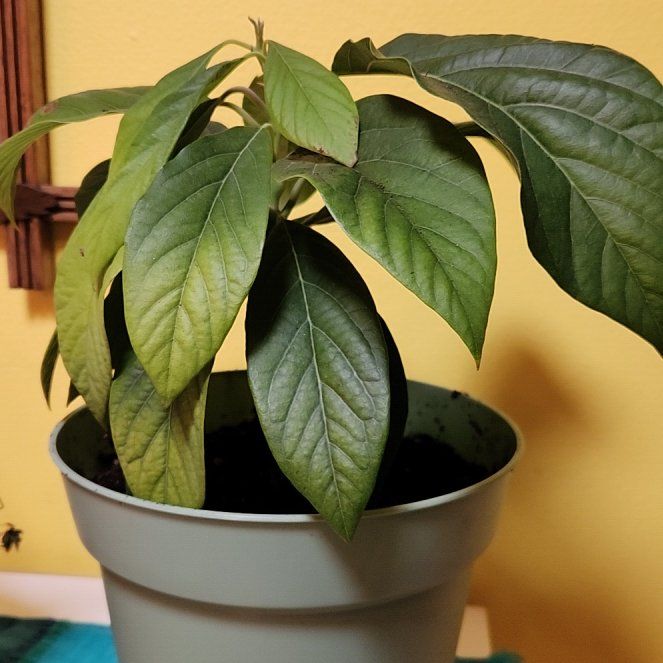
Avocado

What's Wrong with My Avocado?

Persea americana
Reviewed by Kiersten Rankel M.S.
Quick Answer
1.
Most Avocado problems trace back to watering.
Overwatering is the fastest way to kill a container Avocado. Check the soil before every watering. If the top two inches are still damp, wait.
2.
Leaf pattern reveals the nutrient gap.
Avocados show nutrient deficiencies in specific patterns. Yellow leaves with green veins point to iron. Yellow edges with a green center point to magnesium. Each pattern tells you what to add.
3.
New reddish leaf tips mean the tree is fighting.
Avocados push fresh growth in flushes of small, reddish-tinged leaves at branch tips each spring. If you see that flush, the tree is healthy and most problems below it are manageable.
Stay on top of plant care
Get seasonal reminders for watering and fertilizing — personalized for your plants.
Try Greg Free

Common Avocado Problems

Yellow leaves

Nutrient deficiency

Avocado is a heavy feeder and one of the most deficiency-prone trees you can grow in a container. Iron deficiency shows as bright yellow leaves with green veins, appearing first on young leaves because iron does not move freely within the plant. Magnesium deficiency shows as yellow or bronzing margins while the leaf center stays green, appearing on older leaves first because magnesium is mobile and gets pulled toward new growth.

1. Identify the pattern: green veins on a yellow leaf means iron, yellow edges with a green center means magnesium
2. Apply a chelated iron supplement for iron deficiency, or Epsom salt dissolved in water at one tablespoon per gallon for magnesium
3. Test soil pH and lower it to 6.0 to 6.5 with an acidifying fertilizer or diluted sulfur solution if iron deficiency persists despite feeding. High pH locks iron out even when fertilizer is applied.
Overwatering

Avocado roots are extremely sensitive to oxygen deprivation. The species evolved in well-drained volcanic and alluvial soils in Mexico and Central America, not in poorly draining containers with restricted drainage. Soggy soil cuts off oxygen to the roots and triggers rot, and the tree responds by pulling nutrients from its oldest leaves. The yellowing from overwatering is uniform across older leaves rather than the patterned interveinal yellowing of a deficiency.

1. Press the soil two to three inches down. If it feels wet or cool, stop watering and let it dry fully before the next drink
2. Make sure the container has drainage holes and water is not pooling at the base
3. Resume watering only when the top two to three inches feel dry

Brown leaf tips

Salt buildup from tap water or fertilizer

Avocados are notably sensitive to salt and fluoride accumulation in the soil, more so than most houseplants. Tap water deposits dissolved minerals with every watering, and fertilizer leaves behind salt residue that accumulates at the root zone over time. The tree's wide, leathery leaves show this stress first at the tips, which are the farthest point from the roots and lose water supply earliest when salt draws moisture away from roots.

1. Flush the soil thoroughly by watering until several times the pot volume has drained out. Do this every two to three months to push accumulated salts out of the root zone.
2. Switch to filtered or distilled water if tap water is heavily chlorinated or fluoride-treated
3. Reduce fertilizer to the label minimum if you have been applying heavily
Low humidity or dry air

Avocado evolved in humid subtropical conditions and its large, glossy leaves transpire heavily. In dry indoor air, especially near heating vents in winter, the leaf tips lose moisture faster than the roots can replace it and the tips brown and crisp. The browning stays confined to the tip rather than spreading into the leaf body, which distinguishes it from salt damage.

1. Move the tree away from heating vents and radiators
2. Run a humidifier nearby or group the tree with other plants to raise local humidity
3. Mist the leaf tips occasionally during the driest months if a humidifier is not available

Leaf drop

Environmental shock

Avocado drops leaves quickly when moved between very different environments, especially when brought indoors from outside in fall. The species is sensitive to sudden changes in temperature, light intensity, and humidity, and shedding foliage is how it reduces the surface area it has to support when conditions shift. The drop can be alarming in scale but the tree typically stabilizes and pushes new growth once it adjusts.

1. Move the tree to a stable location with consistent temperature above 55°F and no cold drafts from windows or vents
2. Give it four to six weeks of stability in the new spot before judging whether it is recovering
3. Hold a steady watering rhythm during the adjustment period and avoid fertilizing until new growth appears
Overwatering

Root rot from chronic overwatering eventually cuts the tree's ability to move water and nutrients into the canopy. Leaves yellow and then fall, and the drop tends to happen slowly with leaves softening before they detach rather than falling suddenly and green. The soil will feel persistently damp or waterlogged.

1. Stop watering and let the soil dry down significantly before the next drink
2. Check the base of the trunk for soft or discolored tissue. If the stem base is mushy, the rot has moved up from the roots
3. Repot into dry, well-draining mix if the soil is waterlogged and not drying out

Mushy base

Root rot

Phytophthora cinnamomi, the water mold responsible for avocado root rot, is the single most destructive disease this species faces in both commercial orchards and containers. It thrives in saturated soil and attacks Avocado's fine feeder roots first, then works up toward the crown. By the time the stem base is mushy or black, the root system is largely destroyed and the tree is in crisis. Avocado's susceptibility to this pathogen is unusually high compared to most fruit trees.

1. Pull the tree from its pot and cut away all brown or mushy root tissue back to firm, white roots with a clean blade
2. Let the cut roots air-dry in shade for an hour so the wounds seal over before repotting
3. Repot in fresh, very well-draining mix in a clean pot with drainage holes
4. Water sparingly until you see new root growth, and never let the pot sit in standing water again
5. If rot keeps returning after repotting, drench the soil with a copper-based fungicide labeled for Phytophthora

No fruit

Pit-grown tree cannot fruit

An Avocado grown from a pit is a seedling, not a clone of a commercial variety. Seedling Avocados take ten to fifteen years to reach fruiting maturity even in ideal outdoor conditions, and most never produce worthwhile fruit because they have not been selected for fruit quality. Commercial varieties like Hass are propagated by grafting, which preserves the genetics of a proven fruiting tree and lets it fruit in three to five years.

1. Replace the pit-grown tree with a grafted nursery tree if fruiting is the goal. Ask for a named variety grafted onto a disease-resistant rootstock.
2. Grow the pit tree as a tropical foliage specimen and enjoy it for what it is
Insufficient light or heat

Even a mature, grafted Avocado needs significant light and warmth to set flower buds and hold fruit. Indoors or in partial shade, the tree may grow steadily but never trigger the flowering response. Avocado flowers require warm days and cooler nights to set, a cue that rarely occurs indoors in most climates.

1. Move the tree outdoors for the warm season if climate allows, placing it in full sun
2. In zones 9 to 11 where the tree can stay outside year-round, ensure it is getting direct sun for at least six hours daily

Pests

Scale

Scale insects are the most common and damaging pest on indoor and container Avocados. They appear as small tan, brown, or gray bumps stuck along stems and on the undersides of the thick, waxy leaves. They pierce the bark and suck sap, weakening the tree over time, and excrete sticky honeydew that can develop black sooty mold on the leaf surface below.

1. Scrub visible scale off stems and leaf undersides with a soft toothbrush dipped in soapy water
2. Spray the whole tree, including stem joints and leaf undersides, with horticultural oil or insecticidal soap
3. Repeat every seven to ten days for a month to catch hatching eggs
Spider mites

Spider mites thrive in the warm, dry indoor conditions Avocados are often kept in. On Avocado's wide, glossy leaves, the first sign is a fine bronze stippling on the upper surface as the mites pierce cells and drain their contents. Fine webbing appears along the midrib and in leaf axils as the infestation grows, and heavily infested leaves eventually turn grey and drop.

1. Rinse the tree top to bottom in the shower to knock mites off the leaves
2. Wipe both sides of every leaf with insecticidal soap or 70% isopropyl
3. Repeat every three to four days for two to three weeks
4. Raise humidity near the tree, since mites struggle in moist air
Mealybugs

White cottony clusters appear at leaf axils and along the stems, especially on soft new growth. Mealybugs move slowly but spread readily between nearby plants, and they hide in the dense leaf joints that Avocado forms at branch tips.

1. Dab each cluster with a cotton swab dipped in 70% isopropyl alcohol
2. Follow with an insecticidal soap spray over the whole tree
3. Repeat every five to seven days for three weeks

Preventing Avocado Problems

A few consistent habits prevent most of what goes wrong with container Avocados.
Weekly Check
1
Water only when the top two to three inches of soil are dry.
Avocado roots are extremely sensitive to overwatering and root rot. Checking the soil depth before every watering is the single most effective thing you can do to keep the tree alive.
2
Pot in fast-draining mix and never let the container sit in standing water.
Use a mix of potting soil, coarse perlite, and bark. A drainage hole is non-negotiable. Saturated soil is the direct cause of Phytophthora root rot, the most common way container Avocados die.
3
Feed with a citrus or avocado fertilizer that includes chelated iron and magnesium.
Container Avocados deplete nutrients fast and show deficiencies quickly. A fertilizer designed for acid-loving fruit trees prevents the interveinal yellowing that signals iron or magnesium shortage.
4
Flush the soil every two to three months to clear salt buildup.
Water heavily until several times the pot volume has run out the drainage hole. This prevents the salt accumulation from tap water and fertilizer that causes brown leaf tips.
5
Check stems and leaf undersides for scale every few weeks.
Scale builds up on container Avocados faster than most owners expect. Catching a small colony early, before honeydew and sooty mold appear, keeps treatment simple.
Stay on top of plant care
Get seasonal reminders for watering and fertilizing — personalized for your plants.
Try Greg Free

About This Article

Kiersten Rankel M.S.
Botanical Data Lead at Greg · Plant Scientist
About the Author
Kiersten Rankel holds an M.S. in Ecology & Evolutionary Biology from Tulane University. A certified Louisiana Master Naturalist, she has over a decade of experience in science communication, with research spanning corals, cypress trees, marsh grasses, and more. At Greg, she curates species data and verifies care recommendations against botanical research.
See Kiersten Rankel's full background on LinkedIn.
Editorial Process
Every problem and fix in this article was verified against Greg's botanical database, cross-referenced with USDA hardiness zone data and published horticultural research from the Missouri Botanical Garden, university extension programs, and species-specific literature. The Persea americana care profile reflects documented species behavior combined with years of community grower feedback in Greg.
9,143+ Greg users growing this plant
USDA hardiness zones 9a–11b