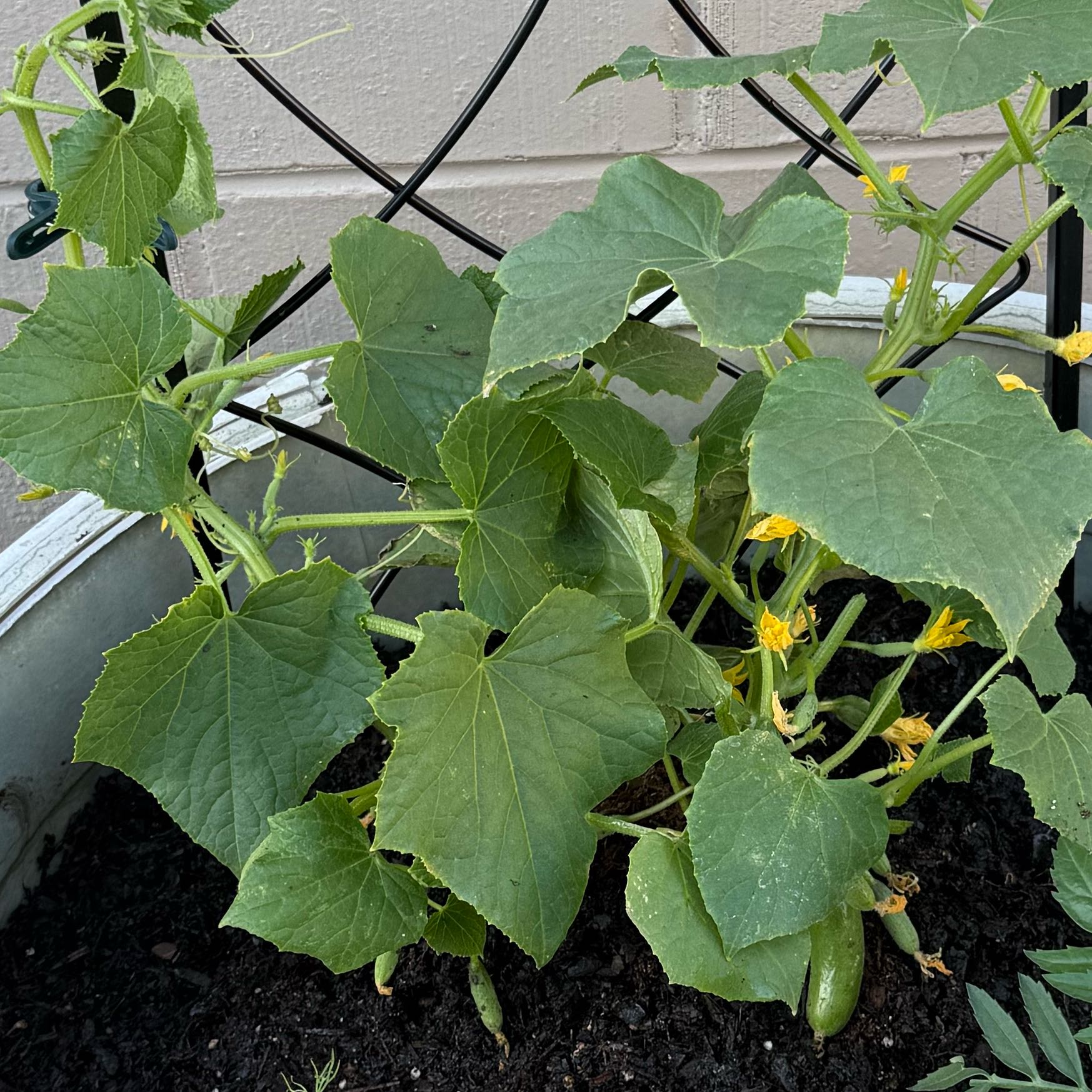
Cucumber

Best Pot for Cucumber

Cucumis sativus
Reviewed by Kiersten Rankel M.S.
Quick Answer
Cucumbers thrive in large plastic or fabric pots, at least 5 gallons per plant, with drainage holes. Their vigorous roots need room to spread, and the plants drink heavily once they start producing fruit. A trellis or cage inside the pot keeps vining types upright.

What Size Pot Does a Cucumber Need?

Cucumbers have extensive, moisture-hungry root systems that need a generous pot. A single plant needs at least a 5-gallon container, and 7-10 gallons gives noticeably better yields. The roots spread both wide and deep, so choose a pot that is at least 12 inches in both width and depth.

Bush cucumber varieties can manage in slightly smaller containers, but vining types need the full 5+ gallons plus a trellis or support structure. The trellis can sit inside the pot or attach to a nearby wall.

Avoid cramming multiple cucumber plants into one pot. They compete aggressively for water and nutrients, and the overcrowded roots produce fewer fruits.

Seedling (transplant ready) 4โ€“6" pot
Bush variety (single plant) 12โ€“14" pot (5 gal)
Vining variety (single plant) 14โ€“18" pot (7โ€“10 gal)
Large planter (2 plants max) 20โ€“24" pot (15+ gal)

What Material Pot Is Best for Cucumber?

Cucumber roots need steady, abundant moisture throughout the growing season. These plants are fast growers that produce a lot of foliage and fruit, and they wilt quickly when the root zone dries out. The pot should hold moisture reliably without becoming waterlogged.

Because cucumbers are warm-season annuals grown outdoors in full sun, the pot will be exposed to heat all day. Lighter-colored containers stay cooler and keep roots more comfortable during summer peaks.

Dries fastest → Slowest
Best for Cucumber
Fabric
Excellent root aeration, but plan to water daily or even twice daily in hot weather.
Unglazed Ceramic
Good breathability, though you will water more often than with non-porous options.
Wood
Raised bed planters and half-barrels are excellent for cucumbers, with good insulation and moisture balance.
Glazed Ceramic
Holds moisture well and reduces watering frequency during peak production.
Plastic
The most popular choice for container cucumbers. Lightweight, affordable, and retains moisture well.
Metal OVERHEATS
Metal pots get dangerously hot in the full sun cucumbers need, cooking roots and drying soil unevenly.

Cucumbers are heavy drinkers that need consistent moisture throughout their growing season, especially once they start producing fruit. Most pot materials work well, with plastic being the most popular choice for container gardening because it is lightweight, affordable, and holds water nicely.

The one material to avoid is metal. Cucumbers need full sun to produce, and metal pots in direct sunlight get hot enough to damage roots and dry soil unevenly. Wood planters and half-barrels are excellent alternatives if you want something sturdier than plastic.

Stay on top of plant care
Get seasonal reminders for watering and fertilizing โ€” personalized for your plants.
Try Greg Free

Does My Cucumber Pot Need Drainage Holes?

Yes. Cucumbers need a lot of water, which means you are watering frequently, sometimes daily in summer. Without drainage holes, that water accumulates and drowns the roots.

Make sure your pot has several drainage holes, not just one small center hole. If you notice water pooling on the soil surface after watering, check that the holes are not clogged with compacted soil.

When Should I Repot My Cucumber?

Cucumbers are warm-season annuals, so you transplant them once rather than repotting over time. Start seeds indoors 3-4 weeks before the last frost, then move seedlings into their final large container once they have 2-3 true leaves and nighttime temperatures stay above 55F.

Transplant into the biggest pot you plan to use. Cucumbers grow fast and do not tolerate root disturbance well, so avoid moving them again after the initial transplant.

Bury the seedling slightly deeper than it was in the starter pot, up to the first set of leaves. This encourages extra root growth along the buried stem.

Signs It's Time to Repot
Seedling has 2-3 true leaves and nights are above 55F
Roots visible through the starter pot's drainage holes
Seedling is wilting between waterings in its small pot
First tendrils appearing, signaling the plant is ready to climb

When Can I Plant My Cucumber in the Ground?

Cucumbers grow in USDA zones 4a through 12b as a warm-season annual. Transplant outdoors or direct sow seeds after the last frost when soil temperatures reach at least 65F. Cucumbers are native to the Himalayan foothills and love warmth, so waiting for genuinely warm soil gives them the strongest start.

In-ground cucumbers typically outproduce container plants since their roots can spread without restriction. Space plants 12-18 inches apart in rows or hills, and provide a trellis for vining types to keep fruit clean and save space.


Got More Questions?

Can I grow cucumbers in a pot without drainage holes?
No. Cucumbers need heavy, frequent watering and all that water must drain out. Without holes, roots rot quickly and the plant collapses.
How do I know if my cucumber pot is too big?
For cucumbers, bigger is almost always better. A too-small pot is the more common problem, leading to constant wilting and reduced fruit production. Five gallons is the minimum.
Do I need a trellis for container cucumbers?
Vining varieties, yes. A simple tomato cage or small trellis inside the pot keeps vines off the ground, improves airflow, and makes harvesting easier. Bush varieties can grow without support.
How often should I water a potted cucumber?
In summer heat, daily or even twice daily. Check the top inch of soil each morning. If it is dry, water thoroughly until it drains from the bottom. Inconsistent watering causes bitter-tasting fruit.
Can I grow cucumbers and tomatoes in the same large pot?
It is possible but not ideal. Both are heavy feeders and heavy drinkers, and they compete for the same resources. Each plant does better with its own dedicated container.
Stay on top of plant care
Get seasonal reminders for watering and fertilizing โ€” personalized for your plants.
Try Greg Free

About This Article

Kiersten Rankel M.S.
Botanical Data Lead at Greg ยท Plant Scientist
About the Author
Kiersten Rankel holds an M.S. in Ecology & Evolutionary Biology from Tulane University. A certified Louisiana Master Naturalist, she has over a decade of experience in science communication, with research spanning corals, cypress trees, marsh grasses, and more. At Greg, she curates species data and verifies care recommendations against botanical research.
See Kiersten Rankel's full background on LinkedIn.
Editorial Process
Container guidance verified against Cucumis sativus growth data from Greg's botanical database, cross-referenced with USDA hardiness zone data and published horticultural research.
3,658+ Greg users growing this plant
USDA hardiness zones 4aโ€“12b