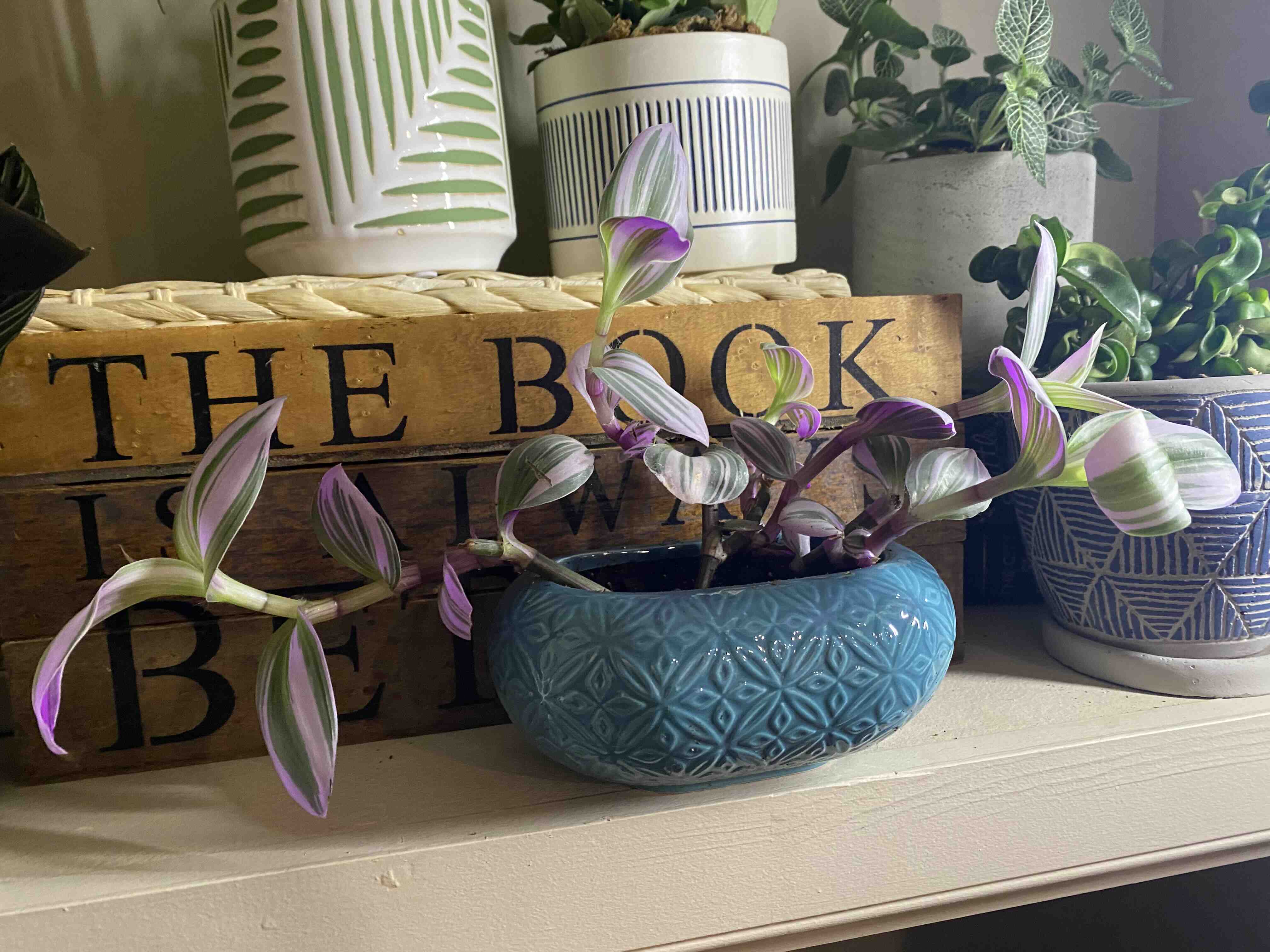
Tradescantia Nanouk

How to Fertilize Tradescantia Nanouk

Tradescantia fluminensis 'Nanouk'
Reviewed by Kiersten Rankel M.S.
Quick Answer
Use a balanced liquid fertilizer (10-10-10 or 20-20-20) diluted to half strength. Feed every two weeks during spring and summer. Cut back to monthly in fall and stop in winter.

When Should I Start Feeding My Tradescantia Nanouk?

Tradescantia Nanouk is a tropical indoor plant (zones 10a–12a) that responds to seasonal light levels, so begin feeding when you notice new growth picking up in early spring.

US feeding regions map
Pacific Mar–Oct
Mountain May–Sep
Midwest Apr–Sep
Northeast Apr–Sep
Southeast Mar–Oct
Stay on top of plant care
Get seasonal reminders for watering and fertilizing — personalized for your plants.
Try Greg Free

How Often Should I Fertilize My Tradescantia Nanouk?

Feed every two weeks from spring through summer. Nanouk is a fast grower that puts out new stems and leaves quickly, so it uses nutrients at a higher rate than most houseplants.

Reduce to once a month in early fall as growth slows. Stop feeding in late fall and winter. Even though Nanouk may still produce some new growth in winter, the reduced light means it can't use the extra nutrients efficiently.

Signs of over-fertilizing include brown, crispy leaf margins and loss of the pink variegation. Under-fertilized Nanouk tends to produce smaller leaves and the colors may look washed out or mostly green.

Feeding Calendar
Spring & Summer
Half-strength liquid fertilizer every 2 weeks
Early Fall
Half-strength liquid fertilizer once a month
Late Fall & Winter
No feeding

What Is the Best Fertilizer for Tradescantia Nanouk?

A balanced liquid fertilizer with an NPK ratio around 10-10-10 or 20-20-20 works well for Tradescantia Nanouk. The balanced ratio supports both the fast trailing growth and the vibrant pink, green, and white leaf coloring this plant is known for.

Dilute to half the label strength. Nanouk is a fast grower that appreciates regular feeding, but concentrated fertilizer can cause brown leaf tips and root damage in its relatively shallow root system.

Liquid fertilizer is the best delivery method because you can adjust the concentration and frequency easily. This matters for Nanouk since it may need slightly less food in winter if kept in lower light, and more during its vigorous spring growth flush.

Synthetic
Complete liquid formula with all 16 essential nutrients. Mix 1/8 tsp per gallon for half-strength feeding that supports lush trailing growth.
Affordable liquid concentrate available at most garden centers. Use 3-4 drops per quart (half the label rate) for regular biweekly feeding.
Organic
Gentle all-in-one organic option with mycorrhizae. Use half a scoop per gallon for consistent feeding without salt buildup.
High-nitrogen organic liquid that fuels fast foliage growth. Dilute to half strength. Best applied outdoors or near a window due to the smell.
Sprinkle a thin layer on the soil surface every couple of months for slow, gentle background nutrition. Won't burn even sensitive roots.

How Do I Fertilize My Tradescantia Nanouk?

1
Water your plant first
Give your Nanouk a thorough watering and let it drain. Applying fertilizer to dry soil risks burning the roots.
2
Dilute to half strength
Mix your balanced liquid fertilizer at half the label rate. For most concentrates, that's about 1/4 teaspoon per gallon of water.
3
Pour evenly over the soil
Apply the diluted solution slowly across the entire soil surface. Avoid getting fertilizer water on the leaves, as it can leave residue on the delicate variegated foliage.
4
Let excess drain completely
Allow all runoff to exit the drainage hole and discard it. Nanouk is sensitive to wet feet, and standing in fertilizer water invites root rot.
5
Flush the soil monthly
Once a month, water thoroughly with plain water to wash out accumulated salts. This keeps the root zone healthy between feedings and prevents leaf tip burn.

Got More Questions?

Can I use banana peels to fertilize my Tradescantia Nanouk?
Banana peels decompose too slowly in a pot to deliver meaningful nutrients. They're more likely to attract fungus gnats than help your plant. A proper liquid fertilizer is much more effective.
What happens if I over-fertilize my Nanouk?
The leaf tips and edges turn brown and crispy, and the pink variegation may fade to mostly green. Flush the soil thoroughly with plain water and skip feeding for 3-4 weeks to let the plant recover.
Will fertilizer make my Nanouk more pink?
Fertilizer alone won't increase the pink coloring. The variegation is primarily driven by light levels. Bright indirect light brings out the strongest pink tones. Proper feeding supports overall health, which gives the plant the energy to maintain its coloring.
Should I fertilize Nanouk cuttings that I'm propagating?
Wait until cuttings have established roots at least 1-2 inches long and are actively growing new leaves. Fertilizing rooting cuttings can cause the cut ends to rot instead of producing roots.
My Nanouk is getting leggy. Should I fertilize more?
Leggy growth is almost always a light problem, not a nutrient one. Move the plant to brighter indirect light before increasing feeding. Over-fertilizing a light-starved plant just makes the leggy growth worse.
Stay on top of plant care
Get seasonal reminders for watering and fertilizing — personalized for your plants.
Try Greg Free

About This Article

Kiersten Rankel M.S.
Botanical Data Lead at Greg · Plant Scientist
About the Author
Kiersten Rankel holds an M.S. in Ecology & Evolutionary Biology from Tulane University. A certified Louisiana Master Naturalist, she has over a decade of experience in science communication, with research spanning corals, cypress trees, marsh grasses, and more. At Greg, she curates species data and verifies care recommendations against botanical research.
See Kiersten Rankel's full background on LinkedIn.
Editorial Process
Fertilizer recommendations verified against Tradescantia fluminensis 'Nanouk' growth data from Greg's botanical database, cross-referenced with USDA hardiness zone data and published horticultural research.
9,504+ Greg users growing this plant
USDA hardiness zones 10a–12a