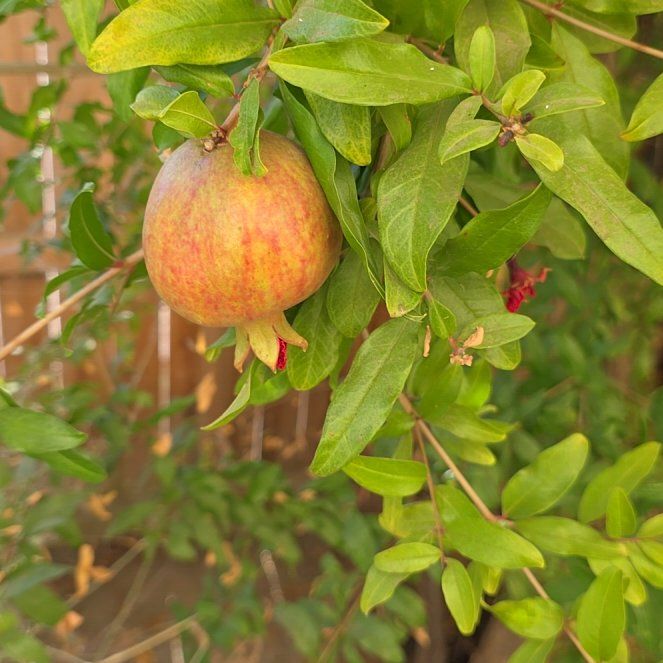
Pomegranate

How to Fertilize Pomegranate

Punica granatum
Reviewed by Kiersten Rankel M.S.
Quick Answer
Feed Pomegranates with a balanced fertilizer (like 10-10-10) in early spring, then switch to a potassium-rich formula through summer to support fruiting. Fertilize every 4 to 6 weeks during the growing season. Stop feeding in fall so the plant can harden off before winter.

When Should I Start Feeding My Pomegranate?

Pomegranates leaf out after the last frost, so begin feeding when you see the first new green growth in spring, adjusting for your region's climate.

US feeding regions map
Pacific Mar–Sep
Mountain May–Aug
Midwest Apr–Aug
Northeast Apr–Aug
Southeast Mar–Sep
Stay on top of plant care
Get seasonal reminders for watering and fertilizing — personalized for your plants.
Try Greg Free

How Often Should I Fertilize My Pomegranate?

Feed every 4 to 6 weeks from early spring through late summer. That typically works out to three or four applications per season, which is plenty for this relatively undemanding tree.

Young trees (under 3 years) benefit from lighter, more frequent feeding to establish a strong root system. Use half the recommended amount every 3 to 4 weeks instead.

Stop feeding by early fall. Pomegranates are cold-hardy to zone 7a, but late-season nitrogen produces tender new growth that is vulnerable to frost damage. Let the tree wind down naturally before winter.

Feeding Calendar
Spring
Balanced granular (10-10-10) at bud break, then again 4–6 weeks later
Summer
Potassium-rich fertilizer every 4–6 weeks through fruit development
Early Fall
Stop feeding to let the tree harden off before winter
Late Fall & Winter
No feeding

What Is the Best Fertilizer for Pomegranate?

Start the season with a balanced granular fertilizer like 10-10-10 to support new leaf and shoot growth in spring. Once flower buds appear, switch to a formula with higher potassium (the third number in NPK), such as a 4-8-12 or tomato-type fertilizer. Potassium drives fruit development and sweetness.

Granular, slow-release fertilizers work well for in-ground Pomegranates because they feed steadily between applications. For container-grown plants, liquid fertilizer gives you more control over the dose.

Avoid high-nitrogen fertilizers during fruiting. Excess nitrogen pushes vegetative growth at the expense of flowers and fruit set, and can cause fruit to crack.

Synthetic
Balanced water-soluble formula for the spring feeding. Dissolve 1 tablespoon per gallon for in-ground trees.
Good transitional option with moderate phosphorus for flowering. Use 7 drops per quart for container Pomegranates.
Organic
Granular organic with beneficial microbes. Apply 1 cup per inch of trunk diameter in spring and again at flowering.
Good nitrogen source for young trees in spring. Dilute per label and apply to the root zone monthly.
Natural potassium source that also provides trace minerals. Scratch into the soil around the drip line during fruiting season.

How Do I Fertilize My Pomegranate?

1
Water the root zone first
Give the tree a deep watering the day before you plan to fertilize. Moist soil helps the roots absorb nutrients and prevents fertilizer burn.
2
Spread granular fertilizer evenly
Scatter the fertilizer in a ring under the canopy drip line, starting about 6 inches from the trunk. Avoid piling it against the bark, which can cause damage.
3
Scratch it into the soil
Use a rake or hand cultivator to lightly work the granules into the top inch of soil. This prevents the fertilizer from washing away in rain or irrigation.
4
Water again to activate
Give the area a thorough watering to dissolve the granules and carry nutrients down to the root zone.
5
Switch to potassium-rich at flowering
When you see the first orange-red tubular flowers, swap your balanced fertilizer for a high-potassium formula. This shift supports fruit set and sweetness through harvest.

Got More Questions?

Can I use banana peels or coffee grounds on my Pomegranate?
Banana peels decompose too slowly to deliver meaningful potassium to the roots. Coffee grounds are mildly acidifying, which Pomegranates tolerate but do not need. A proper potassium-rich fertilizer is far more effective.
What happens if I over-fertilize my Pomegranate?
Excess nitrogen is the most common issue. It causes lush leafy growth but fewer flowers and fruit. You may also see fruit cracking, which happens when rapid growth outpaces the skin's ability to stretch.
Should I fertilize a newly planted Pomegranate tree?
Wait about 4 to 6 weeks after planting before the first feeding. Let the roots establish in the new soil first. Then start with half-strength applications and increase to full strength in the second year.
Do container Pomegranates need more fertilizer?
Container trees need more frequent but lighter feeding because water flushes nutrients out of the limited soil volume. Use liquid fertilizer at half strength every 2 to 3 weeks instead of granular every 4 to 6 weeks.
Why are my Pomegranate fruits splitting?
Fruit splitting is often caused by irregular watering combined with excess nitrogen. Keep watering consistent and switch to a high-potassium, low-nitrogen fertilizer once fruit begins to develop.
Stay on top of plant care
Get seasonal reminders for watering and fertilizing — personalized for your plants.
Try Greg Free

About This Article

Kiersten Rankel M.S.
Botanical Data Lead at Greg · Plant Scientist
About the Author
Kiersten Rankel holds an M.S. in Ecology & Evolutionary Biology from Tulane University. A certified Louisiana Master Naturalist, she has over a decade of experience in science communication, with research spanning corals, cypress trees, marsh grasses, and more. At Greg, she curates species data and verifies care recommendations against botanical research.
See Kiersten Rankel's full background on LinkedIn.
Editorial Process
Fertilizer recommendations verified against Punica granatum growth data from Greg's botanical database, cross-referenced with USDA hardiness zone data and published horticultural research.
1,518+ Greg users growing this plant
USDA hardiness zones 7a–11b