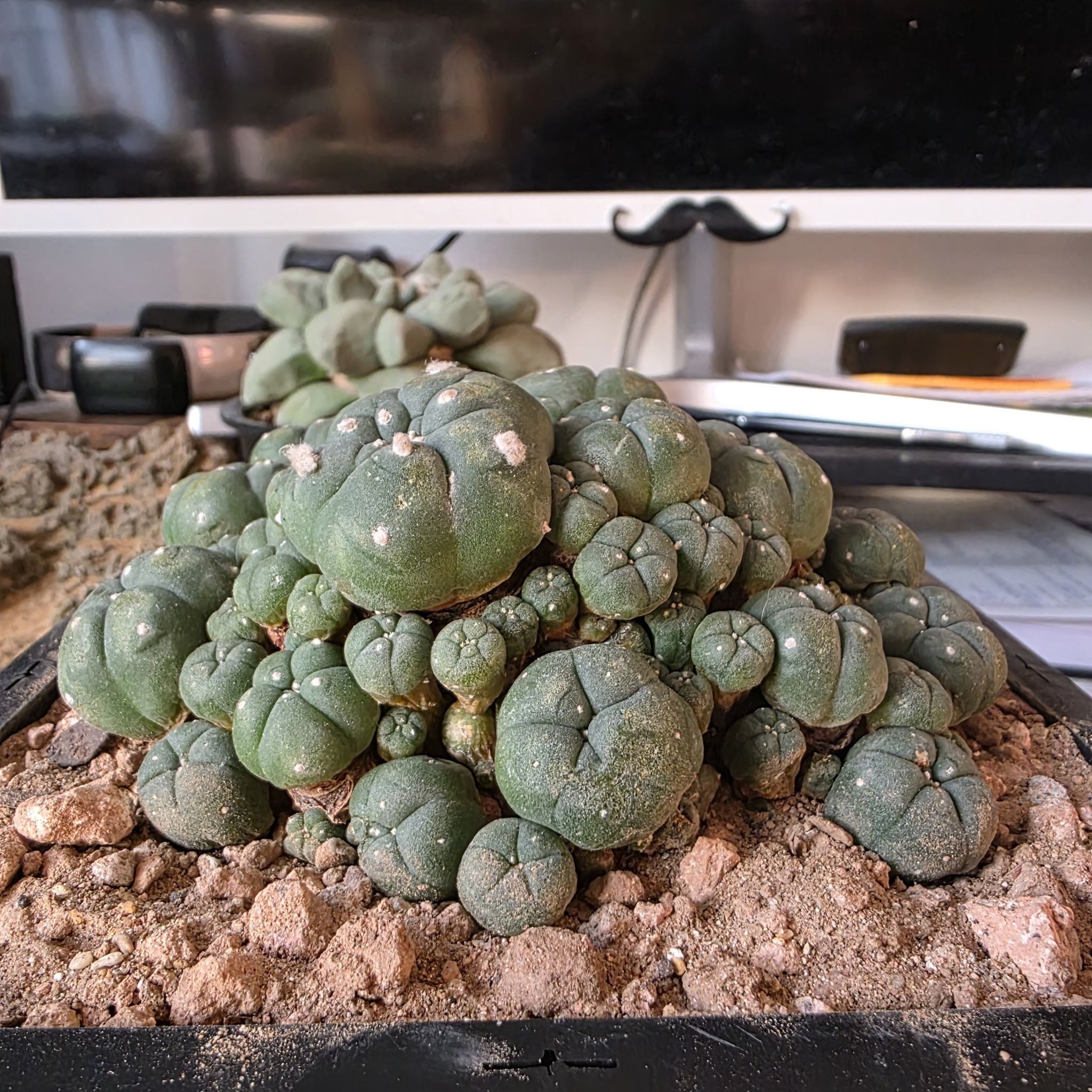
Peyote

How to Fertilize Peyote

Lophophora williamsii
Reviewed by Kiersten Rankel M.S.
Quick Answer
Peyote is an extremely slow-growing cactus that needs very little fertilizer. Use a low-nitrogen cactus formula (2-7-7 or similar) diluted to quarter strength, applied once or twice during the spring and summer growing season. Do not feed in fall or winter.

When Should I Start Feeding My Peyote?

Peyote's growing season runs from late spring through midsummer in most climates, and feeding outside this window risks root damage during dormancy.

US feeding regions map
Pacific Apr–Aug
Mountain May–Jul
Midwest May–Jul
Northeast May–Jul
Southeast Apr–Aug
Stay on top of plant care
Get seasonal reminders for watering and fertilizing — personalized for your plants.
Try Greg Free

How Often Should I Fertilize My Peyote?

Once or twice per year is enough. Feed once in late spring after the plant shows signs of swelling or producing a woolly tuft at the crown, and optionally once more in midsummer.

Peyote grows so slowly that excess nutrients cause more harm than good. Over-fertilizing leads to unnatural bloating, cracking, or loss of the tight button shape that indicates a healthy plant.

Stop feeding entirely by late summer. The plant enters dormancy in fall and winter when its metabolism slows nearly to a halt.

Feeding Calendar
Spring & Summer
Quarter-strength cactus fertilizer, once or twice total
Early Fall
No feeding (tapering into dormancy)
Late Fall & Winter
No feeding (full dormancy)

What Is the Best Fertilizer for Peyote?

Peyote grows naturally in the limestone deserts of northern Mexico and southern Texas, where soil nutrients are scarce. A low-nitrogen cactus fertilizer with a ratio like 2-7-7 is the best match. The higher phosphorus and potassium support root development and the dense, slow tissue growth this cactus is known for.

Always use a liquid formula diluted to one-quarter the label rate. Peyote's taproot is sensitive to salt buildup, and even a standard cactus dose can be too strong.

Avoid granular or slow-release fertilizers. They concentrate nutrients near the roots as they dissolve and make it impossible to control how much the plant receives.

Synthetic
Low-nitrogen liquid formula made for desert cacti. Use at quarter strength for Peyote, about 3-4 drops per quart.
Pre-diluted pump formula gentle enough for slow-growing cacti. One pump per watering during growing season.
Organic
Low-nitrogen organic liquid. Dilute to half the label rate for Peyote to avoid salt stress on the taproot.
A thin top-dressing of worm castings in spring provides gentle, slow-release nutrition without any burn risk.

How Do I Fertilize My Peyote?

1
Confirm active growth
Look for slight swelling of the button or new wool forming at the crown. If the plant looks unchanged from winter, wait a few more weeks.
2
Water lightly first
Moisten the soil and wait about 30 minutes. Peyote's taproot is sensitive, and dry soil concentrates fertilizer salts near the roots.
3
Dilute to quarter strength
Mix your low-nitrogen cactus liquid fertilizer at one-quarter the label rate. For most products, that means roughly 1/8 teaspoon per gallon.
4
Pour onto the soil surface
Apply the solution directly to the soil, keeping it away from the crown and wool. Trapped moisture at the crown encourages rot.
5
Allow full drying
Let the soil dry completely before the next watering. Peyote's taproot stores water efficiently and does not tolerate prolonged wetness.

Got More Questions?

Can I use coffee grounds on Peyote?
No. Coffee grounds are acidic and retain moisture, both of which are harmful to Peyote. This cactus prefers alkaline, fast-draining soil that mimics its native limestone desert habitat.
What happens if I over-fertilize my Peyote?
The button may swell unnaturally, crack, or develop soft spots. In severe cases the taproot rots from salt damage. Flush the soil with plain water and skip feeding for at least a year if you suspect over-fertilizing.
Does Peyote need fertilizer to flower?
Peyote can flower without any supplemental feeding if it receives adequate light. A single quarter-strength feeding in spring may support bloom production, but the plant flowers on its own schedule regardless.
Should I fertilize a newly repotted Peyote?
Wait at least four to six weeks after repotting before feeding. Fresh cactus soil mix contains enough trace nutrients for the short term, and the taproot needs time to recover from disturbance.
Can I use banana peels as fertilizer for Peyote?
Banana peels do not release meaningful potassium into potted soil and can attract fungus gnats. A proper low-nitrogen cactus fertilizer once a year is far more effective.
Stay on top of plant care
Get seasonal reminders for watering and fertilizing — personalized for your plants.
Try Greg Free

About This Article

Kiersten Rankel M.S.
Botanical Data Lead at Greg · Plant Scientist
About the Author
Kiersten Rankel holds an M.S. in Ecology & Evolutionary Biology from Tulane University. A certified Louisiana Master Naturalist, she has over a decade of experience in science communication, with research spanning corals, cypress trees, marsh grasses, and more. At Greg, she curates species data and verifies care recommendations against botanical research.
See Kiersten Rankel's full background on LinkedIn.
Editorial Process
Fertilizer recommendations verified against Lophophora williamsii growth data from Greg's botanical database, cross-referenced with USDA hardiness zone data and published horticultural research.
913+ Greg users growing this plant
USDA hardiness zones 9a–11b