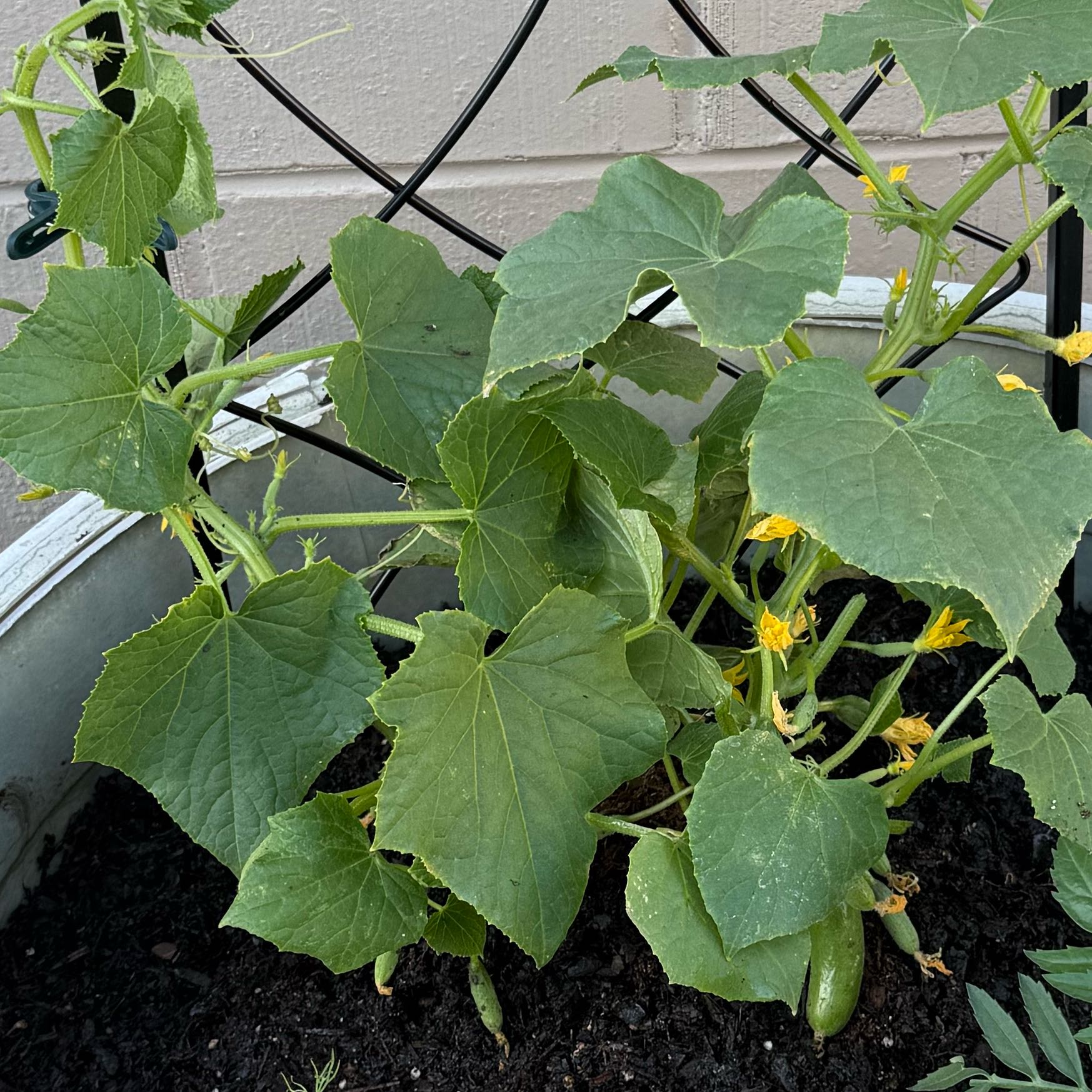
Cucumber

How to Fertilize Cucumber

Cucumis sativus
Reviewed by Kiersten Rankel M.S.
Quick Answer
Start with a balanced fertilizer (10-10-10) at planting, then switch to a higher-potassium formula (5-10-10 or similar) once flowers appear. Feed every 1 to 2 weeks throughout the growing season. Cucumbers are heavy feeders that need consistent nutrition to produce well.

When Should I Start Feeding My Cucumber?

Cucumbers are warm-season annuals, so your feeding window matches your frost-free growing period.

US feeding regions map
Pacific Apr–Oct
Mountain Jun–Sep
Midwest May–Sep
Northeast Jun–Sep
Southeast Apr–Oct
Stay on top of plant care
Get seasonal reminders for watering and fertilizing — personalized for your plants.
Try Greg Free

How Often Should I Fertilize My Cucumber?

Feed every one to two weeks once the vines are established. Cucumbers grow rapidly and set fruit continuously, so they burn through nutrients fast.

Start fertilizing about a week after transplanting, or when seedlings have their first true leaves. Continue through the entire harvest period until the plant declines in fall.

If leaves turn yellow from the bottom up, the plant is running low on nitrogen. If flowers drop without setting fruit, it may need more phosphorus and potassium. Adjust your formula based on what you see.

Feeding Calendar
Spring
Mix balanced granular (10-10-10) into soil at planting
Summer
Liquid fertilizer (5-10-10) every 1–2 weeks during fruiting
Early Fall
Continue feeding while plant is still producing
Late Fall & Winter
No feeding (plant has finished its lifecycle)

What Is the Best Fertilizer for Cucumber?

Cucumbers need two phases of feeding. At planting, use a balanced fertilizer like 10-10-10 to support strong vine and leaf growth. Once the first flowers appear, switch to a formula with more potassium and phosphorus, like 5-10-10, to support fruit production.

Liquid fertilizer works well because you can adjust the dose easily and it reaches the roots quickly. Granular slow-release fertilizer mixed into the soil at planting is also effective as a base layer.

Cucumbers are annual plants that grow fast and produce heavily. They need more fertilizer than most garden vegetables, so don't be shy about feeding on schedule.

Synthetic
High-potassium formula ideal for fruiting vegetables. Mix 1 tablespoon per gallon and apply every 1 to 2 weeks.
High-potassium concentrate that supports heavy fruit production. Mix 1 tablespoon per gallon every 10 to 14 days.
Organic
Slow-release organic granular with beneficial soil microbes. Work into soil at planting and side-dress monthly.
Fast-acting organic nitrogen source for early vine growth. Mix 1 tablespoon per gallon weekly until flowering begins.
Top-dress around plants monthly for gentle, slow-release nutrition and improved soil structure.

How Do I Fertilize My Cucumber?

1
Amend soil before planting
Work a balanced granular fertilizer or compost into the top 6 inches of soil before transplanting. This gives your Cucumber a strong nutritional start.
2
Water deeply first
Always water the soil thoroughly before applying liquid fertilizer. Cucumbers have shallow roots that burn easily in dry conditions.
3
Apply liquid fertilizer to the soil
Pour the diluted solution around the base of each plant, staying a few inches away from the stem. Aim for the drip line where feeder roots are active.
4
Switch formulas at flowering
When you see the first flowers, shift from balanced fertilizer to a higher-potassium option (5-10-10 or tomato fertilizer). This supports fruit set and development.
5
Side-dress with compost monthly
Spread a 1-inch layer of compost around the base of each plant once a month. This adds slow-release nutrients and improves soil moisture retention.

Got More Questions?

Can I use coffee grounds on my Cucumber plants?
In small amounts mixed into compost, they're fine. Don't apply them directly to the soil surface, as they can form a dense mat that repels water and attract mold.
What happens if I over-fertilize my Cucumber?
Too much nitrogen causes lush vine growth with few flowers and fruit. Excess fertilizer can also burn leaf edges and stunt the roots. If you see these signs, skip a feeding and water deeply.
Why are my Cucumber leaves turning yellow?
Yellowing from the bottom up usually means nitrogen deficiency. Give a dose of balanced or nitrogen-rich fertilizer. If the yellowing starts at leaf edges, it may be potassium deficiency instead.
Should I use the same fertilizer all season?
No. Start with balanced fertilizer for vine growth, then switch to a higher-potassium formula once flowers appear. This two-phase approach gets you more fruit.
Can banana peels help my Cucumber plants?
Banana peels decompose very slowly and don't release potassium efficiently in garden soil. They're better added to a compost pile than placed directly around plants.
Stay on top of plant care
Get seasonal reminders for watering and fertilizing — personalized for your plants.
Try Greg Free

About This Article

Kiersten Rankel M.S.
Botanical Data Lead at Greg · Plant Scientist
About the Author
Kiersten Rankel holds an M.S. in Ecology & Evolutionary Biology from Tulane University. A certified Louisiana Master Naturalist, she has over a decade of experience in science communication, with research spanning corals, cypress trees, marsh grasses, and more. At Greg, she curates species data and verifies care recommendations against botanical research.
See Kiersten Rankel's full background on LinkedIn.
Editorial Process
Fertilizer recommendations verified against Cucumis sativus growth data from Greg's botanical database, cross-referenced with USDA hardiness zone data and published horticultural research.
3,629+ Greg users growing this plant
USDA hardiness zones 4a–12b