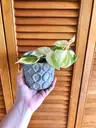
Coprosma brassii
Taxonomy

Coprosma brassii
Coprosma
Rubiaceae
Gentianales

How to care for Coprosma brassii
How often to water your Coprosma brassii

every 9
Coprosma brassii needs 0.5 cups of water every 9 when it doesn’t get direct sunlight and is potted in a 5" pot.
Use our water calculator to personalize watering recommendations to your environment or download Greg for more advanced recommendations for all of your plants.
Water 0.5 cups every
9
Finding light for Coprosma brassii in your home

a window
Coprosma brassii love being close to bright, sunny windows 😎.
Place it less than 1ft from a south-facing window to maximize the potential for growth.
Coprosma brassii does not tolerate low-light 🚫.
Select your region to see how the current weather in your area affects the placement of Coprosma brassii in your home 🏡.
How to fertilize Coprosma brassii

Most potting soils come with ample nutrients which plants use to produce new growth.
By the time your plant has depleted the nutrients in its soil it’s likely grown enough to need a larger pot anyway.
To replenish this plant's nutrients, repot your Coprosma brassii after it doubles in size or once a year—whichever comes first.
-
It is no more. 🥲 I was re-reading what I did wrong and there is contrasting info… app told me it loooves direct sunlight, but then the text says it does best in indirect sunlight. Help? #CreepingCoprosma
-
Got this bonsai mirror bush as a gift and she's not happy about it. Leaves browning and dropping, pls help, what does she need? #MirrorBush
-
Hi! Help with my coprosma repens? I have very recently became into plants, and this plant, the Coprosma Repens, is why. I became fascinated with it. I took my time and studied, acquired other plants and waited before I finally acquired one of them. It arrived three weeks ago. I live in Brazil, far away from its natural habitat. It arrived out of a pot, which meant I had a self-watering pot ready to go, and immediately and with all the care in the world replanted it. However, since then, it has been like this. I do not know if it is the placing, the watering, the plant itself... or even if there's something wrong at all! I'm worried that's all. Would someone help me? #help #mirrorbush #coprosmarepens #indoorplants #urbanjungle
-
Under grow light for 12 hours a day and just watered, it is dying but i’m not sure how?? please help


Care Summary for Coprosma brassii
Coprosma brassii
 Greg recommends:
 Water
Water
0.5 cups every 9 days
 Placement
< 1ft from a window
 Nutrients
Repot after 2x growth
Based on the 4” pot your plant is in, and that it doesn’t get direct sunlight.
 Trending in your area






 Similar to Coprosma brassii

✨ Discover rare plants

Anastasia Weeping Fig
Hoya 'Memoria'

Vatricania guentheri

Aloe 'Lavender Star'
Hoya crassipetiolata

Electric Fern
Linnaei Kunth

Echeveria Arrow
Rosularia platyphylla

Scindapsus pictus 'Si…

Sedum 'White Diamond'

Pine Cone Plant

Pink Ruby Sedevaria
Carolina Reaper
Astroloba congesta

Sedeveria 'Blue Elf'