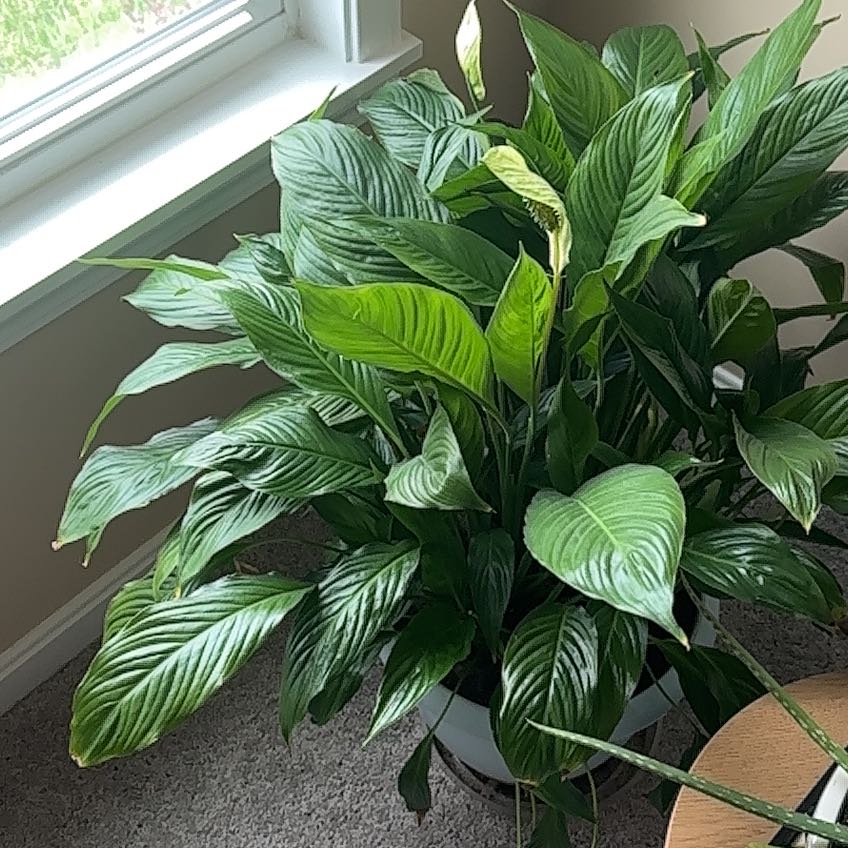
Peace Lily

What's Wrong with My Peace Lily?

Spathiphyllum wallisii
Reviewed by Kiersten Rankel M.S.
Quick Answer
1.
Dramatic drooping is usually thirst, not crisis.
Peace lily's broad leaves go limp fast when the soil dries out, but the plant bounces back within an hour or two of a good drink.
2.
Brown tips mean tap water or dry air.
Switch to filtered or distilled water and keep humidity above 40%, and the tips stop browning.
3.
No flowers means not enough light.
Peace lily tolerates low light but needs a brighter spot to bloom. Bright indirect light a few feet from a window is the sweet spot.
Stay on top of plant care
Get seasonal reminders for watering and fertilizing โ€” personalized for your plants.
Try Greg Free

Common Peace Lily Problems

Drooping leaves

Underwatering

Peace lily's broad, thin leaves have almost no water storage, so the plant collapses fast when the soil dries out. The dramatic droop is the species' built-in thirst signal. Water it and the leaves stand back up within an hour or two.

1. Check the soil. If the top inch feels dry and the pot feels light, the plant is thirsty
2. Water thoroughly until it drains from the bottom
3. If the rootball repels water, bottom-soak the pot for 20 minutes
4. Shorten the interval before the next watering
Overwatering and root rot

Peace lily's shallow rhizomatous roots suffocate quickly when the soil stays wet. Rotting roots stop absorbing moisture, so the plant droops even though the soil is soaked. Check whether the soil is wet before assuming thirst.

1. Stop watering and feel the soil. If it's wet and the plant is still drooping, assume root damage
2. Unpot and inspect the roots, cutting brown or mushy sections back to firm white tissue
3. Repot in fresh, well-draining mix in a pot with a drainage hole
4. Hold off watering for several days until new growth signals recovery

Brown leaf tips

Tap water sensitivity

Peace lily is famously sensitive to fluoride and chlorine in tap water. Those minerals travel up through the transpiration stream and accumulate at the leaf tips, where water exits. The tip cells die first, leaving crisp brown points with a sharp yellow border.

Switch to filtered, distilled, or rainwater. Flush the pot with clean water every few months to rinse out accumulated salts. Trim dead tips back to a slight point so the leaf keeps its shape.
Low humidity

Peace lily comes from warm, humid rainforest understory and wants 50%+ humidity indoors. In dry indoor air the thin leaf blades lose moisture faster than the shallow roots can replace it, and the tips are the first to go.

Run a humidifier nearby, aiming for 50%+. Group the plant with other plants to raise local humidity. Move it away from heating vents, radiators, and cold drafts.

Yellow leaves

Overwatering

Peace lily's roots rot when kept continuously wet, and damaged roots stop delivering nutrients. The plant pulls them back from the oldest leaves first, so yellowing starts at the base of the clump and works its way up.

1. Let the top inch of soil dry before the next watering
2. Check that the pot has a drainage hole and is not sitting in a saucer of water
3. If the soil stays wet for more than a few days, unpot and check the roots for rot
4. Repot in fresh, well-draining mix if the roots are damaged
Aging lower leaves

Peace Lilies naturally retire their oldest outer leaves as new ones push up from the center. If only one or two lower leaves turn yellow while the center keeps producing new growth, the plant is healthy.

Not flowering

Not enough light

Peace lily's white spathe is a modified leaf, not a true flower, and producing it takes more energy than the plant can generate in deep shade. The plant survives in low light but reserves that energy for leaves, not blooms. Bright indirect light is the threshold that tips it into flowering.

Move to within a few feet of a bright window with filtered light. Avoid direct sun, which burns the leaves. Give it 2 to 3 months at the new spot before expecting blooms.

Scorched patches

Direct sun

Peace lily evolved on the dim rainforest floor and its broad, dark leaves are built to absorb filtered light, not deflect direct sun. Strong light bleaches chlorophyll and kills cells in dry tan or papery patches where the sun hit hardest. The damage does not reverse.

Move the plant out of direct sun immediately and settle it a few feet from a bright window or behind a sheer curtain. The scorched patches won't recover. Trim off badly damaged leaves so the plant directs energy to new growth.

Pests

Spider mites

Fine webbing on leaf undersides and along stems, plus pale stippling across the blade. Peace lily is a mite magnet when indoor air turns dry, and the broad dark leaves hide stipple damage until it spreads wide.

1. Rinse the plant under a strong shower to knock mites off
2. Wipe leaves top and bottom with insecticidal soap or 70% isopropyl
3. Repeat every 3 to 4 days for two weeks
4. Raise local humidity, since mites struggle above 50%
Mealybugs

White cottony clumps tucked into leaf axils and at the base of petioles. Peace lily's dense clumping growth gives mealybugs plenty of shelter, so populations build up before you notice the sticky honeydew residue on the leaves below.

1. Dab every visible cluster with a cotton swab dipped in 70% isopropyl
2. Follow up with an insecticidal soap spray, coating the crown and leaf axils
3. Check weekly and re-treat for three weeks, since eggs survive the first round

Preventing Peace Lily Problems

A few consistent habits prevent most of what goes wrong with peace lily.
Weekly Check
1
Water with filtered or distilled water whenever possible.
Peace lily is one of the most fluoride-sensitive houseplants you can own. Clean water is the single best defense against chronic brown leaf tips.
2
Water when the top inch of soil is dry, or the moment leaves start to droop.
The dramatic flop is this species' built-in thirst gauge. Watering on that signal prevents both drought stress and the overwatering that follows guessing.
3
Keep humidity at 50%+ with a humidifier or by grouping plants.
Peace lily is a rainforest plant. Consistent humidity prevents crispy tips, brown edges, and spider mite invasions all at once.
4
Place in bright indirect light, not deep shade.
The plant survives low light but blooms only in brighter conditions. A spot a few feet from a window is the sweet spot between scorch and non-flowering.
5
Quarantine new plants for two weeks before placing them near your peace lily.
Spider mites and mealybugs almost always arrive on another plant. Isolation stops infestations before they spread.
Stay on top of plant care
Get seasonal reminders for watering and fertilizing โ€” personalized for your plants.
Try Greg Free

About This Article

Kiersten Rankel M.S.
Botanical Data Lead at Greg ยท Plant Scientist
About the Author
Kiersten Rankel holds an M.S. in Ecology & Evolutionary Biology from Tulane University. A certified Louisiana Master Naturalist, she has over a decade of experience in science communication, with research spanning corals, cypress trees, marsh grasses, and more. At Greg, she curates species data and verifies care recommendations against botanical research.
See Kiersten Rankel's full background on LinkedIn.
Editorial Process
Every problem and fix in this article was verified against Greg's botanical database, cross-referenced with USDA hardiness zone data and horticultural research from Missouri Botanical Garden, the University of Florida IFAS Extension, and the Royal Horticultural Society. The Spathiphyllum wallisii care profile reflects documented rainforest-understory biology and years of community grower feedback in Greg, including the notable fluoride sensitivity that drives most brown-tip complaints.
71,487+ Greg users growing this plant
USDA hardiness zones 10aโ€“12b