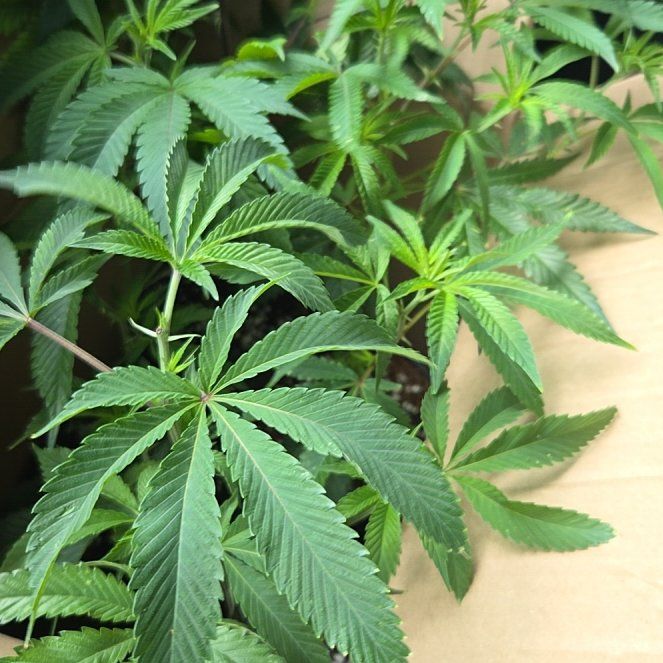
Marijuana

How to Fertilize Marijuana

Cannabis sativa
Reviewed by Kiersten Rankel M.S.
Quick Answer
Use a 3-1-2 NPK fertilizer during veg, then switch to a high-phosphorus bloom formula for flowering. Feed every 1 to 2 weeks. Stop feeding 1 to 2 weeks before harvest.

When Should I Start Feeding My Marijuana?

Because marijuana is typically grown as an annual, feeding timing depends on your planting date and whether you grow indoors or outdoors in your climate zone.

US feeding regions map
Pacific Mar–Oct
Mountain May–Sep
Midwest May–Sep
Northeast May–Sep
Southeast Apr–Oct
Stay on top of plant care
Get seasonal reminders for watering and fertilizing — personalized for your plants.
Try Greg Free

How Often Should I Fertilize My Marijuana?

During the vegetative stage, feed every 7 to 14 days with a nitrogen-focused liquid fertilizer. Fast-growing plants in bright light may benefit from weekly feeding at half strength.

When flowering starts, continue feeding every 1 to 2 weeks but switch to your bloom formula. Reduce frequency as the plant matures and buds ripen.

Stop all fertilizer 1 to 2 weeks before harvest. This "flush" period lets the plant use up stored nutrients and can improve final quality. Watch for yellowing lower leaves (normal late in flower) versus dark, curling tips (a sign of overfeeding).

Feeding Calendar
Spring
Begin feeding seedlings/clones at quarter strength once they have 3-4 sets of true leaves
Summer
Full-strength veg formula every 7-14 days; switch to bloom formula when flowering begins
Early Fall
Continue bloom feeding, then flush with plain water 1-2 weeks before harvest
Late Fall & Winter
No feeding (annual lifecycle complete)

What Is the Best Fertilizer for Marijuana?

During vegetative growth, marijuana is a heavy nitrogen feeder. Look for a liquid fertilizer with a 3-1-2 ratio, like a 9-3-6 or 6-2-4 formula, to fuel leaf and stem development.

Once flowering begins, switch to a bloom-specific formula with higher phosphorus, such as a 2-8-4 or 1-3-2 ratio. This supports bud formation and overall flower quality.

Liquid fertilizers are easiest to dose accurately. Start at half the label rate and increase only if the plant shows no signs of burn. Cannabis is sensitive to salt buildup, so a gentle approach pays off.

Synthetic
Three-part liquid system (Grow, Micro, Bloom) that lets you customize NPK ratios for each growth stage. Start at half the recommended dose.
Three-bottle set covering veg through bloom. Big Bloom, Grow Big, and Tiger Bloom give you stage-specific feeding in one kit.
Organic
Organic bloom fertilizer with beneficial soil microbes. Work into the top inch of soil or brew as a tea for flowering stage.
Granular organic blend that feeds slowly over several weeks. Mix into soil at planting or top-dress monthly.
A gentle, slow-release amendment that improves soil biology. Mix a handful into the top inch of soil every few weeks.

How Do I Fertilize My Marijuana?

1
Water your plant first
Always water with plain water before applying fertilizer. This protects roots from chemical burn and helps nutrients distribute evenly through the soil.
2
Mix your fertilizer at half strength
Start with half the label rate for your liquid fertilizer. Cannabis is sensitive to nutrient burn, so it is safer to underfeed and increase gradually.
3
Pour evenly around the base
Apply the diluted solution slowly around the base of the plant, avoiding the leaves and stems. Continue until you see a small amount of runoff from the drainage holes.
4
Check your runoff pH
Cannabis prefers a slightly acidic root zone (6.0 to 6.5 in soil). If your runoff pH drifts outside this range, nutrients get locked out even when they are present.
5
Watch the leaves for feedback
Dark green, clawing leaf tips mean you are overfeeding. Light green or yellowing lower leaves during veg usually mean the plant needs more nitrogen. Adjust your dose accordingly.
6
Flush before harvest
Stop all fertilizer 1 to 2 weeks before you plan to harvest. Water with plain water to allow the plant to use up stored nutrients.

Got More Questions?

Can I use coffee grounds to fertilize marijuana?
Coffee grounds add a small amount of nitrogen and slightly acidify the soil, which cannabis does enjoy. However, they are not a complete fertilizer. Use them as a light soil amendment, not a replacement for balanced feeding.
What happens if I over-fertilize my marijuana plant?
The leaf tips will turn dark and curl downward, sometimes looking burnt or crispy. In severe cases, the leaves may develop brown spots. Flush the soil with plain water and skip feeding for a week before resuming at a lower dose.
Should I use the same fertilizer for veg and flower?
No. Vegetative growth demands more nitrogen for leaf and stem development, while flowering plants need more phosphorus and potassium for bud production. Switch to a bloom formula when you see the first signs of flowers.
Do I need CalMag supplements?
If you grow in coco coir or use reverse osmosis water, your plant may show calcium or magnesium deficiencies (brown spots, interveinal yellowing). A CalMag supplement can help, but most growers using tap water and soil do not need it.
Can I fertilize marijuana seedlings?
Wait until your seedling has 3 to 4 sets of true leaves before introducing any fertilizer, and start at one-quarter strength. Seedlings are very sensitive and the seed itself provides enough nutrition for the first week or two.
Stay on top of plant care
Get seasonal reminders for watering and fertilizing — personalized for your plants.
Try Greg Free

About This Article

Kiersten Rankel M.S.
Botanical Data Lead at Greg · Plant Scientist
About the Author
Kiersten Rankel holds an M.S. in Ecology & Evolutionary Biology from Tulane University. A certified Louisiana Master Naturalist, she has over a decade of experience in science communication, with research spanning corals, cypress trees, marsh grasses, and more. At Greg, she curates species data and verifies care recommendations against botanical research.
See Kiersten Rankel's full background on LinkedIn.
Editorial Process
Fertilizer recommendations verified against Cannabis sativa growth data from Greg's botanical database, cross-referenced with USDA hardiness zone data and published horticultural research.
6,901+ Greg users growing this plant
USDA hardiness zones 8a–11b