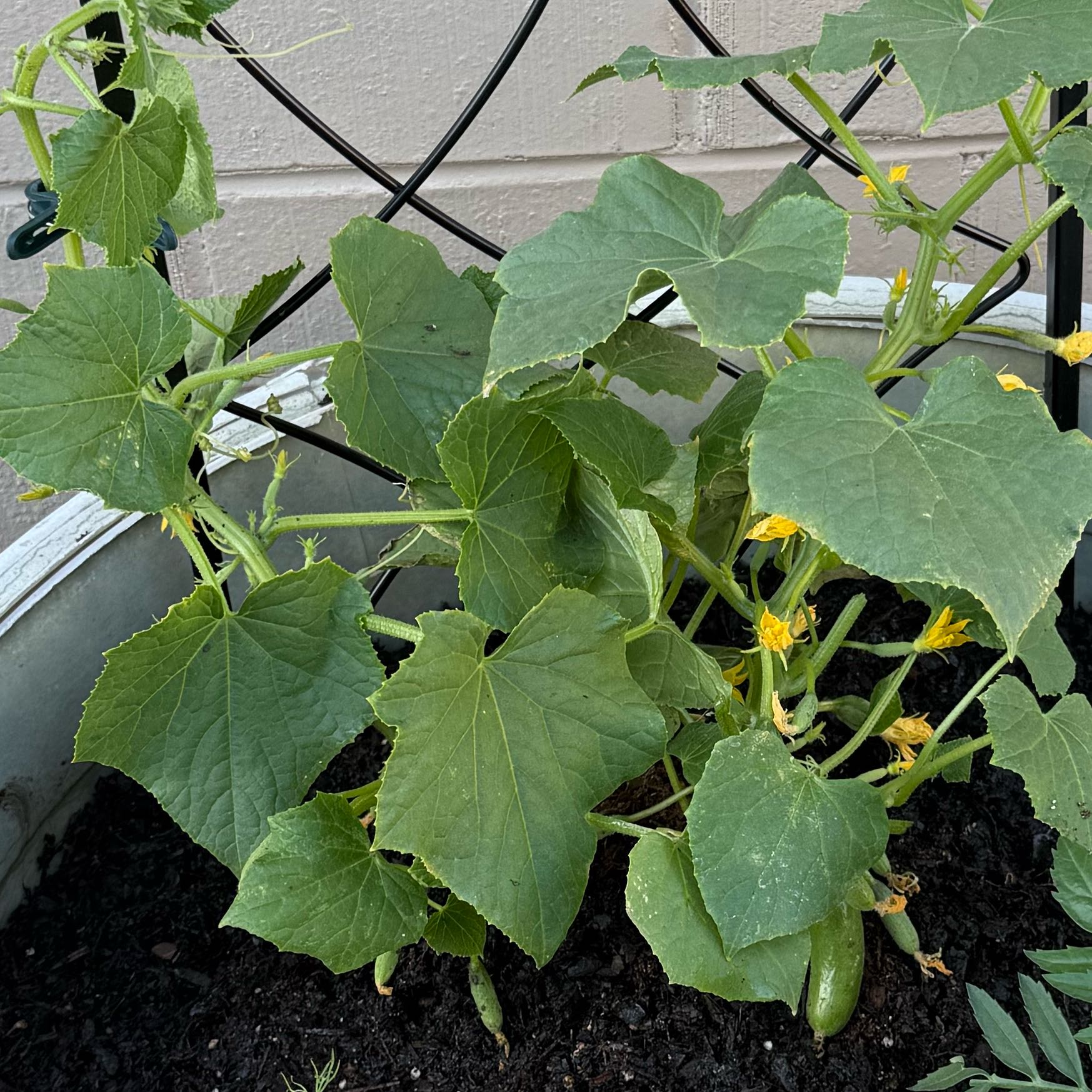
Cucumber

What's Wrong with My Cucumber?

Cucumis sativus
Reviewed by Kiersten Rankel M.S.
Quick Answer
1.
White coating on leaves means powdery mildew.
It's nearly universal on cucumbers in late summer. Treat early and the vine keeps producing. Ignore it and the vine collapses within weeks.
2.
Bitter or misshapen fruit points to watering or heat.
Drought stress concentrates bitter compounds. Poor pollination from extreme heat leaves fruit small and curved.
3.
New female flowers mean the vine is healthy.
Female flowers have a tiny cucumber at the base. If they're forming on actively growing vines, the plant is healthy and fruit set is still happening.
Stay on top of plant care
Get seasonal reminders for watering and fertilizing โ€” personalized for your plants.
Try Greg Free

Common Cucumber Problems

White powder on leaves

Powdery mildew

Cucumbers are one of the most mildew-susceptible vegetables in the garden. The Cucurbitaceae family's broad, shallow-veined leaves create a large surface for the fungal spores to colonize, and the warm dry days with cool nights of late summer are exactly the conditions powdery mildew needs to explode. Unlike most fungi, it thrives in dry air rather than wet, so it hits hardest when you think the weather is fine.

1. Remove the worst-affected leaves and dispose of them in the trash, not the compost
2. Spray remaining leaves top and bottom with a diluted baking soda solution (1 tablespoon per gallon of water) or a potassium bicarbonate product
3. Improve airflow by thinning dense foliage and ensuring vines on a trellis aren't layered over each other
4. Reapply every 7โ€“10 days and accept some spread -- the goal is to slow it, not stop it

Yellow leaves

Nitrogen deficiency

Cucumbers are fast-growing, heavy feeders with vines that can push several inches a day at peak. That pace depletes nitrogen from the root zone quickly. When the supply runs short, the plant draws it back from the oldest leaves first, so yellowing starts at the base and progresses up the vine toward the tips.

1. Side-dress with a balanced vegetable fertilizer or compost around the base of the vine
2. Water it in so nutrients reach the root zone
3. Repeat every 3โ€“4 weeks through the growing season
Powdery mildew (early stage)

Mildew often shows as general yellowing before the white coating is visible. The fungus blocks photosynthesis by colonizing the leaf surface, and older leaves yellow from the base up. If you see any faint white dusting or a slightly powdery texture on the yellow leaves, mildew is the cause, not a nutrient problem.

1. Look closely for the white powder under good light before deciding on a treatment
2. If mildew is present, remove affected leaves and treat the remaining foliage with baking soda spray or potassium bicarbonate
3. If no white powder is visible, feed with a balanced vegetable fertilizer and recheck in one week

Bitter fruit

Drought stress

Cucumbers produce cucurbitacins, the bitter compounds that give gourds their characteristic sharpness, when the plant is water-stressed. The fast-growing cucumber vine needs consistent moisture to dilute these compounds as the fruit swells. When the soil dries out repeatedly during fruit development, bitterness concentrates at the stem end and throughout the skin.

1. Water deeply every 2โ€“3 days in hot weather and daily during heat waves, aiming for consistent soil moisture at root depth
2. Mulch thickly around the base to reduce evaporation between waterings
3. Harvest fruit at the recommended size -- overripe cucumbers are reliably bitter regardless of watering
Harvesting too late

As a cucumber matures past its prime, cucurbitacin levels rise and seeds harden. A slicing cucumber left to turn yellow on the vine tastes bitter even if the plant was perfectly watered. Cucumbers grow fast and can go from ideal to overripe in 48 hours during peak summer heat.

1. Check vines daily once fruit is developing and harvest when cucumbers reach their expected size, not when the skin starts yellowing
2. Removing mature fruit promptly signals the vine to keep producing new flowers

Poor fruit set

Insufficient pollination

Cucumbers produce separate male and female flowers on the same vine, and bees must carry pollen between them. Without a bee visit, the tiny cucumber behind the female flower shrivels and drops within a few days. Low pollinator activity from rain, heavy pesticide use, or growing in an isolated spot all reduce fruit set.

1. Hand-pollinate by picking a male flower (no bump at the base) and touching its center to the center of an open female flower
2. Avoid spraying pesticides in the morning when bees are active
3. Plant pollinator-attracting flowers nearby to draw more bees to the garden
Heat above 95ยฐF

Cucumber pollen becomes unviable when temperatures push above 95ยฐF for extended periods. Flowers open and close without successful pollination, and female flowers abort the tiny developing fruit. Heat also causes plants to produce a flush of male flowers while delaying female ones, creating a further gap.

1. Shade plants with 30% shade cloth during peak afternoon heat
2. Water deeply in the morning so vines go into the hottest part of the day fully hydrated
3. Wait it out -- female flower production and fruit set resume when temperatures drop

Wilting vines

Bacterial wilt

Bacterial wilt is spread by cucumber beetles and is one of the fastest killers in the vegetable garden. Once the beetles feed and introduce the bacterium, it multiplies in the vascular system and blocks water movement from the roots upward. A single vine wilts first, usually in the morning when temperatures are still cool, then collapses completely within days. There is no recovery once a plant has bacterial wilt.

1. Pull and dispose of any wilted vine immediately to prevent beetles from spreading the bacterium to neighboring plants
2. Inspect healthy plants for yellow-green cucumber beetles and knock them into soapy water
3. Cover newly transplanted starts with floating row cover for the first few weeks to block beetle access until the plants are established
Drought

Cucumber vines can wilt dramatically by midday when soil moisture is low, even on healthy plants. The vine's large leaves and fast growth rate mean it moves a tremendous amount of water. Midday wilt that recovers by evening is usually heat and drought stress, not disease.

1. Check the soil at root depth. If it's dry several inches down, water deeply right away
2. Mulch 3 inches deep around the base to retain moisture between waterings
3. If wilting persists into the cool evening even after watering, check for bacterial wilt by cutting a stem and watching for sticky threads

Pests

Cucumber beetles

Striped or spotted cucumber beetles are the most damaging pest specific to cucumbers and their relatives. They feed on leaves, flowers, and fruit, but the real danger is that they carry bacterial wilt. A light infestation that gets ignored can introduce the disease and kill a vine that otherwise looks fine.

1. Hand-pick adults into soapy water in the morning when they're slow
2. Spray with pyrethrin or neem oil if numbers are high, covering flowers and leaf undersides
3. Use yellow sticky traps to monitor population pressure
Aphids

Aphid colonies form quickly on cucumber growing tips and the undersides of young leaves, curling and puckering the soft tissue. Cucumbers push tender new growth continuously through the summer, giving aphids a sustained food source. Dense colonies also transmit cucumber mosaic virus, which can distort leaves and reduce yield.

1. Knock aphids off with a strong blast of water aimed at leaf undersides
2. Follow up with insecticidal soap if populations return within a few days
3. Repeat every 3โ€“4 days until populations collapse
Spider mites

Spider mites thrive in hot, dry conditions and can build to damaging numbers on cucumber foliage within a week during a heat wave. They feed by puncturing leaf cells, creating a stippled, bronzy appearance on the upper surface. Cucumber leaves are broad enough that serious mite damage can halve photosynthesis before webbing becomes visible.

1. Spray the undersides of leaves with a strong water jet every 2โ€“3 days to disrupt populations
2. Apply insecticidal soap or neem oil to leaf undersides, repeating every 5โ€“7 days
3. Keep vines consistently watered since drought-stressed cucumbers are far more vulnerable

Preventing Cucumber Problems

A few consistent habits prevent most of what goes wrong with cucumbers.
Weekly Check
1
Water deeply and consistently throughout fruit development.
Cucumber vines need even soil moisture to produce sweet, non-bitter fruit. Aim for 1โ€“2 inches per week and mulch 3 inches deep to buffer between waterings.
2
Cover transplants with floating row cover for the first 2โ€“3 weeks.
Row cover keeps cucumber beetles off young plants during the most vulnerable establishment period, which is the best defense against bacterial wilt.
3
Train vines on a trellis to improve airflow.
Vines sprawling on the ground trap humidity and slow air circulation, accelerating powdery mildew. A vertical trellis also makes it easier to spot pests and harvest.
4
Harvest cucumbers at peak size, every day if needed.
Fruit left on the vine past prime turns bitter and signals the plant to stop flowering. Daily harvests keep the vine producing through the season.
5
Plant pollinator-friendly flowers nearby.
Cucumbers depend on bees for fruit set. Marigolds, basil, and borage nearby attract pollinators and increase the frequency of bee visits to cucumber flowers.
Stay on top of plant care
Get seasonal reminders for watering and fertilizing โ€” personalized for your plants.
Try Greg Free

About This Article

Kiersten Rankel M.S.
Botanical Data Lead at Greg ยท Plant Scientist
About the Author
Kiersten Rankel holds an M.S. in Ecology & Evolutionary Biology from Tulane University. A certified Louisiana Master Naturalist, she has over a decade of experience in science communication, with research spanning corals, cypress trees, marsh grasses, and more. At Greg, she curates species data and verifies care recommendations against botanical research.
See Kiersten Rankel's full background on LinkedIn.
Editorial Process
Every problem and fix in this article was verified against Greg's botanical database, cross-referenced with USDA hardiness zone data and published horticultural research from Cornell Cooperative Extension, University of Minnesota Extension, and NC State Extension. The Cucumis sativus care profile reflects 3,600+ Greg users growing cucumbers across USDA zones 4โ€“11, alongside peer-reviewed research on cucurbit pathology and integrated pest management.
3,713+ Greg users growing this plant
USDA hardiness zones 4aโ€“12b