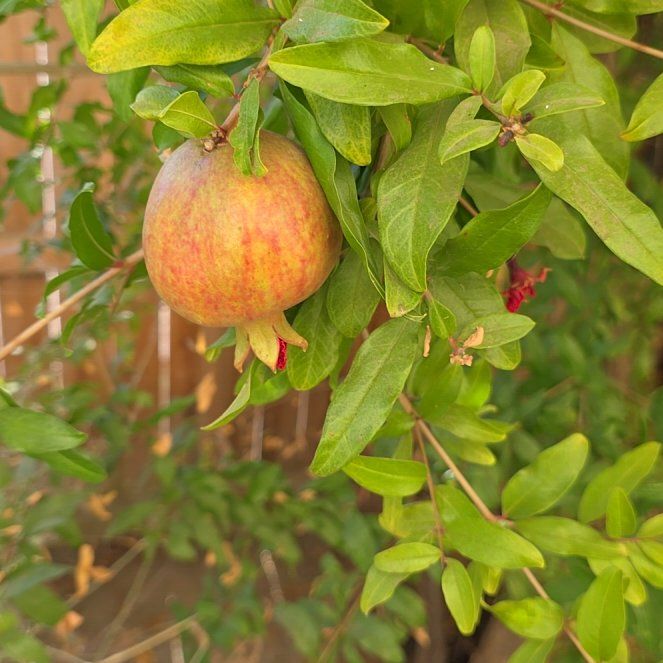
Pomegranate trees grow best in unglazed ceramic or wood containers with drainage holes. Start with a 14–18 inch pot for a young tree, and use well-draining soil. These drought-adapted trees prefer their soil to dry out between waterings, so avoid materials that trap moisture.
What Size Pot Does a Pomegranate Tree Need?
Pomegranates develop a strong, branching root system that needs room to anchor a top-heavy canopy. Start a young nursery tree in a 14–18 inch pot. This gives the roots enough room to establish without an excess of wet soil around them.
As the tree grows, plan to size up every 2–3 years until you reach a 20–24 inch container. That's a practical maximum for most patio pomegranates. Dwarf varieties can stay in 14–16 inch pots long-term.
A pot that's too small restricts fruiting since pomegranates need a healthy root mass to support a crop. But jumping to a huge pot all at once leaves too much wet soil around young roots.
Young nursery tree (1–2 ft)14–18" pot
Established tree (3–5 ft)18–20" pot
Mature fruiting tree (5–8 ft)20–24" pot or half barrel
What Material Pot Is Best for Pomegranate?
Pomegranates are native to the hot, dry regions stretching from Turkey to Afghanistan. Their roots are adapted to lean, well-drained soil that dries out between rains. In a pot, you want a material that mimics those conditions by allowing airflow and moderate drying.
Stability is just as important. A fruiting pomegranate tree is heavy and catches wind, so a weighty container prevents toppling on a patio or deck.
Dries fastest → Slowest
Best for Pomegranate
Fabric
Excellent root aeration and drainage. Best for younger trees since fabric can't support the weight of a large fruiting pomegranate.
Unglazed Ceramic
The ideal match. Breathable, heavy enough to stabilize a mature tree, and dries at the right pace.
Wood
Half barrels are a classic choice for patio fruit trees. Line the inside to slow rot from constant soil contact.
Glazed Ceramic
Works well if you use a gritty, fast-draining soil mix. The weight provides good stability for taller trees.
Plastic
Affordable for large sizes, but light enough to tip in wind. Weigh down with a gravel layer at the base.
MetalOVERHEATS
Pomegranates live in full sun, and metal pots can overheat roots on hot summer days. Avoid for outdoor trees.
Pomegranate trees need a pot that drains well and has enough weight to support a mature, fruit-laden tree. Unglazed ceramic is the ideal match, offering breathability and stability in one package. Wood half-barrels are a classic choice for patio fruit trees too.
Metal is the material to avoid. Pomegranates need full sun to produce fruit, and metal pots can overheat roots on hot summer days. If you choose a lighter material like plastic, weigh the base down with a gravel layer to prevent tipping.
Stay on top of plant care
Get seasonal reminders for watering and fertilizing — personalized for your plants.
Yes. Pomegranates are drought-adapted and handle dry soil much better than wet. Roots sitting in standing water develop rot quickly, and a waterlogged tree drops fruit and leaves.
Use a pot with multiple drainage holes if possible, especially for larger containers. Pair the holes with a coarse soil mix so water moves through freely after each watering.
When Should I Repot My Pomegranate?
Repot young pomegranate trees every 2–3 years in early spring, just before new growth begins. Go up 2–4 inches in diameter each time until you reach your target container size.
Once the tree is in its final pot (typically 20–24 inches), you can top-dress instead of repotting. Remove the top 2–3 inches of old soil each spring and replace it with fresh mix and a slow-release fertilizer.
When repotting, gently loosen circling roots at the bottom. Pomegranates tolerate root disturbance reasonably well, but avoid removing large sections of the root ball all at once.
Signs It's Time to Repot
Roots circling densely at the bottom of the pot
Water runs through without soaking into the root ball
Growth has slowed noticeably compared to previous years
Tree becomes unstable or top-heavy in its current pot
Fruit production has dropped despite proper care
When Can I Plant My Pomegranate in the Ground?
Pomegranates grow in the ground year-round in zones 7a through 11b. They handle heat, drought, and even brief cold snaps down to about 10°F once established. Plant in early spring after the last frost for the best start.
Choose a spot with full sun and well-draining soil. Pomegranates don't need rich soil and actually produce better fruit in leaner conditions. In zones colder than 7a, grow in a container so you can move the tree to a garage or cool indoor space for winter.
Got More Questions?
Can I use a pot without drainage holes for my pomegranate?
No. Pomegranate roots rot in waterlogged soil. Always use a container with drainage holes and a fast-draining soil mix.
How do I know if my pomegranate's pot is too big?
If the soil stays wet for more than a few days after watering, the pot is too large for the current root mass. Excess moisture around young roots leads to rot. Size up gradually.
Can I grow a pomegranate tree on a balcony?
Yes, if the balcony gets full sun (6+ hours). Use a dwarf variety like 'Nana' in a 14–16 inch pot. Make sure the pot is heavy enough to resist wind.
Do pomegranates fruit in containers?
Yes. Container-grown pomegranates fruit reliably as long as they get full sun, proper drainage, and the pot is large enough (18+ inches for standard varieties). Dwarf varieties fruit in smaller pots.
Should I prune my potted pomegranate's roots?
Light root pruning is fine when repotting. Trim circling roots and any dead or mushy sections. Avoid removing more than a quarter of the root mass at once.
Stay on top of plant care
Get seasonal reminders for watering and fertilizing — personalized for your plants.
Kiersten Rankel holds an M.S. in Ecology & Evolutionary Biology from Tulane University. A certified Louisiana Master Naturalist, she has over a decade of experience in science communication, with research spanning corals, cypress trees, marsh grasses, and more. At Greg, she curates species data and verifies care recommendations against botanical research.
See Kiersten Rankel's full background on LinkedIn.
Editorial Process
Container guidance verified against Punica granatum growth data from Greg's botanical database, cross-referenced with USDA hardiness zone data and published horticultural research.