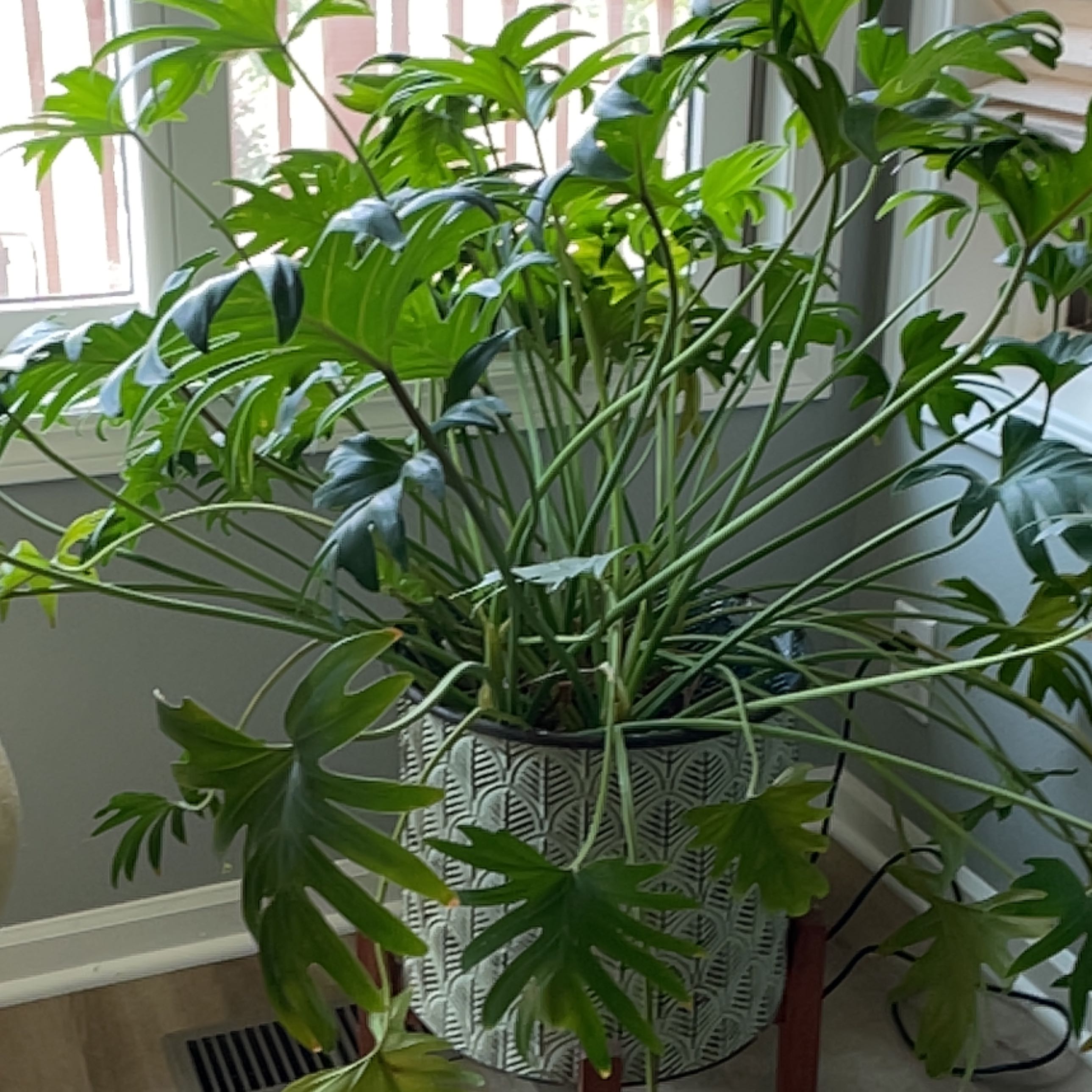
What's Wrong with My Philodendron Xanadu?

Common Philodendron Xanadu Problems
Yellow leaves
Xanadu's compact root system sits in a relatively small volume of soil, so waterlogged conditions turn dangerous fast. Roots suffocate and begin to rot, cutting off nutrient delivery. The plant pulls energy from its oldest outer leaves first, so yellowing starts at the bottom of the clump and works inward.
Xanadu's glossy, deeply lobed leaves move a steady amount of water through transpiration. When the soil stays dry too long, the plant scavenges moisture from its oldest outer leaves first. They yellow and go limp before the inner newer leaves show any stress.
A mature Xanadu regularly sheds its outermost older leaves to redirect energy into new growth from the center. If only one or two of the lowest outer leaves are yellowing and the rest of the plant looks strong, this is normal and needs no action.
Drooping leaves
Xanadu's leaves are held up by water pressure in the petioles. When the compact rootball dries out fully, that pressure drops and the whole clump sags at once. Check the soil. If it is dry several inches down, this is the cause and recovery is fast after watering.
Root rot from saturated soil shuts down water delivery to the leaves. Xanadu droops even when the soil is wet because damaged roots can no longer absorb. If the soil is soggy and the leaves are also yellowing, root damage is the likely cause.
Brown tips
Xanadu originates from the humid Brazilian rainforest and wants at least 50% humidity indoors. In drier conditions, moisture evaporates fastest from the farthest points on each leaf. The deeply cut lobe tips are especially exposed, so they brown first and the damage creeps back along each lobe edge.
Philodendrons are sensitive to fluoride in tap water and to fertilizer salts that accumulate in the soil over time. Both cause crispy brown tips on otherwise healthy leaves. The damage is permanent on affected leaves but stops on new growth once the source is addressed.
Shallow leaf lobes
The deeply cut, multi-lobed leaves are Xanadu's signature trait, and that shape develops fully only in bright indirect light. In dimmer spots, the plant produces leaves with shallower notches or nearly smooth edges as it tries to maximize photosynthesis. New leaves that unfurl without the characteristic deep cuts are a reliable signal the plant needs a brighter spot.
Young Xanadu plants and new growth from small cuttings naturally produce simpler, less lobed leaves. The deep lobing develops as the plant matures and the stem base thickens. If the plant is young or was recently purchased in a small pot, this is normal and no action is needed.
Pests
Fine webbing on leaf undersides and a bronze or stippled look on the leaf surface are the signs. Dry indoor air invites them, and Xanadu's dense, compact clump makes it easy for mites to spread from leaf to leaf without detection. Check the undersides along the midrib of each lobe.
White cottony clusters appear in the tight leaf axils where petioles emerge from the central stem base. Xanadu's self-heading clumping habit packs these bases densely together, giving mealybugs sheltered pockets where they can build up for weeks before becoming obvious. Check by parting the foliage at the base.
Preventing Philodendron Xanadu Problems
About This Article
