Passion Fruit

What's Eating Your Passion Fruit?

Passiflora edulis
Reviewed by Kiersten Rankel M.S.
Quick Answer

For passion fruit, the most likely culprits are scale insects (brown bumps along woody stems and leaf undersides) and aphids (clustered on tendrils and new growth flushes). Spider mites flare in hot dry summers, leaving pale dots and webbing along the three-lobed leaves. Gulf fritillary caterpillars are common too. They strip foliage but turn into the orange butterflies many gardeners plant passionvine for.

Stay on top of plant care
Get seasonal reminders for watering and fertilizing, personalized for your plants.
Try Greg Free

What does the damage look like?

Tap the closest match to jump straight to the fix.

Pests, ranked by impact

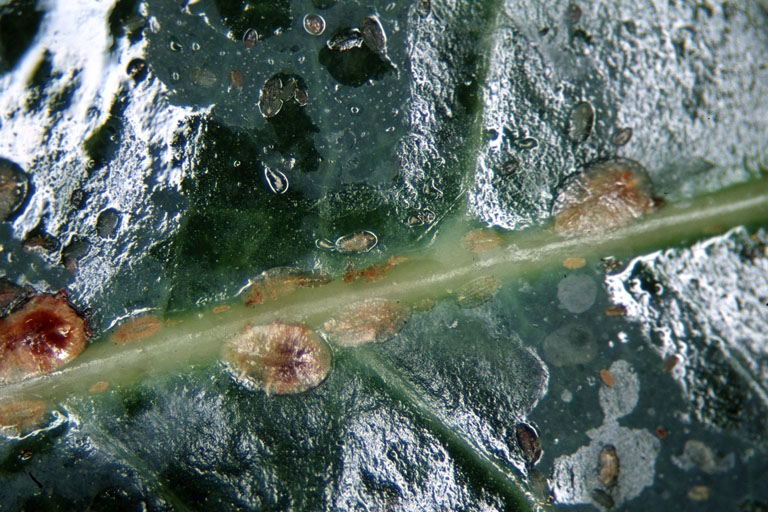
Brown soft scale (Coccus hesperidum) clustered on a plant stem

Scale insects

Damage
Medium
Removal
Hard
What it looks like

Hard or soft brown bumps glued to the woody main stem, the underside of three-lobed leaves, and along the central vein. 1 to 4 mm wide. Look like tiny barnacles. Passionvine is a known scale host because the woody twining stems give crawlers many sheltered crevices to settle into.

What the damage looks like

A sticky shiny film coats leaves and the soil or surface below the vine. Black sooty mold grows on the residue over weeks. Yellowed leaves around each cluster. Heavy infestations weaken flowering and reduce fruit set across the season.

How to get rid of them
Option 1

Scrub and oil weekly for 4 weeks

1

Wet affected stems and leaf undersides with horticultural oil (Bonide All Seasons, ~$15).

2

Scrub gently with a soft toothbrush to dislodge bumps from woody stems and break the waxy seal.

3

Spray a final coat of oil and leave on. Repeat weekly for 4 weeks to catch newly hatched crawlers.

Option 2

Insecticidal soap on leaf undersides, every 5 days

Spray ready-to-use insecticidal soap (Safer Brand, ~$10) on the underside of leaves and along stem nodes at dusk. Soap kills the soft crawler stage on contact but does not penetrate the waxy adult shell. Repeat every 5 days for 3 weeks to keep pressure on each new hatch.

Option 3

Prune the most heavily infested woody stems

Passion fruit is a vigorous climber and tolerates aggressive pruning. Cut out the worst-infested stem sections and bag them. The vine regrows quickly from lower nodes. This is faster than treating an old crusted infestation in place.

Dense colony of aphids clustered on a plant stem

Aphids

Damage
Medium
Removal
Easy
What it looks like

Tiny pear-shaped insects 1 to 3 mm long, in shades of green, brown, or black. Cluster densely on new growth flushes, on the soft underside of young three-lobed leaves, and along the curling tendrils that the vine uses to climb.

What the damage looks like

New leaves curl and twist as aphids drain sap. Tendrils distort and fail to grip supports. A sticky shiny film coats leaves below the cluster, and black sooty mold grows on the residue over a few weeks. Heavy infestations on flowering shoots weaken fruit set.

How to get rid of them
Option 1

Strong water blast every 2 to 3 days for 2 weeks

Hold a hose nozzle 12 inches from infested new growth and tendrils and spray at high pressure. Most aphids dislodge and don't make it back to the vine. Repeat every 2 to 3 days for 2 weeks. The fastest, cheapest fix and chemical-free.

Option 2

Neem oil spray at dusk, every 5 days for 3 rounds

1

Mix 2 tablespoons cold-pressed neem oil with 1 teaspoon dish soap per gallon of water.

2

Spray the underside of every young leaf and along tendril tips at dusk.

3

Repeat every 5 days for 3 rounds. Covers the egg-to-adult cycle.

Option 3

Plant alyssum or yarrow within 3 feet of the trellis

Alyssum, dill, and yarrow attract ladybugs and lacewings, which feed on aphids. Tuck them into the bed at the base of the passionvine trellis. Established plantings keep aphid pressure low without sprays and last for years.

Spider mite infestation on a stem with fine silk webbing and pale speckled leaf damage

Spider mites

Damage
Medium
Removal
Moderate
What it looks like

Almost invisible without a hand lens. Yellow-green to red-orange specks on the underside of three-lobed leaves and along the leaf-petiole junction. Hot dry summer weather and drought-stressed vines trigger population booms.

What the damage looks like

Tiny pale yellow dots tiny pale dots the upper leaf surface, then bronze patches that spread between the leaf lobes. Fine webbing strung along the leaf-petiole junction in heavy infestations. Stressed vines drop foliage and set fewer fruit through the rest of the season.

How to get rid of them
Option 1

Hose down the foliage weekly for 3 weeks

Spray cool water on the underside of every leaf for 30 seconds, working from the lower vine up. Mites can't reattach quickly when knocked off. Passionvine tolerates a hard rinse well. Repeat weekly for 3 weeks. Pair with deeper watering to ease the drought stress that triggered the bloom.

Option 2

Neem oil at dusk, every 5 days for 3 rounds

1

Mix 2 tablespoons cold-pressed neem oil and 1 teaspoon dish soap per gallon of water.

2

Spray the underside of every leaf at dusk, paying attention to the leaf-petiole junction where mites cluster.

3

Repeat every 5 days for 3 rounds. That covers the full egg-to-adult life cycle.

Option 3

Deep-water the root zone in summer heat

Passion fruit is tropical and hates drought stress. Water deeply at the base once or twice a week through the hottest months instead of light daily sprinkles. A well-watered vigorous vine resists mite pressure. Mulch 2 to 3 inches deep to hold soil moisture.

Macro photo of a caterpillar resting on a green leaf

Gulf fritillary caterpillar

Damage
Medium
Removal
Easy
What it looks like

Bright orange-red caterpillars with rows of soft black branching spines, 1 to 1.5 inches long when full grown. The spines look fierce but don't sting. Passiflora is the obligate host. Gulf fritillary butterflies can't reproduce on any other plant, which is why many grow passionvine for them.

What the damage looks like

Three-lobed leaves chewed from the edges in. Whole sections of vine can be defoliated in a few days during peak summer feeding. The caterpillars are easy to spot because of the bright color, and you'll often see the orange-and-black butterflies laying eggs on the same vine.

How to get rid of them
Option 1

Decide first: are you growing this for fruit or for butterflies?

This is the only pest on this list with a built-in tradeoff. If you planted passionvine for the butterflies, the caterpillars are the point. Tolerate the leaf loss and enjoy the show. The vine regrows fast. If you planted it strictly for fruit, treat the caterpillars as a pest. The treatments below assume the fruit goal.

Option 2

Hand-pick caterpillars off fruiting stems

1

Walk the trellis every 2 to 3 days during summer feeding.

2

Pick caterpillars off the stems carrying flowers and developing fruit. The spines don't sting.

3

Move them to a sacrificial passionvine planted elsewhere in the yard, or relocate to a wild patch. Don't drop into soapy water unless you're sure you don't want the butterflies.

Option 3

Plant a dedicated host vine 10 feet from the fruit vine

The cleanest solution is to grow extra passionvine just for the caterpillars, away from the fruit-bearing vine. Pick a spot 10 feet or more from the harvest trellis. The butterflies usually choose the lower-stress vine, and your fruit vine stays mostly intact. This is how serious passion fruit growers live with the dual nature of this plant.

Common myth

Spray Bt on caterpillars to save the vine.

Bt (Bacillus thuringiensis) kills every caterpillar that eats the sprayed leaves, including the gulf fritillaries that only this plant supports. On passionvine, Bt is the wrong tool unless you've decided to give up on butterflies entirely. Hand-picking is selective and saves the species you actually wanted to grow this plant for.

Stay ahead of all of them

Four habits that keep passion fruit pests in check and let you enjoy both the fruit and the butterflies.
1

Tendril and underleaf check, every Sunday

Aphids cluster on tendrils, scale hides on woody stems, and spider mites work the leaf undersides. A weekly 30-second scan along the trellis catches all three before they spread up the vine.

2

Plant a sacrificial host vine for the butterflies

Tuck a second passionvine 10 feet or more from your fruit-bearing vine. The gulf fritillaries usually choose the spare vine for egg-laying and your harvest stays mostly untouched. The simplest way to grow fruit and host pollinators on the same property.

3

Deep-water through summer heat

Passion fruit is tropical and drought stress invites spider mites. Water deeply at the base once or twice a week through the hottest months. Mulch 2 to 3 inches deep at the base of the trellis to hold soil moisture and ease pressure.

4

Prune out heavily infested woody stems in late winter

Scale builds up year over year on the woody stems passionvine keeps from season to season. An annual hard prune in late winter removes infested wood and stimulates fresh productive growth. The vine bounces back fast from aggressive cuts.

Stay on top of plant care
Get seasonal reminders for watering and fertilizing, personalized for your plants.
Try Greg Free

About This Article

Kiersten Rankel M.S.
Botanical Data Lead at Greg · Plant Scientist
About the Author
Kiersten Rankel holds an M.S. in Ecology & Evolutionary Biology from Tulane University. A certified Louisiana Master Naturalist, she has over a decade of experience in science communication, with research spanning corals, cypress trees, marsh grasses, and more. At Greg, she curates species data and verifies care recommendations against botanical research.
See Kiersten Rankel's full background on LinkedIn.
Editorial Process
Pest identification and treatment guidance verified against Passiflora edulis field reports from Greg's botanical database, cross-referenced with university extension sources and published horticultural research.