Bougainvillea

What's Eating Your Bougainvillea?

Bougainvillea spectabilis
Reviewed by Kiersten Rankel M.S.
Quick Answer

For bougainvillea, the most likely culprits are the bougainvillea looper (a night-feeding inchworm that chews leaf margins and disappears by morning) and spider mites (pale specks and webs in hot dry weather, especially on stressed plants). Aphids cluster on tender new growth and flower stalks in spring. Scale insects sit as small bumps along the woody stems and the underside of leaves.

Stay on top of plant care
Get seasonal reminders for watering and fertilizing, personalized for your plants.
Try Greg Free

What does the damage look like?

Tap the closest match to jump straight to the fix.

Pests, ranked by impact

Macro photo of a caterpillar resting on a green leaf

Bougainvillea looper

Damage
High
Removal
Moderate
What it looks like

A slender 1-inch inchworm in green or pale brown that loops as it crawls. Color matches the leaf or the woody stem so well it disappears in plain sight. Feeds only at night, then hides motionless along a stem or leaf rib by day. The signature bougainvillea pest.

What the damage looks like

Scalloped notches and curved bites along leaf margins, often on the soft new growth and tender bracts at the cane tips. Damage appears overnight with no caterpillar visible the next morning. Heavy nightly feeding strips new shoots and weakens the next bloom flush.

How to get rid of them
Option 1

Flashlight hunt at dusk, every 2 to 3 nights

1

Wait until 30 to 60 minutes after sunset, then walk the plant with a bright flashlight or headlamp.

2

Scan the underside of new leaves and along the woody stems near the bract clusters. The loopers stand out on lit foliage at night.

3

Pluck each one off and drop into a jar of soapy water. Repeat every 2 to 3 nights for 2 weeks to break the cycle.

Option 2

Bt spray at dusk, every 7 days for 3 rounds

Mix 1 teaspoon Bt (Monterey Bt or Safer Caterpillar Killer, ~$15) per quart of water. Spray the top and underside of every leaf and the soft cane tips at dusk because Bt breaks down in sunlight. Loopers eat the treated leaf and stop feeding within hours. Reapply every 7 days for 3 rounds, and after any rain.

Option 3

Spinosad spray at dusk for heavier infestations

If Bt isn't keeping up, switch to spinosad (Captain Jack's Deadbug Brew or Monterey Garden Insect Spray, ~$12 to $15). Spray at dusk on the new growth and along the cane tips where loopers feed. Spinosad is bee-safe once dry, so apply after the pollinators have left for the day. Repeat every 7 days for 2 to 3 rounds.

Spider mite infestation on a stem with fine silk webbing and pale speckled leaf damage

Spider mites

Damage
High
Removal
Moderate
What it looks like

Almost invisible without a hand lens. Pinpoint yellow-green to red specks along the underside of leaves and at the base of the bract clusters. Hot dry air and drought-stressed bougainvillea trigger explosive population booms within a week.

What the damage looks like

Tiny pale yellow dots peppered across the upper leaf surface, then bronze and dusty patches that spread across whole leaves. Fine webbing strung between the petiole and stem and across bract clusters in heavy infestations. Leaves drop fast, weakening the cane and cutting blooms.

How to get rid of them
Option 1

Hose blast the underside of leaves, weekly for 3 weeks

Hold a hose nozzle 12 inches from the affected canes and spray the underside of every leaf at high pressure. Mites can't reattach quickly when knocked off, and the rinse humidity slows survivors. Bougainvillea tolerates a hard rinse well as long as the soil drains. Repeat weekly for 3 weeks.

Option 2

Neem oil at dusk, every 5 days for 3 rounds

1

Mix 2 tablespoons cold-pressed neem oil and 1 teaspoon dish soap per gallon of water.

2

Spray the underside of every leaf and the bract clusters at dusk. Avoid spraying in direct sun on hot days because oil plus heat scorches bougainvillea leaves.

3

Repeat every 5 days for 3 rounds. That covers the full egg-to-adult life cycle.

Option 3

Fix the underlying drought stress

Spider mites take off on bougainvillea when the plant is hot, dry, and stressed. Deep-water the root zone every 7 to 10 days through the hottest months instead of letting the plant wilt then drenching. A consistently watered bougainvillea fights mites off on its own. Stressed canes invite the next outbreak.

Dense colony of aphids clustered on a plant stem

Aphids

Damage
Medium
Removal
Easy
What it looks like

Tiny pear-shaped insects 1 to 3 mm long, in shades of green, yellow, brown, or black. Cluster densely on tender new growth, on the soft underside of young leaves, and along the flower stalks below the bract clusters. Spring flush is peak aphid season.

What the damage looks like

New leaves curl, twist, and yellow as aphids drain sap. Flower stalks droop and bracts open smaller than normal. A sticky shiny film coats leaves and the stems below the cluster. Black sooty mold grows on the residue over a few weeks. Heavy spring infestations cut the bloom flush short.

How to get rid of them
Option 1

Strong water blast every 2 to 3 days for 2 weeks

Hold a hose nozzle 12 inches from the affected new growth and spray at high pressure. Most aphids dislodge and don't make it back to the plant. Aim into the bract clusters and along the flower stalks where they hide. Repeat every 2 to 3 days for 2 weeks. Fast, cheap, and chemical-free.

Option 2

Insecticidal soap spray at dusk, every 5 days for 3 rounds

1

Use ready-to-use insecticidal soap (Safer Insect Killing Soap, ~$10) or mix 1 tablespoon mild dish soap per quart of water.

2

Spray the underside of new leaves and the flower stalks at dusk so the spray stays wet long enough to suffocate the aphids. Avoid spraying open bracts in direct sun.

3

Repeat every 5 days for 3 rounds. Covers the egg-to-adult cycle.

Option 3

Plant alyssum or yarrow within 3 feet

Plant alyssum, dill, or yarrow within 3 feet of the bougainvillea. These attract ladybugs and lacewings, which feed on aphids. Established companion plantings keep aphid pressure low without sprays and last for years. Bougainvillea shares this strategy well with most flowering ornamentals.

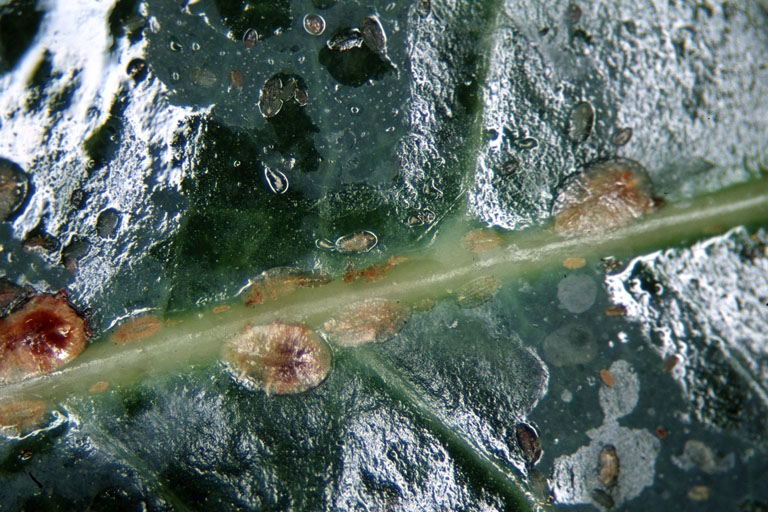
Brown soft scale (Coccus hesperidum) clustered on a plant stem

Scale insects

Damage
Medium
Removal
Hard
What it looks like

Hard or soft brown, tan, or white bumps stuck along the woody stems, on the underside of leaves, and tucked at the base of the thorny nodes. 1 to 4 mm wide and shaped like tiny barnacles. Don't move because they're glued in place. Easy to mistake for bark texture on older canes.

What the damage looks like

A glossy sticky film on leaves and the surface below the affected canes. Black sooty mold grows on the residue over weeks. Yellowed leaves around each cluster, especially on the woody main stems. Heavy infestations weaken the cane, drop leaves, and reduce the next bloom cycle.

How to get rid of them
Option 1

Scrub and oil weekly for 4 weeks

1

Wet the affected stems and leaf undersides with horticultural oil (Bonide All Seasons, ~$15). Watch the thorns.

2

Scrub gently with a soft toothbrush to dislodge the bumps and break the waxy seal.

3

Spray a final coat of oil and leave on. Repeat weekly for 4 weeks to catch newly hatched crawlers.

Option 2

Prune out heavily infested canes

Cut off and bag any cane crusted in scale beyond easy scrubbing. Bougainvillea blooms on new growth, so hard pruning encourages a fresh flush of cleaner canes. Disinfect pruners with rubbing alcohol between cuts. Bag and discard the trimmings. Do not compost.

Option 3

Systemic drench for non-flowering plants

If the plant is not in active bloom and not visited by bees, drench the soil with imidacloprid granules (Bonide Annual Tree & Shrub, ~$30). The systemic moves up through the cane and kills scale through the sap over 2 to 4 weeks. Skip this entirely while bracts are open because bougainvillea draws bees and butterflies to the surrounding garden.

Stay ahead of all of them

Four habits that keep bougainvillea pests rare and the bract flushes uninterrupted.
1

Dusk flashlight check, every 2 to 3 nights in summer

Bougainvillea looper feeds only at night and disappears by morning. A 60-second flashlight scan after sunset across the cane tips and bract clusters catches them before they strip a flush. Skip the daytime hunt because they hide in plain sight on the woody stems.

2

Prune after each bloom flush to remove egg-laden tips

Bougainvillea blooms on new growth, so a hard pruning after each flush rewards you with denser canes and more bracts next round. The cut also removes the tender tips where loopers and aphids lay eggs. Disinfect pruners with alcohol between plants and watch the thorns.

3

Deep-water on a steady schedule through hot months

Bougainvillea takes off when stressed by drought, and so do spider mites. Soak the root zone every 7 to 10 days in summer instead of letting the plant wilt then drenching. Consistent watering also slows the soft-growth flushes that aphids target. Let the top 2 inches dry between waterings.

4

Scout the woody stems and underleaves every Sunday

Scale insects, mites, and early aphid clusters all hide along the woody main stems and on the underside of leaves below the bracts. A weekly 30-second scan from cane base to bract cluster catches infestations while they're still on one branch.

Stay on top of plant care
Get seasonal reminders for watering and fertilizing, personalized for your plants.
Try Greg Free

About This Article

Kiersten Rankel M.S.
Botanical Data Lead at Greg · Plant Scientist
About the Author
Kiersten Rankel holds an M.S. in Ecology & Evolutionary Biology from Tulane University. A certified Louisiana Master Naturalist, she has over a decade of experience in science communication, with research spanning corals, cypress trees, marsh grasses, and more. At Greg, she curates species data and verifies care recommendations against botanical research.
See Kiersten Rankel's full background on LinkedIn.
Editorial Process
Pest identification and treatment guidance verified against Bougainvillea spectabilis field reports from Greg's botanical database, cross-referenced with university extension sources and published horticultural research.