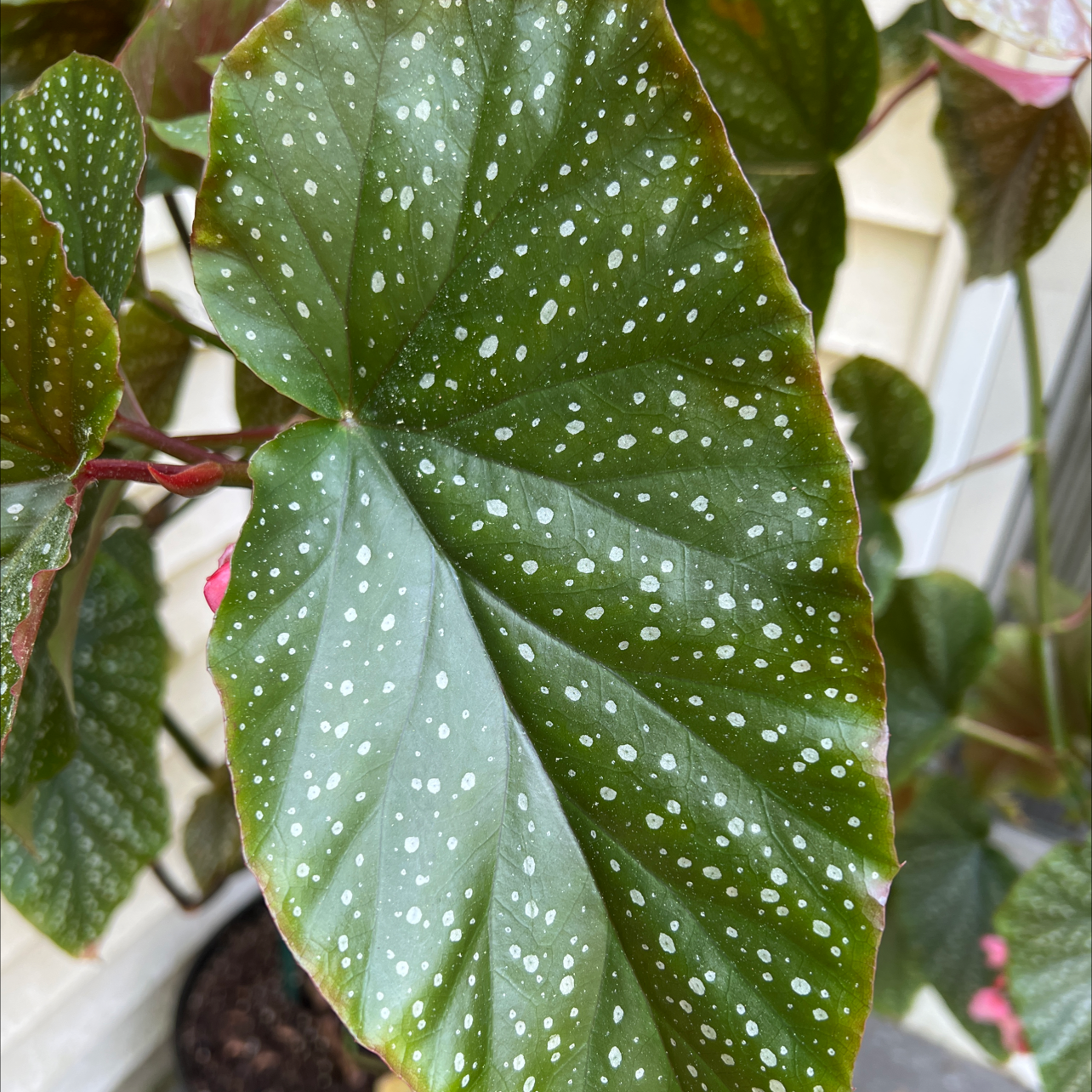
Polka Dot Begonia

What's Wrong with My Polka Dot Begonia?

Begonia maculata
Reviewed by Kiersten Rankel M.S.
Quick Answer
1.
Humidity is behind most problems.
Crispy brown edges are the signature complaint for this plant. Begonia maculata evolved in humid Brazilian rainforest and suffers fast in dry indoor air. If something looks wrong, check the humidity first.
2.
Check soil moisture if humidity looks fine.
Overwatering is the other big killer. Begonia maculata's shallow, fibrous roots rot quickly in soggy soil. Yellowing lower leaves and a damp-but-struggling plant both point here.
3.
New spotted leaves at cane tips mean recovery.
Fresh leaves unfurling at the top of the canes with the full silver-dot pattern and red undersides visible mean the plant is still actively growing. Problems in the lower leaves are fixable.
Stay on top of plant care
Get seasonal reminders for watering and fertilizing — personalized for your plants.
Try Greg Free

Common Polka Dot Begonia Problems

Brown leaf edges

Low humidity

Begonia maculata's large, silver-spotted leaves transpire heavily and need 50–60%+ humidity to stay healthy. In dry indoor air, the leaf margins brown and crisp first because the tissue at the edges is furthest from the central water supply along each leaf's thick, waxy surface.

Run a humidifier near the plant and aim for 50–60%+ relative humidity. Grouping with other plants also helps raise local moisture. The damaged edges will not recover, but new growth should come in clean once humidity improves.
Underwatering

When the soil dries out completely, Begonia maculata's relatively thin leaves lose water faster than the roots can replace it. The edges brown and go papery before the rest of the leaf shows stress, because the margins are the last stop on the plant's water distribution route.

Water thoroughly until water runs from the drainage hole. The crispy edges will not recover, but the plant should stop losing more tissue once it gets consistent moisture. Check the soil every few days and water before it dries out completely.

Yellow leaves

Overwatering

Begonia maculata grows from a shallow, fibrous root system that suffocates quickly in waterlogged soil. When the roots rot, the plant pulls nutrients back from the oldest leaves first. Yellowing starts at the base of the canes and works upward, with soil that stays wet long after watering.

1. Stop watering immediately and let the soil dry down significantly
2. Make sure the pot has a drainage hole and is not sitting in standing water
3. Once the soil is dry, resume on a less frequent schedule and check the top inch before each watering
Normal lower-leaf shedding

As Begonia maculata grows taller along its canes, the oldest lower leaves yellow and drop off naturally. This is normal for a cane-forming begonia. If only the bottom one or two leaves are yellowing and the cane tips are pushing out fresh spotted growth, nothing is wrong.

Dropping leaves

Cold draft or sudden move

Begonia maculata is sensitive to abrupt environmental change. A cold draft from a window or AC vent, or moving the plant to a new spot, can trigger rapid leaf drop within a day or two. The cane-forming stems hold leaves at nodes, and those nodes release leaves quickly under stress.

1. Move the plant away from cold windows, AC vents, and doorways
2. Keep it in a stable spot above 60°F (15°C) and avoid moving it again until it stabilizes
3. New leaves at the cane tips should resume within a few weeks once conditions are steady
Overwatering

Root rot from overwatering cuts off water delivery to every part of the plant. Begonia maculata drops leaves from the lower canes first as the plant sheds tissue it can no longer support. The soil will feel wet or smell sour if this is the cause.

1. Stop watering and let the soil dry down fully
2. Check the cane bases for soft or dark tissue, which signals rot has spread upward
3. If the canes are still firm, resume on a drier schedule. If they are soft, take stem cuttings from the firm upper sections and root them in water

White powder on leaves

Powdery mildew

Begonias are among the most powdery-mildew-prone houseplants. The white dusty coating is a fungal infection that spreads across Begonia maculata's silver-spotted leaves in conditions with poor airflow and stagnant humidity. It looks like someone dusted flour on the surface and spreads leaf to leaf if left alone.

1. Remove the worst-affected leaves and bin them
2. Move the plant to a spot with better airflow and avoid misting the leaves
3. Spray the remaining leaves with a diluted neem oil solution or a baking soda spray once a week until new clean growth comes in

Leggy growth

Needs pinching back

Begonia maculata grows naturally as a tall, upright cane and will keep stretching upward indefinitely without intervention. The lower canes go bare and the spotted leaves cluster only at the top, making the plant look sparse. Regular pinching is what keeps this species looking full and bushy rather than like a bare stick with a tuft.

1. Pinch or cut stem tips just above a leaf node to force the plant to branch
2. Repeat every four to six weeks during the growing season to keep new branching coming
3. Use the cuttings to propagate new plants in water if the stems are healthy

Pests

Mealybugs

Mealybugs are the most common pest on Begonia maculata. They hide in the tight leaf axils where the spotted leaves attach to the canes, making them easy to miss until a heavy infestation is underway. The white cottony masses and sticky honeydew dripping down the canes are the telltale signs.

1. Dab each visible cluster with a cotton swab soaked in 70% isopropyl alcohol
2. Follow up with an insecticidal soap spray, coating all leaf axils and undersides
3. Check every week for a month, since new hatchlings appear in waves
Spider mites

Dry indoor air invites spider mites, and Begonia maculata's large, succulent-feeling leaves are a prime target. Fine webbing at the stem joints and pale stippled speckling on the upper surface of the spotted leaves are the first signs. Mite populations build fast in heated indoor rooms in winter.

1. Rinse the plant under a strong shower, hitting the undersides of every leaf
2. Wipe all leaf surfaces with insecticidal soap or 70% isopropyl on a cloth
3. Repeat every three to four days for two weeks
4. Raise humidity to 50%+ to make conditions less hospitable to mites

Preventing Polka Dot Begonia Problems

A few consistent habits prevent most of what goes wrong with Polka Dot Begonia.
Weekly Check
1
Run a humidifier and keep humidity at 50–60%+.
Begonia maculata evolved in humid Brazilian rainforest. Dry indoor air causes the brown leaf edges this plant is notorious for. Use a humidifier rather than misting the leaves, since wet foliage invites powdery mildew.
2
Water when the top inch of soil is dry, not before.
Begonia maculata's shallow roots are vulnerable to overwatering. Checking the soil with a finger before each watering prevents the soggy conditions that cause yellowing, leaf drop, and root rot.
3
Place in bright indirect light, away from direct sun.
Bright filtered light matches this plant's rainforest understory origins and keeps new leaves coming in with a strong spot pattern. Direct afternoon sun scorches the large, thin leaves.
4
Pinch cane tips every four to six weeks.
Without regular pinching, Begonia maculata becomes a bare-caned stick with leaves only at the top. Pinching is what keeps it bushy and slows the leggy growth cycle.
5
Keep the plant in one stable, draft-free spot.
Begonia maculata drops leaves when moved or hit by cold drafts. Choose a warm spot above 60°F away from AC vents and windows that open, and leave it there.
Stay on top of plant care
Get seasonal reminders for watering and fertilizing — personalized for your plants.
Try Greg Free

About This Article

Kiersten Rankel M.S.
Botanical Data Lead at Greg · Plant Scientist
About the Author
Kiersten Rankel holds an M.S. in Ecology & Evolutionary Biology from Tulane University. A certified Louisiana Master Naturalist, she has over a decade of experience in science communication, with research spanning corals, cypress trees, marsh grasses, and more. At Greg, she curates species data and verifies care recommendations against botanical research.
See Kiersten Rankel's full background on LinkedIn.
Editorial Process
Every problem and fix in this article was verified against Greg's botanical database, cross-referenced with USDA hardiness zone data and published horticultural research from the Missouri Botanical Garden, university extension programs, and species-specific literature. The Begonia maculata care profile reflects documented species behavior combined with years of community grower feedback in Greg.
17,148+ Greg users growing this plant
USDA hardiness zones 10a–11b