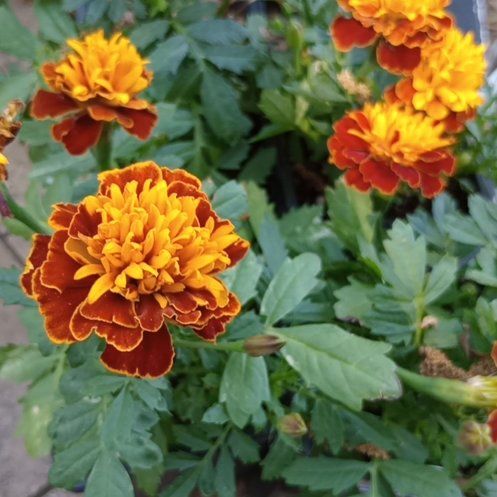
French Marigold

What's Eating Your French Marigold?

Tagetes patula
Reviewed by Kiersten Rankel M.S.
Quick Answer

For French marigold, the most likely culprit is spider mites in hot dry summer weather (the bushy compact form holds heat tight against the foliage). Aphids cluster on the small bicolor flower buds and stalks. Slugs chew young plants and lower leaves at night, especially on freshly bedded transplants. Japanese beetles target the gold and maroon petals despite the strong scent.

Stay on top of plant care
Get seasonal reminders for watering and fertilizing, personalized for your plants.
Try Greg Free

What does the damage look like?

Tap the closest match to jump straight to the fix.

Pests, ranked by impact

Spider mite infestation on a stem with fine silk webbing and pale speckled leaf damage

Spider mites

Damage
High
Removal
Moderate
What it looks like

Microscopic specks the size of a dust grain. Yellow, red, or pale green, packed onto the underside of the deeply divided leaflets and tucked into the dense interior of the 6 to 12 inch bush. The compact French marigold form traps heat and stagnates airflow, which is exactly the microclimate that triggers a population boom in July and August.

What the damage looks like

Pinprick pale dots peppering the upper leaf surface, then whole leaflets fade to a dull bronze. Lower interior foliage drops first because the dense bush hides the worst infestations from view. Bloom slows visibly within 10 days of a heavy outbreak as the plant pulls energy back to survive.

How to get rid of them
Option 1

Hose down the bush interior every 3 days

Aim a hose nozzle into the heart of the compact bush from the side, not the top. Spray for 20 seconds per plant, focusing on the underside of interior leaflets where mites cluster. The dense French marigold form makes top-down rinsing miss most of the population. Repeat every 3 days for 2 weeks during a heat wave.

Option 2

Insecticidal soap on interior foliage at dusk

1

Use a ready-to-use insecticidal soap (Safer Brand, ~$10) and tilt the bush gently to expose the inner leaflets.

2

Spray the underside of the deeply divided leaflets and the leaf-rachis junctions where mites concentrate.

3

Repeat every 5 days for 3 rounds. Spray at dusk to keep the soap on the leaf longer and avoid afternoon sun burn.

Option 3

Space transplants 10 inches apart at minimum

Crowded French marigolds in a vegetable bed create a humid microclimate inside the planting that mites love and predators can't reach. Set new transplants at least 10 inches apart so air moves between bushes. The slightly thinner row also makes weekly inspection of interior foliage practical.

Dense colony of aphids clustered on a plant stem

Aphids

Damage
Medium
Removal
Easy
What it looks like

Tiny pear-shaped insects 1 to 3 mm long in green, black, or yellow. Cluster on the small 1 to 2 inch flower buds before they open and on the slim stalks just below each bud. The bicolor French marigold sets a heavy bud crop, so any single plant can host hundreds of aphids during peak bloom.

What the damage looks like

Buds open lopsided or fail to open at all, with malformed gold-and-maroon petals. A sticky shiny film coats the upper foliage and any vegetable leaves nearby (companion crops are often the first sign). Sooty mold grows on the residue within a few weeks, dimming the bicolor petal contrast.

How to get rid of them
Option 1

Finger-squish clusters every morning for a week

Walk the bed each morning and pinch each visible aphid cluster between thumb and finger. The small French marigold buds make this faster than spraying because the colonies are highly localized. A 5-minute morning pass through 20 plants takes out the majority before they reproduce. Wash hands after.

Option 2

Neem oil and dish soap mix on bud clusters

1

Mix 2 tablespoons cold-pressed neem oil and 1 teaspoon dish soap per gallon of water.

2

Spray each bud cluster and the stalk just below it at dusk. Skip the open flowers if pollinators are still working them.

3

Repeat every 5 days for 3 rounds to cover the egg-to-adult cycle.

Option 3

Plant alyssum and dill within 2 feet of the bed edge

Sweet alyssum and dill flowers attract hoverflies and lacewings, both of which lay eggs in aphid colonies. The larvae eat through the colony in days. Plant a band of alyssum at the bed edge in early spring so the predator population builds up before the marigold bloom flush peaks.

Large red-brown slug (Arion rufus) crawling on a rhubarb leaf

Slugs

Damage
Medium
Removal
Moderate
What it looks like

Soft brown or gray mollusks 1 to 4 inches long. Active overnight and on overcast damp mornings. Hide under mulch, drip irrigation lines, and the dense low foliage of vegetable companion plants during the day. Freshly bedded French marigold transplants are the iconic target because the lower leaflets sit close to the soil.

What the damage looks like

Ragged irregular holes in the lower deeply divided leaflets, often with whole leaflet tips missing. Silvery dried slime trails on the soil and on lower stems. Young transplants can vanish overnight on a wet spring night before their root systems establish enough to recover.

How to get rid of them
Option 1

Crushed eggshell ring around each transplant

1

Save eggshells for a week, dry them in a low oven, and crush coarsely with a rolling pin.

2

Lay a 2-inch wide ring of crushed shell around each newly bedded French marigold, touching the stem.

3

Refresh after heavy rain. The sharp edges deter slugs from crossing during the most vulnerable 3-week establishment window.

Option 2

Iron phosphate bait scattered along the bed edge

Sprinkle iron phosphate slug bait (Sluggo or Monterey Sluggo, ~$15) sparingly along the bed perimeter, not directly on the marigold crowns. Pet-safe and breaks down into fertilizer. One application drops the slug population within 5 to 7 days, which is usually enough to get transplants past establishment.

Option 3

Switch to drip irrigation under mulch

Overhead watering keeps the soil surface and lower leaflets damp around the clock, which is the climate slugs need. Run drip irrigation under a 2-inch mulch layer (kept 2 inches off the stem) so the surface dries between cycles. French marigolds tolerate this watering style well because their roots run deeper than the slug zone.

Metallic green and copper Japanese beetle (Popillia japonica) on a lantana flower

Japanese beetles

Damage
Medium
Removal
Moderate
What it looks like

Iridescent green-and-copper beetles half an inch long, with white tufts of hair along the abdomen edge. Cluster on the small 1 to 2 inch French marigold flower heads in groups of 3 to 8, working the gold and maroon petals down to bare receptacle. Active mid-June through August across the eastern and central US.

What the damage looks like

Petals chewed into ragged lace, then whole bicolor heads reduced to a brown stub. Deeply divided leaflets skeletonized between the veins so only a fishbone of veins remains. Beetles often clamp onto a single open flower for hours, so groups of feeding adults are visible on a morning walk-through.

How to get rid of them
Option 1

Tap into a soapy water jar at sunrise

1

Fill a wide-mouth jar with 2 inches of water and a squirt of dish soap.

2

At sunrise, while beetles are cool and slow, hold the jar under each cluster and tap the flower head sharply. Beetles drop straight in.

3

Walk the bed daily through July. Daily collection knocks the local population down faster than any spray and keeps the small bicolor flowers intact.

Option 2

Row cover during peak flight period

Drape lightweight floating row cover (Agribon AG-15, ~$20 for a small piece) over the marigold patch from mid-June through mid-August. The compact 6 to 12 inch bushes fit easily under low hoops. Lift the cover for an hour at midday twice a week to let pollinators reach the flowers if you're using the marigolds for vegetable companion bloom.

Option 3

Skip pheromone traps near your bed

Iowa State Extension research shows pheromone bag traps pull more beetles into the yard than they catch. The small bicolor French marigold heads can't survive the inflated pressure. If you must hang a trap, place it at the far property edge well downwind of the marigolds.

Common myth

French marigolds are bug-proof because of the strong scent.

The pungent thiophenes in marigold roots do suppress some soil nematodes around tomato and bean roots, which is why French marigold is the iconic vegetable bed companion. But the foliage and bicolor flowers still get hit by spider mites, aphids, slugs, and Japanese beetles. Treat the marigold itself for what shows up. Don't lean on the scent for plant-level protection.

Stay ahead of all of them

Four habits that keep French marigold healthy through a long bicolor bloom season in the vegetable bed.
1

Tuck French marigolds directly into the vegetable bed

The compact 6 to 12 inch form was bred for interplanting. Set marigolds within 12 inches of tomatoes, beans, and peppers at transplant time. The root exudates suppress soil nematodes that attack those crops, and the dense bush holds its own without crowding the vegetables out.

2

Pinch open buds and lift inner foliage every Sunday

The dense compact bush hides early aphid clusters and the start of mite bronzing in the interior foliage. Once a week, gently lift the outer leaflets and look down into the center. Pinch off any opened buds with sticky residue. Two minutes per bed catches most pest pressure at the small-colony stage.

3

Water the bed at dawn, never at dusk

French marigold leaflets dry slowly inside the compact bush form. Dawn watering lets the surface dry by mid-morning. Dusk watering leaves wet foliage overnight, which is exactly the climate slugs and powdery mildew need. The vegetable companions in the same bed also benefit from morning irrigation.

4

Replace the patch each spring as a reset

French marigold is a frost-tender annual. Pulling and composting last year's plants at season end and starting fresh transplants each spring breaks pest carry-over (especially mite eggs in spent stems). The annual cycle is the simplest pest reset of any vegetable bed companion.

Stay on top of plant care
Get seasonal reminders for watering and fertilizing, personalized for your plants.
Try Greg Free

About This Article

Kiersten Rankel M.S.
Botanical Data Lead at Greg · Plant Scientist
About the Author
Kiersten Rankel holds an M.S. in Ecology & Evolutionary Biology from Tulane University. A certified Louisiana Master Naturalist, she has over a decade of experience in science communication, with research spanning corals, cypress trees, marsh grasses, and more. At Greg, she curates species data and verifies care recommendations against botanical research.
See Kiersten Rankel's full background on LinkedIn.
Editorial Process
Pest identification and treatment guidance verified against Tagetes patula field reports from Greg's botanical database, cross-referenced with university extension sources and published horticultural research.