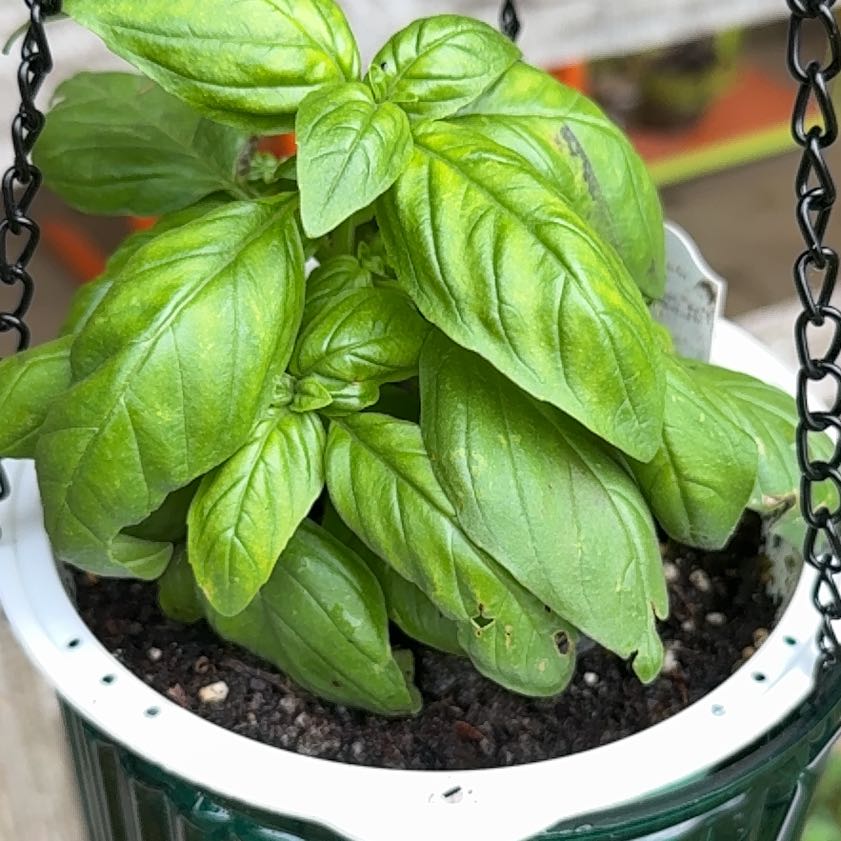
Sweet Basil

What's Eating Your Sweet Basil?

Ocimum basilicum
Reviewed by Kiersten Rankel M.S.
Quick Answer

For sweet basil, the most likely culprits are Japanese beetles (skeletonized leaves with only veins left, mid-summer outdoors) and aphids (clustered tightly on tender new growth and flower spikes). Spider mites attack stressed container basil in hot dry weather. Slugs chew young plants overnight, and thrips leave silvery streaks on the oily leaves.

Stay on top of plant care
Get seasonal reminders for watering and fertilizing, personalized for your plants.
Try Greg Free

What does the damage look like?

Tap the closest match to jump straight to the fix.

Pests, ranked by impact

Metallic green and copper Japanese beetle (Popillia japonica) on a lantana flower

Japanese beetles

Damage
High
Removal
Moderate
What it looks like

Half-inch metallic green and copper beetles, often in clumps of 5 to 20 on a single plant. Active on warm sunny mornings from late June through August across the eastern and midwestern US. They feed openly on top of leaves, not hidden underneath.

What the damage looks like

Skeletonized leaves where the soft tissue is chewed away and only the lacy network of veins is left. A patch of basil can go from full leaves to bare ribs in 2 to 3 days during peak emergence. Beetles attract more beetles through pheromones, so small infestations escalate fast.

How to get rid of them
Option 1

Hand-pick into soapy water at dawn

1

Fill a wide jar with soapy water (a few drops of dish soap per cup).

2

Walk the bed at dawn while beetles are still cold and sluggish. Hold the jar under a cluster and tap or knock the leaves. Beetles drop straight in and can't fly out.

3

Repeat every morning through the 4 to 6 week emergence window. Daily removal stops the pheromone signal that pulls in more beetles.

Option 2

Spinosad spray on opposite leaves at dusk

Spray Spinosad (Captain Jack's Deadbug Brew or Monterey Garden Insect Spray, ~$12 to $15) on the tops and undersides of leaves at dusk. Spinosad is approved for edibles and breaks down in sunlight, so dusk timing matters. Reapply every 7 days through July and August. Wait 1 day before harvesting.

Option 3

Skip Japanese beetle pheromone traps

The bag traps sold at garden centers attract more beetles to your yard than they catch. They pull beetles in from a wider radius and concentrate damage on the basil and roses near the trap. Hand-picking and Spinosad are far more effective.

Spider mite infestation on a stem with fine silk webbing and pale speckled leaf damage

Spider mites

Damage
High
Removal
Moderate
What it looks like

Almost invisible without a hand lens. Yellow-green or red-orange specks on the underside of leaves and where opposite leaves meet the stem. Container basil and stressed indoor windowsill plants in hot dry air get hit fastest.

What the damage looks like

Tiny pale yellow dots across the upper leaf surface, then a dusty bronze cast as feeding spreads. Fine webbing strung between the leaf and stem in heavy infestations. Container basil can defoliate in under 2 weeks once mites take hold, ending the harvest for that plant.

How to get rid of them
Option 1

Shower the foliage every 3 days for 2 weeks

Take container basil to the sink or hose and spray cool water on the underside of every leaf for 30 seconds. Mites can't reattach quickly when knocked off, and the rinse boosts humidity around the plant. Basil tolerates the rinse well as long as the leaves dry within a few hours. Repeat every 3 days for 2 weeks.

Option 2

Insecticidal soap at dusk, every 5 days for 3 rounds

Spray ready-to-use insecticidal soap (Safer Brand or Bonide, ~$10) on the underside of every leaf at dusk. Soap kills only on contact, so coat thoroughly and let it dry on the plant. Repeat every 5 days for 3 rounds to cover the egg-to-adult cycle. Rinse leaves before harvesting.

Option 3

Move container basil out of dry heat

Pull pots off baking concrete patios and out of direct afternoon sun during heat waves. Move indoor windowsill basil away from radiators and forced-air vents. Mites breed fastest above 80F at low humidity, so removing the conditions ends the population boom faster than any spray.

Dense colony of aphids clustered on a plant stem

Aphids

Damage
Medium
Removal
Easy
What it looks like

Tiny pear-shaped insects 1 to 3 mm long, in green, black, or pale yellow. Cluster densely on the soft new growth at the top of the plant and along developing flower spikes. The aromatic oils in basil leaves don't deter them once a colony lands.

What the damage looks like

New top leaves curl, twist, and yellow as aphids drain sap. A sticky shiny film coats lower leaves below the cluster, and black sooty mold can grow on the residue. Heavy aphid loads weaken basil flavor as the plant shifts energy from oil production to repair.

How to get rid of them
Option 1

Strong water blast every 2 days for a week

Hold a hose nozzle or kitchen sprayer 12 inches from the affected new growth and spray at high pressure. Most aphids dislodge and don't make it back. Repeat every 2 days for a week. The fastest fix and works without chemicals, which matters on a leaf you're about to eat.

Option 2

Insecticidal soap on flower spikes and growing tips

Spray ready-to-use insecticidal soap (Safer Brand, ~$10) on the developing flower spikes and on the underside of the top 4 leaves of every stem. Soap is approved for edibles. Rinse leaves under cool water before eating. Repeat every 5 days until aphid clusters disappear.

Option 3

Pinch flower spikes to remove aphid hot spots

Aphids cluster densely on the developing flower spikes, which you should be pinching off anyway to keep leaf production going. Snap the spike off with the top whorl of leaves at the next node down. The colony goes in the trash with the bud, and the plant pushes new leaf growth instead of seed.

Large red-brown slug (Arion rufus) crawling on a rhubarb leaf

Slugs

Damage
Medium
Removal
Easy
What it looks like

Soft brown or gray slimy bodies, 1 to 3 inches long. Active at night and on cool damp mornings. Hide under mulch, pot rims, paving stones, and the lower foliage of the basil itself during the day. Most damaging to seedlings and the lowest leaves of established plants.

What the damage looks like

Ragged irregular holes chewed through lower leaves overnight. Silvery slime trails on leaves, soil, and the pot rim in the morning confirm slugs over a chewing insect. Young transplants can be eaten to the soil line in a single night, which is when slugs do the most lasting damage.

How to get rid of them
Option 1

Iron phosphate bait around the bed

Sprinkle iron phosphate slug bait (Sluggo or Monterey Sluggo, ~$15) on the soil surface within 12 inches of every basil plant. Approved for edible gardens and safe around pets and wildlife. Reapply after heavy rain. Slugs eat the bait, stop feeding within hours, and die within 3 days.

Option 2

Hand-pick at dusk with a flashlight

1

Wait an hour after sunset and walk the bed with a flashlight. Slugs come out to feed on cool damp evenings.

2

Pick them off the basil and surrounding soil. Drop into a jar of soapy water.

3

Repeat for 3 to 4 evenings in a row. The local population drops fast once the largest breeders are gone.

Option 3

Pull mulch back from the base of each plant

Slugs hide and breed in the moist layer under mulch during the day. Pull mulch and any decaying leaves back to a 3-inch ring of bare soil around each basil plant. The exposed soil dries faster between waterings and removes the daytime hideout.

Slender adult thrips (Frankliniella sp.) on a flower petal

Thrips

Damage
Medium
Removal
Moderate
What it looks like

Slender insects under 2 mm long, pale yellow to dark brown. Slip into tight spaces between developing leaves at the growing tip and under the calyx of flower spikes. Tap a flower spike over white paper to see them scatter, the easiest field check.

What the damage looks like

Silvery or pale streaks on the upper leaf surface where thrips have rasped open the leaf cells and fed on the sap. Tiny black specks of frass on the underside. Heavy feeding distorts new leaves into curled shapes and weakens the oil flavor that makes basil worth growing.

How to get rid of them
Option 1

Blue sticky traps just above the canopy

Hang blue sticky traps (Trappify or Stingmon, ~$10 for a pack) just above the basil canopy. Thrips are drawn to blue specifically, more than yellow. Traps catch adults and confirm the population over time. Move traps higher as the plants grow.

Option 2

Spinosad spray at dusk, every 7 days for 3 rounds

1

Mix Spinosad (Monterey Garden Insect Spray, ~$15) per the label rate.

2

Spray every leaf, the developing flower spikes, and the growing tips at dusk. Spinosad reaches thrips tucked into tight spaces and is approved for edibles.

3

Repeat every 7 days for 3 rounds. Wait 1 day between spraying and harvesting.

Option 3

Pinch flower spikes weekly

Thrips lay eggs in the calyx of developing flower spikes. Pinch every spike off at the top node weekly. The eggs go in the trash with the bud, and the plant pushes new leaf growth instead of seed, which is the harvest you want anyway.

Stay ahead of all of them

Four habits that keep basil pests rare and the harvest going through summer.
1

Pinch flower spikes weekly

Aphids and thrips both cluster on developing flower spikes, and once basil flowers the leaves turn bitter and oil drops. A weekly pinch at the top node removes pest egg-laying sites and pushes the plant back into leaf production for another 2 to 3 weeks of harvest.

2

Water at the base, never overhead

Wet leaves invite slugs to climb at night and create the damp surface that downy mildew spreads on. Water the soil directly with a slow stream early in the morning so any splash on the foliage dries within an hour.

3

Plant tomatoes within 2 feet of every basil

Basil and tomato is a classic companion pairing. Basil's volatile oils deter some thrips and whiteflies on tomato, and the dense tomato foliage shades basil from afternoon heat that triggers spider mite booms. Both plants taste better and crop longer for it.

4

Underleaf and growing-tip check, every Sunday

Aphids cluster on the soft new growth at the top of every stem. Spider mites hide on the underside of older leaves. Thrips slip into the developing flower spikes. A 30-second weekly scan from the soil up catches all three while colonies are still local to one stem.

Stay on top of plant care
Get seasonal reminders for watering and fertilizing, personalized for your plants.
Try Greg Free

About This Article

Kiersten Rankel M.S.
Botanical Data Lead at Greg · Plant Scientist
About the Author
Kiersten Rankel holds an M.S. in Ecology & Evolutionary Biology from Tulane University. A certified Louisiana Master Naturalist, she has over a decade of experience in science communication, with research spanning corals, cypress trees, marsh grasses, and more. At Greg, she curates species data and verifies care recommendations against botanical research.
See Kiersten Rankel's full background on LinkedIn.
Editorial Process
Pest identification and treatment guidance verified against Ocimum basilicum field reports from Greg's botanical database, cross-referenced with university extension sources and published horticultural research.