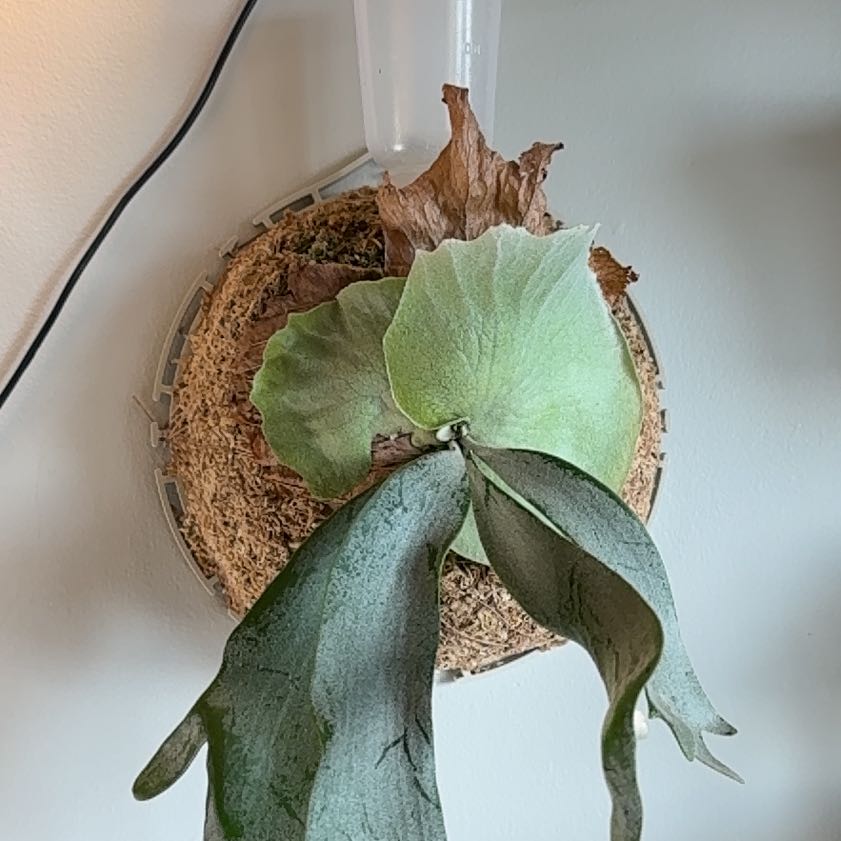
Staghorn Fern

What's Eating Your Staghorn Fern?

Platycerium alcicorne
Reviewed by Kiersten Rankel M.S.
Quick Answer

For staghorn fern, the most likely culprits are scale insects, the signature pest of the Platycerium genus. They cluster along the antler-shaped fertile fronds and tuck under the dried brown basal shield fronds where they're protected from spray. Mealybugs hide in that same shield fold and are just as hard to clear. Spider mites show up in dry winter heat.

Stay on top of plant care
Get seasonal reminders for watering and fertilizing, personalized for your plants.
Try Greg Free

What does the damage look like?

Tap the closest match to jump straight to the fix.

Pests, ranked by impact

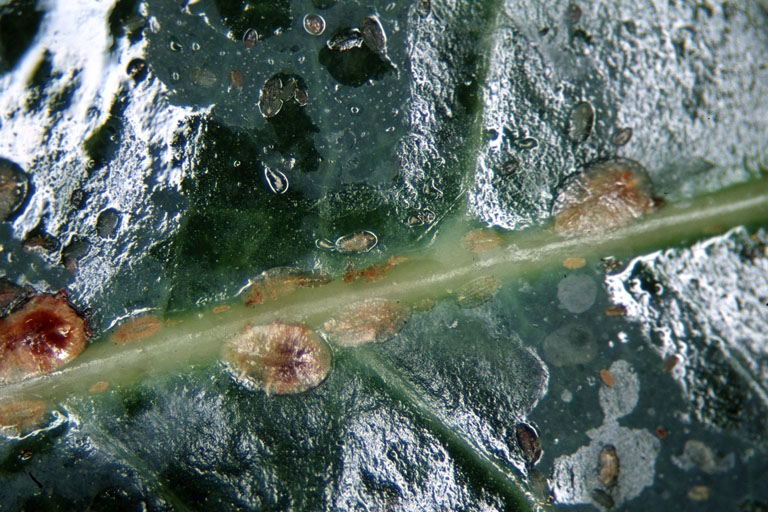
Brown soft scale (Coccus hesperidum) clustered on a plant stem

Scale insects

Damage
High
Removal
Hard
What it looks like

Hard or soft brown bumps stuck along the antler-shaped fertile fronds, 1 to 3 mm wide, looking like tiny barnacles glued in place. Heaviest pressure tucks under the dried brown basal shield fronds where the fern presses against the mounting board. Don't move because they're cemented down.

What the damage looks like

Yellowing patches on the antler fronds around each cluster. A sticky shiny film on the fronds and the mounting board below, sometimes with sooty black mold. Heavy infestations stunt new fertile-frond growth and leave the basal shield discolored where colonies hide protected.

How to get rid of them
Option 1

Lift the basal shield, scrape, and dab with alcohol

1

Gently lift the loose edges of the dried brown shield frond away from the mounting board with a fingernail or popsicle stick. The living growing edge stays attached, only the dried portion lifts.

2

Scrape every visible bump off the antler fronds and the exposed shield underside.

3

Dab any remaining bumps with a cotton swab dipped in 50% isopropyl alcohol, diluted from 70% with equal parts water. The fuzzy indument on the green fertile fronds is sensitive to full-strength alcohol.

4

Repeat weekly for 3 weeks to catch newly hatched crawlers in the protected shield pockets.

Option 2

Horticultural oil spray, weekly for 3 weeks

Spray horticultural oil (Bonide All Seasons, ~$15) on every antler frond and along the exposed shield edges. Smother both crawlers and adults. Test on one small frond tip first because the silvery indument on staghorn can spot. Apply at lights-out, every 7 days for 3 weeks.

Option 3

Take the mount down to soak-spray the back

Lift the whole mounted fern off the wall and lay it face up. Spray treatment thoroughly under every lifted shield edge and along the wire or fishing line that holds the root mass to the board. Scale crawlers travel back here where most owners never look. Reattach after the fronds dry.

Cluster of long-tailed mealybugs (Pseudococcus longispinus) showing the white cottony wax on a leaf

Mealybugs

Damage
High
Removal
Hard
What it looks like

Soft white insects covered in cottony fluff, 2 to 4 mm long. Cluster in the protected pocket between the dried brown basal shield and the mounting board, and at the base of the antler fronds where they emerge. Slow-moving and almost always missed because the shield fold hides them completely.

What the damage looks like

White cottony tufts visible at the edges of the basal shield where it meets the mounting board. A sticky shiny film on the antler fronds below the shield. New fertile fronds emerge stunted or distorted. The dried shield often looks discolored or damp around active colonies.

How to get rid of them
Option 1

Cotton swab and 50% diluted alcohol, weekly for 3 weeks

1

Dilute 70% isopropyl alcohol with equal parts water to make 50%. Full-strength alcohol can damage the silvery indument on the green antler fronds.

2

Lift the loose edges of the dried brown shield frond and dab every visible mealybug underneath. Pull aside gently. The living growing edge stays attached.

3

Treat the leaf-frond junctions where antler fronds emerge from the central root mass.

4

Repeat every 5 days for 3 weeks because eggs hatch in the protected shield pockets over time and need ongoing pressure.

Option 2

Insecticidal soap soak under the shield

Take the mount down. Spray ready-to-use insecticidal soap thoroughly into every exposed gap between the basal shield and the mounting board. Let it sit 10 minutes, then rinse the antler fronds with cool water. The soak reaches colonies the cotton swab missed. Repeat weekly for 4 weeks.

Option 3

Isolate the mount from your collection

Move the staghorn at least 6 feet from other mounted ferns and houseplants. Mealybugs spread by crawling and jumping between touching foliage. Wipe nearby walls, the picture rail, and any tools that touched the mount.

Common myth

Stronger alcohol kills mealybugs faster.

Full-strength 70% or 95% alcohol damages the silvery fuzzy indument that gives staghorn antler fronds their silvery sheen, leaving permanent dark patches. Dilute to 50% with equal parts water for this fern.

Spider mite infestation on a stem with fine silk webbing and pale speckled leaf damage

Spider mites

Damage
Medium
Removal
Moderate
What it looks like

Almost invisible without a hand lens. Yellow-green to red-orange specks running along the underside of the antler fronds, especially near the forking points. Indoor heated air through winter dries the fern and triggers a population boom. Less common than scale but real.

What the damage looks like

Pale tiny pale dots on the antler fronds, often along the forks where colonies start. Fine webbing strung between the forking tips of the fertile fronds. Heavy infestations bronze the antler fronds and slow new frond production from the central crown.

How to get rid of them
Option 1

Take the mount down and rinse weekly for 3 weeks

Lift the mount off the wall and rinse cool water over both sides of every antler frond for 30 seconds in the shower or sink. Mites can't reattach quickly when knocked off. Let drain fully before rehanging because trapped water behind the basal shield invites root rot. Repeat weekly for 3 weeks.

Option 2

Neem oil at lights-out, every 5 days for 3 rounds

1

Mix 2 tablespoons cold-pressed neem oil and 1 teaspoon dish soap per gallon of water.

2

Spray top and bottom of every antler frond at lights-out. Test one frond tip first because the silvery indument can spot.

3

Repeat every 5 days for 3 rounds. That covers the full egg-to-adult cycle.

Option 3

Raise humidity above 50%

Run a humidifier near the mount for 50 to 60% relative humidity. Staghorn is a tropical epiphyte and wants the moisture anyway. Hot dry indoor heating is the climate mites need to breed fast.

Stay ahead of all of them

Four habits that keep staghorn fern pests rare and easy to catch.
1

Shield-edge and antler check, every Sunday

Scale and mealybugs both shelter in the pocket where the dried brown shield meets the mounting board. A weekly 30-second look along the shield edges and the underside of the antler fronds catches colonies before they spread under the protected shield.

2

Quarantine new mounted plants for 2 weeks

Scale and mealybugs travel home from the nursery already tucked into the shield fold of a new mount. Two weeks of isolation in a separate room catches anything before it reaches your other ferns.

3

Soak-water the mount instead of misting

Dunk the whole mount in a tub of room-temperature water for 10 to 15 minutes every 1 to 2 weeks, then drain fully. The full soak hydrates the root mass and rinses early scale crawlers off the fronds. Misting alone wets foliage without dislodging pests.

4

Run a humidifier in winter

Indoor heated air drops humidity below 30% and triggers spider mite booms on staghorn. A small humidifier holding 50 to 60% relative humidity keeps the antler fronds healthy and the mites at bay.

Stay on top of plant care
Get seasonal reminders for watering and fertilizing, personalized for your plants.
Try Greg Free

About This Article

Kiersten Rankel M.S.
Botanical Data Lead at Greg · Plant Scientist
About the Author
Kiersten Rankel holds an M.S. in Ecology & Evolutionary Biology from Tulane University. A certified Louisiana Master Naturalist, she has over a decade of experience in science communication, with research spanning corals, cypress trees, marsh grasses, and more. At Greg, she curates species data and verifies care recommendations against botanical research.
See Kiersten Rankel's full background on LinkedIn.
Editorial Process
Pest identification and treatment guidance verified against Platycerium alcicorne field reports from Greg's botanical database, cross-referenced with university extension sources and published horticultural research.