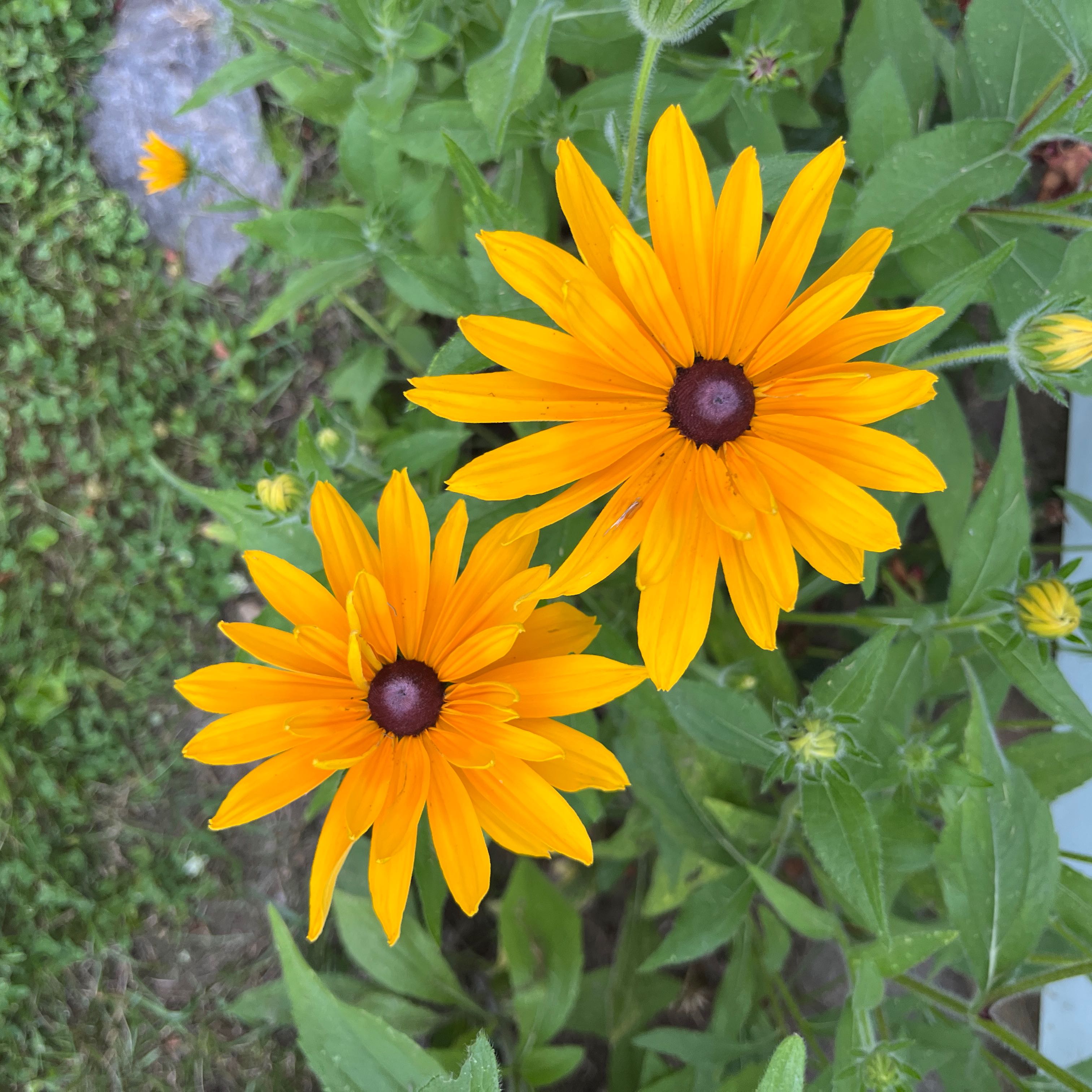


Japanese beetles
Half-inch metallic green beetles with copper-bronze wing covers and small white tufts along each side. Cluster in groups on the golden ray florets and on the upper leaves of the flower stalks. Most active on warm sunny mornings from late June through August.
Leaves skeletonized to a lace pattern with only the veins left intact. Ragged half-eaten ray florets around the dark central cone, sometimes whole flower heads chewed back to the disc. Damage stacks fast because beetles feed in groups and ruin the bloom display in days.
Hand-pick into soapy water at dawn
Walk the planting at sunrise when beetles are slow and still clumped on flower heads.
Hold a wide jar of soapy water under each cluster and tap or flick the beetles in. They drop straight down and can't fly out.
Repeat every morning for 2 to 3 weeks through peak emergence. Daily picking through the worst stretch keeps the population from building.
Neem oil spray at dusk through peak emergence
Mix 2 tablespoons cold-pressed neem oil and 1 teaspoon dish soap per gallon of water. Spray the upper and lower leaf surfaces and the open ray florets at dusk so it dries on the plant overnight. Repeat every 5 to 7 days from late June through early August. Avoid spraying open flowers in midday because that's when bees and other native pollinators are working the cones.
Skip pheromone bag traps
Yellow-and-green pheromone traps (Spectracide Bag-A-Bug, ~$10) draw beetles from a wide radius and only catch a fraction. The rest land on whatever's blooming nearby, which means more beetles on your Black-eyed Susans, not fewer. If you want a trap, place it across the yard from the planting, not next to it.
Bag traps protect your flowers.
Pheromone traps pull in beetles from neighboring yards and only catch a small share. The rest land on the closest bloom, which is your Black-eyed Susan. Skip the trap and hand-pick instead, or place any trap as far as possible from the planting.


