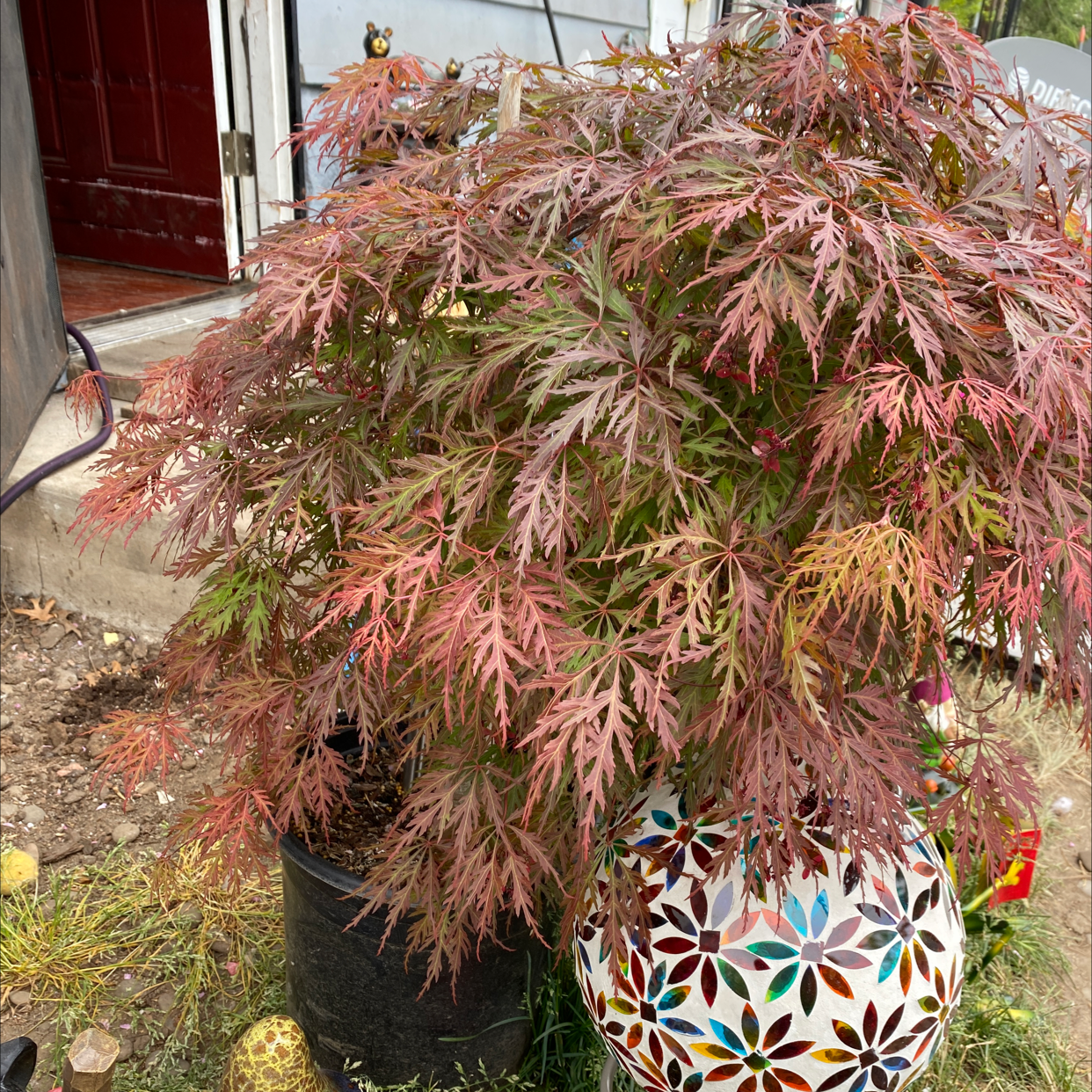
Japanese Maple

What's Eating Your Japanese Maple?

Acer palmatum
Reviewed by Kiersten Rankel M.S.
Quick Answer

For Japanese maple, the most likely culprits are cottony maple scale (large white egg masses on branches in late spring) and spider mites (pale specks and bronzing on stressed trees in hot dry summers). Aphids cluster on the spring flush and leave a sticky honeydew film. Japanese beetles skeletonize the delicate palmate leaves through June and July.

Stay on top of plant care
Get seasonal reminders for watering and fertilizing, personalized for your plants.
Try Greg Free

What does the damage look like?

Tap the closest match to jump straight to the fix.

Pests, ranked by impact

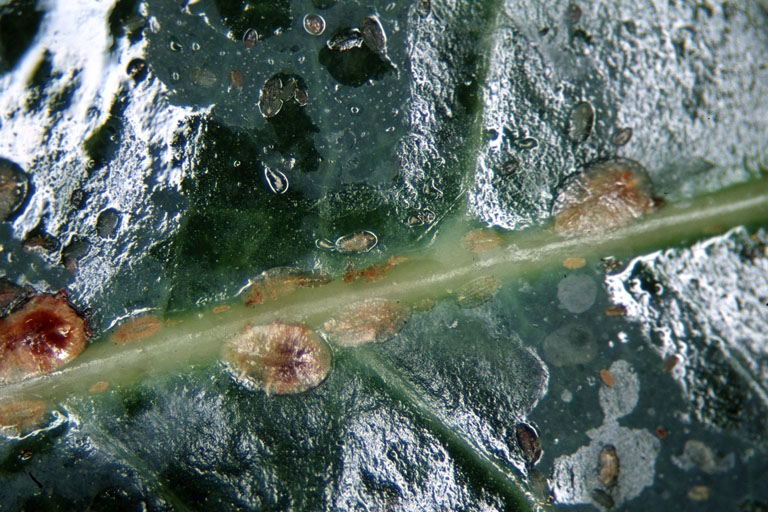
Brown soft scale (Coccus hesperidum) clustered on a plant stem

Scale insects

Damage
High
Removal
Hard
What it looks like

Cottony maple scale is the iconic scale of Acer. Mature females are flat brown discs 3 to 5 mm wide, but the giveaway is the large white cottony egg sac trailing behind each female on twigs and small branches in late spring. Looks like popcorn or wads of cotton wool stuck to the bark.

What the damage looks like

Branches lined with cottony white egg masses, often along the underside of twigs. A glossy sticky film coats leaves below, with black sooty mold growing on the residue. Heavy infestations cause yellowing leaves, premature fall color, and branch dieback over a season.

How to get rid of them
Option 1

Dormant horticultural oil in late winter

Spray the entire tree with horticultural oil (Bonide All Seasons, ~$15) in late February or early March before bud break. The oil smothers overwintering scale on the bark. Coverage is the whole game. Hit every twig, the undersides of branches, and the trunk crotches. One thorough dormant spray prevents most of the season's pressure.

Option 2

Summer oil at the crawler stage, every 10 days for 3 rounds

1

Watch the cottony egg masses in late May and early June. Crawlers (the mobile young stage) emerge as eggs hatch.

2

Spray a lighter summer-rate horticultural oil on every branch and the underside of leaves at dusk to avoid leaf burn on hot days.

3

Repeat every 10 days for 3 rounds to catch later-hatching crawlers. The waxy adult coating resists sprays, so the crawler window is when to act.

Option 3

Prune out heavily infested branches

When a branch is lined with egg masses end to end, cut it out below the lowest cluster and bag the prunings. This removes thousands of eggs in one cut and restores the tree's graceful branching habit. Sterilize pruners with isopropyl alcohol between cuts. Best done in late winter while the tree is dormant.

Spider mite infestation on a stem with fine silk webbing and pale speckled leaf damage

Spider mites

Damage
High
Removal
Moderate
What it looks like

Almost invisible without a hand lens. Yellow-green to red specks running along the underside of leaves and where the deep cuts of palmate leaves narrow toward the petiole. A drought-stressed Japanese maple in hot dry summer weather is exactly the climate spider mites need to breed fast.

What the damage looks like

Tiny pale dots across the upper leaf surface, fading to dull bronze patches that ruin the tree's red or burgundy display. Fine webbing strung between leaf lobes in heavy infestations. A stressed tree can drop most of its leaves in 2 to 3 weeks, ruining the foliage the user grows it for.

How to get rid of them
Option 1

Deep water the root zone first

Drought stress is the trigger. Soak the root zone slowly with a hose at low flow for 30 to 60 minutes, out to the drip line. Mulch 2 to 3 inches deep with shredded bark, keeping mulch off the trunk. A well-watered Japanese maple resists mites on its own. This step alone clears most light infestations.

Option 2

Strong water blast on the leaf undersides, every 3 days for 2 weeks

Hold a hose nozzle 12 inches from the foliage and spray the underside of leaves at high pressure. Mites can't reattach quickly when knocked off. Repeat every 3 days for 2 weeks. Works on container trees and small landscape trees within hose reach. Pair with the deep water above.

Option 3

Skip broad-spectrum sprays

Pyrethroids and other broad-spectrum insecticides kill the predatory mites that already keep pest mites in check. Spider mite outbreaks on Japanese maple frequently follow a routine pesticide application. Stick with water and patience. The tree's own ecosystem suppresses mites once moisture and predator populations recover.

Metallic green and copper Japanese beetle (Popillia japonica) on a lantana flower

Japanese beetles

Damage
High
Removal
Moderate
What it looks like

Iridescent metallic green and copper beetles, 1 cm long, with white tufts of hair along each side. Feed in groups on the upper canopy in full sun through June and July, mostly mid-morning to early afternoon. The delicate palmate leaves of Japanese maple are a favorite during peak emergence.

What the damage looks like

Lacy skeletonized leaves with the green tissue chewed away between the veins, leaving the fine network of veins behind. Damage shows up first on the sunny side of the canopy and on the deeply cut lobes of dissectum cultivars. Heavy feeding can defoliate small trees in a week.

How to get rid of them
Option 1

Hand-pick at dawn into soapy water

1

Walk the tree at dawn while beetles are sluggish from the cool air.

2

Hold a wide-mouth jar of soapy water under each cluster and tap the branch. Beetles drop straight in.

3

Repeat every morning through the 4 to 6 week emergence window (typically late June through July). Daily removal keeps the tree from broadcasting feeding pheromones that draw more beetles.

Option 2

Floating row cover on small specimen trees

For young or small specimen Japanese maples, drape lightweight floating row cover (Agribon AG-19, ~$20) over the canopy through the 4 to 6 week beetle window. Tie loosely at the trunk. The cover blocks beetles without overheating the tree. Remove once peak emergence ends in late July.

Option 3

Skip pheromone traps near the tree

Japanese beetle traps draw far more beetles than they catch. Hanging one near a Japanese maple guarantees worse damage. If a neighbor uses traps, ask them to place traps at the far property line, away from your tree.

Common myth

Hang Japanese beetle traps near the tree to protect it.

Pheromone traps lure beetles from a wide area and most fly past the trap to feed on nearby plants. Studies from university extensions show trees within 30 feet of a trap suffer more damage, not less. On a Japanese maple where the foliage display is the whole point, a trap near the tree wrecks the season.

Dense colony of aphids clustered on a plant stem

Aphids

Damage
Medium
Removal
Easy
What it looks like

Tiny pear-shaped insects 1 to 3 mm long, in shades of green, black, or pink. Cluster densely on the soft new growth flush in early spring, on the underside of young leaves, and on tender shoot tips. Spring is peak aphid season for Japanese maple.

What the damage looks like

A glossy sticky film on leaves and on whatever sits below the tree, like patio furniture or the deck. Black sooty mold grows on the honeydew, dulling the red or burgundy leaf color the tree is grown for. New growth twists, curls, and yellows. Established trees tolerate the feeding well.

How to get rid of them
Option 1

Strong water blast every 2 to 3 days for 2 weeks

Hold a hose nozzle 12 inches from the affected new growth and spray at high pressure. Most aphids dislodge and don't make it back. Repeat every 2 to 3 days for 2 weeks. The fastest, cheapest fix and works without chemicals. Best done in the morning so leaves dry before evening.

Option 2

Insecticidal soap on the new growth flush

Spray ready-to-use insecticidal soap (Safer Brand, ~$10) on the underside of leaves and tender new shoots at dusk. Coats and suffocates aphids on contact. Reapply after rain or every 5 days for 2 to 3 rounds. Avoid spraying open flowers and skip the hottest part of the day to prevent leaf burn.

Option 3

Wash off the honeydew once the aphids are cleared

After the population crashes, hose down the leaves and any patio furniture or hardscape below the tree. Sooty mold doesn't damage the tree but dulls the red and burgundy foliage that's the whole point. Clean leaves photosynthesize better and the fall display comes back vibrant.

Stay ahead of all of them

Four habits that protect Japanese maple's foliage display through the year.
1

Deep water through summer drought

Drought stress is the single biggest trigger for spider mite outbreaks on Japanese maple. Soak the root zone slowly out to the drip line every 7 to 10 days through hot dry stretches. A well-watered tree resists mites on its own and holds its leaf color through fall.

2

Mulch 2 to 3 inches deep, off the trunk

A wide ring of shredded bark mulch holds soil moisture, moderates root temperature, and reduces drought stress that brings on mites. Keep mulch a few inches off the trunk to avoid bark rot. Refresh in spring as the old layer breaks down.

3

Late-winter dormant oil spray

One thorough horticultural oil application in late February or early March smothers overwintering scale and aphid eggs on the bark. Hit every twig, the underside of branches, and the trunk crotches. This single annual spray prevents most of the cottony maple scale pressure for the coming year.

4

Skip broad-spectrum sprays year round

Pyrethroids and other broad-spectrum insecticides kill the predatory mites and parasitic wasps that quietly keep aphid, scale, and spider mite populations down. Outbreaks frequently follow a routine pesticide application. Spot-treat with water blasts, soap, or oil. Save the heavy chemistry for genuine emergencies that the tree's own ecosystem can't handle.

Stay on top of plant care
Get seasonal reminders for watering and fertilizing, personalized for your plants.
Try Greg Free

About This Article

Kiersten Rankel M.S.
Botanical Data Lead at Greg · Plant Scientist
About the Author
Kiersten Rankel holds an M.S. in Ecology & Evolutionary Biology from Tulane University. A certified Louisiana Master Naturalist, she has over a decade of experience in science communication, with research spanning corals, cypress trees, marsh grasses, and more. At Greg, she curates species data and verifies care recommendations against botanical research.
See Kiersten Rankel's full background on LinkedIn.
Editorial Process
Pest identification and treatment guidance verified against Acer palmatum field reports from Greg's botanical database, cross-referenced with university extension sources and published horticultural research.