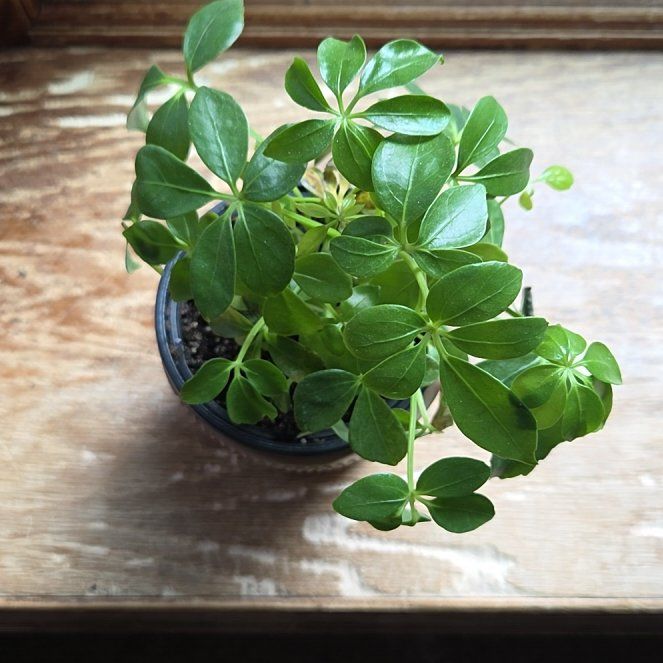
Dwarf Umbrella Tree

What's Eating Your Dwarf Umbrella Tree?

Heptapleurum arboricola
Reviewed by Kiersten Rankel M.S.
Quick Answer

For dwarf umbrella tree, the most likely culprits are spider mites (winter dry-heat triggers them on the leaflet undersides) and scale insects clinging along petioles. Mealybugs cluster at the umbrella spoke center where leaflets meet the petiole. Aphids appear on tender new growth flushes.

Stay on top of plant care
Get seasonal reminders for watering and fertilizing, personalized for your plants.
Try Greg Free

What does the damage look like?

Tap the closest match to jump straight to the fix.

Pests, ranked by impact

Spider mite infestation on a stem with fine silk webbing and pale speckled leaf damage

Spider mites

Damage
High
Removal
Moderate
What it looks like

Almost invisible without a hand lens. Yellow-green to red-orange specks running along the underside of each leaflet. The 7 to 9 leaflets radiating from each umbrella spoke create dozens of hiding surfaces, and indoor heated air through winter triggers a population boom.

What the damage looks like

Pale tiny pale dots across the upper leaflet faces and fine webbing strung between leaflets at the umbrella center. Heavy infestations bronze the foliage and cause leaflets to drop one by one, defoliating the umbrella shape that gives the plant its appeal.

How to get rid of them
Option 1

Shower the canopy weekly for 3 weeks

Move the plant to the shower. Spray cool water on the underside of every leaflet for 60 seconds, working through the dense umbrella canopy and tilting branches so water reaches the spoke centers. Mites can't reattach quickly when knocked off. Repeat weekly for 3 weeks.

Option 2

Neem oil at lights-out, every 5 days for 3 rounds

1

Mix 2 tablespoons cold-pressed neem oil and 1 teaspoon dish soap per gallon of water.

2

Spray top and bottom of every leaflet at lights-out, lifting branches to coat the leaflet undersides where mites cluster.

3

Repeat every 5 days for 3 rounds. That covers the full egg-to-adult cycle.

Option 3

Raise humidity above 50%

Run a humidifier near the plant for 50 to 60% relative humidity through winter. Dwarf umbrella tree comes from humid Southeast Asian forests and prefers the moisture anyway. Hot dry indoor heating is the climate mites need to breed fast on the dense leaflet canopy.

Cluster of long-tailed mealybugs (Pseudococcus longispinus) showing the white cottony wax on a leaf

Mealybugs

Damage
High
Removal
Hard
What it looks like

Soft white insects covered in cottony fluff, 2 to 4 mm long. Cluster at the umbrella's center where each leaflet meets the central petiole, and along the woody trunk where new branches emerge. The spoke junctions are the iconic mealybug hiding spot on this plant and the colonies sit deep enough to be missed at a glance.

What the damage looks like

White cottony tufts visible at the leaflet-petiole junctions and along the central trunk. A sticky shiny film coats leaflets below the cluster. New leaves emerge stunted, and umbrella spokes near heavy colonies wither and drop off the trunk.

How to get rid of them
Option 1

Cotton swab dipped in 70% isopropyl alcohol

Dab every visible mealybug. The alcohol melts the waxy coating and kills on contact. Pull each umbrella spoke gently aside to reach colonies hiding at the leaflet-petiole junctions. Repeat every 3 days for 3 weeks to catch newly hatched eggs in those protected spoke centers.

Option 2

Insecticidal soap + neem oil rotation, 4 weeks

Spray ready-to-use insecticidal soap on the underside of every leaflet and into the spoke centers at lights-out. Alternate weekly with neem oil. Continue 4 weeks because eggs hatch in protected umbrella junctions over time and need ongoing pressure.

Option 3

Isolate the plant from your collection

Move the umbrella tree at least 6 feet from other houseplants. Mealybugs spread by crawling along touching leaves. Wipe nearby pots, the windowsill, and any tools that touched the infested plant.

Common myth

Stronger alcohol kills mealybugs faster.

95%+ alcohol evaporates faster than it can kill the bug, and on the umbrella tree's glossy leaflets the higher concentrations leave dry brown patches that don't grow back. Stick with 70%.

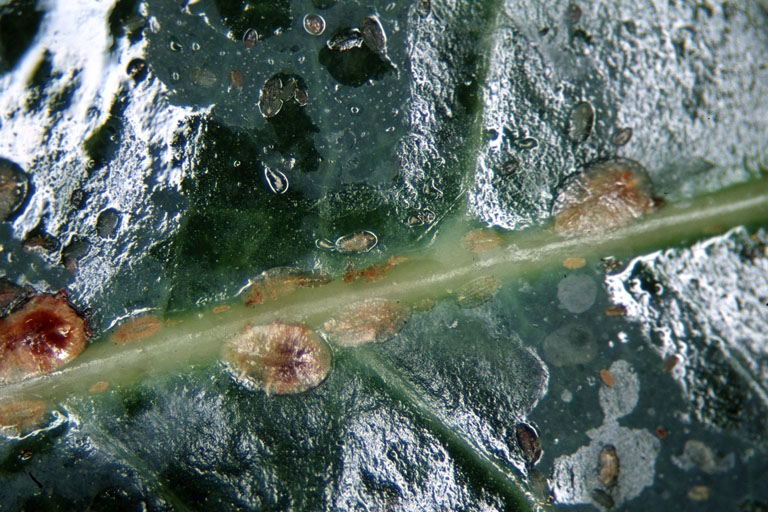
Brown soft scale (Coccus hesperidum) clustered on a plant stem

Scale insects

Damage
High
Removal
Hard
What it looks like

Hard or soft brown bumps stuck to the long petioles and the underside of leaflets, 1 to 3 mm wide. Look like tiny barnacles. Don't move because they're glued in place. Heptapleurum and the older Schefflera name are both well-known scale magnets in the houseplant world, so any brown bump on this plant deserves a closer look.

What the damage looks like

Yellowed patches around each cluster on the leaflets. A sticky shiny film on lower foliage and the pot rim, sometimes with sooty black mold. Heavy infestations cause whole umbrella spokes to yellow and drop, leaving bare sections of the central trunk.

How to get rid of them
Option 1

Scrape and dab with alcohol, weekly for 3 weeks

1

Scrape every visible bump off the petioles and leaflet undersides with a fingernail or soft toothbrush.

2

Dab any remaining bumps with a cotton swab dipped in 70% isopropyl alcohol to penetrate the waxy seal.

3

Repeat weekly for 3 weeks to catch newly hatched crawlers moving along the petioles.

Option 2

Horticultural oil spray, weekly for 3 weeks

Spray horticultural oil (Bonide All Seasons, ~$15) along every petiole and across all leaflet surfaces. Smothers crawlers and adults. Apply at lights-out, every 7 days for 3 weeks. Pay attention to the long petioles where crawlers travel between umbrella spokes.

Option 3

Systemic granules for stubborn cases

Bonide Systemic Houseplant Insect Control (~$12) is imidacloprid granules sprinkled on the soil and watered in. The plant takes it up through the roots, killing scale that feed on sap. Use when scrape-and-spray cycles haven't cleared the infestation after 4 weeks. Keep away from pets.

Dense colony of aphids clustered on a plant stem

Aphids

Damage
Medium
Removal
Easy
What it looks like

Soft pear-shaped insects 1 to 3 mm long, usually pale green but sometimes black or pink. Cluster on the tender new umbrella spokes as they unfurl from the trunk tips, and on the youngest leaflets before they harden off. Move slowly and pop easily between fingers.

What the damage looks like

New umbrella spokes emerge curled, twisted, or sticky to the touch. A shiny film of honeydew coats leaflets below the colony, sometimes with sooty black mold. Mature leaflets are usually untouched. Damage stays on the new growth flush.

How to get rid of them
Option 1

Rinse the new growth at the sink

Move the plant to the sink and spray cool water at the new umbrella spokes for 30 seconds. Aphids can't reattach. Repeat every 3 days until you stop seeing fresh colonies on emerging foliage. Easiest fix and usually all you need.

Option 2

Insecticidal soap on tender growth

Spray ready-to-use insecticidal soap (Safer Brand, ~$10) on every new umbrella spoke at lights-out. Coat the underside of the youngest leaflets where aphids cluster. Repeat every 4 days for two weeks. Avoid older waxy leaflets to prevent residue spotting.

Stay ahead of all of them

Four habits that keep dwarf umbrella tree pests rare and easy to catch.
1

Spoke-center check, every Sunday

Mealybugs and scale hide where each leaflet meets the central petiole at the umbrella spoke. A weekly 30-second scan of those junctions catches colonies while they're still small.

2

Quarantine new houseplants for 2 weeks

Scale and mealybugs travel home from the nursery on the plant you bought, and umbrella trees are a known scale magnet. Two weeks of isolation catches anything before it spreads to your collection.

3

Wipe leaflets with a damp cloth monthly

The dense umbrella canopy collects dust that hides early infestations. A monthly wipe across both sides of every leaflet catches dust, early spider mites, and scale crawlers before they multiply.

4

Run a humidifier through winter

Dry indoor heat from November to March is the single biggest spider mite trigger on this plant. Hold humidity at 50% or higher near the umbrella tree and the dense leaflet canopy stays inhospitable to mite breeding.

Stay on top of plant care
Get seasonal reminders for watering and fertilizing, personalized for your plants.
Try Greg Free

About This Article

Kiersten Rankel M.S.
Botanical Data Lead at Greg · Plant Scientist
About the Author
Kiersten Rankel holds an M.S. in Ecology & Evolutionary Biology from Tulane University. A certified Louisiana Master Naturalist, she has over a decade of experience in science communication, with research spanning corals, cypress trees, marsh grasses, and more. At Greg, she curates species data and verifies care recommendations against botanical research.
See Kiersten Rankel's full background on LinkedIn.
Editorial Process
Pest identification and treatment guidance verified against Heptapleurum arboricola field reports from Greg's botanical database, cross-referenced with university extension sources and published horticultural research.