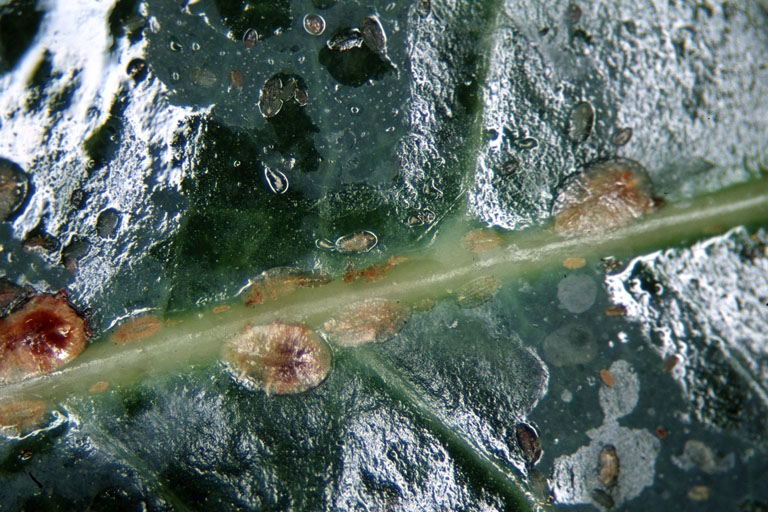
Spider mites
Almost invisible without a hand lens. Yellow-green to red-orange specks running along the underside of the broad oblong leaves, especially near the central vein. Winter heating dries dieffenbachia's large leaf surface fast and triggers a population boom.
Pale tiny pale dots along the central vein that quickly bronzes across the wide leaf surface. Fine webbing strung along the leaf-petiole junction. Because dieffenbachia leaves are large and flat, the bronzing shows up dramatically and spreads leaf to leaf in days.
Shower the leaves weekly for 3 weeks
Move the plant to the shower or sink. Spray cool water on the underside of every leaf for 30 seconds, including the leaf-petiole junctions. The smooth waxy leaves take a hard rinse well. Wear gloves because bruised leaves leak the toxic milky sap. Repeat weekly for 3 weeks.
Neem oil at lights-out, every 5 days for 3 rounds
Mix 2 tablespoons cold-pressed neem oil and 1 teaspoon dish soap per gallon of water.
Spray top and bottom of every leaf at lights-out, with extra coverage along the central vein and the leaf-petiole junction.
Repeat every 5 days for 3 rounds to cover the full egg-to-adult cycle.
Raise humidity above 50%
Run a humidifier near the plant for 50 to 60% relative humidity. Dieffenbachia is a tropical understory plant and wants the moisture anyway. Hot dry indoor heating is the climate mites need to breed fast.