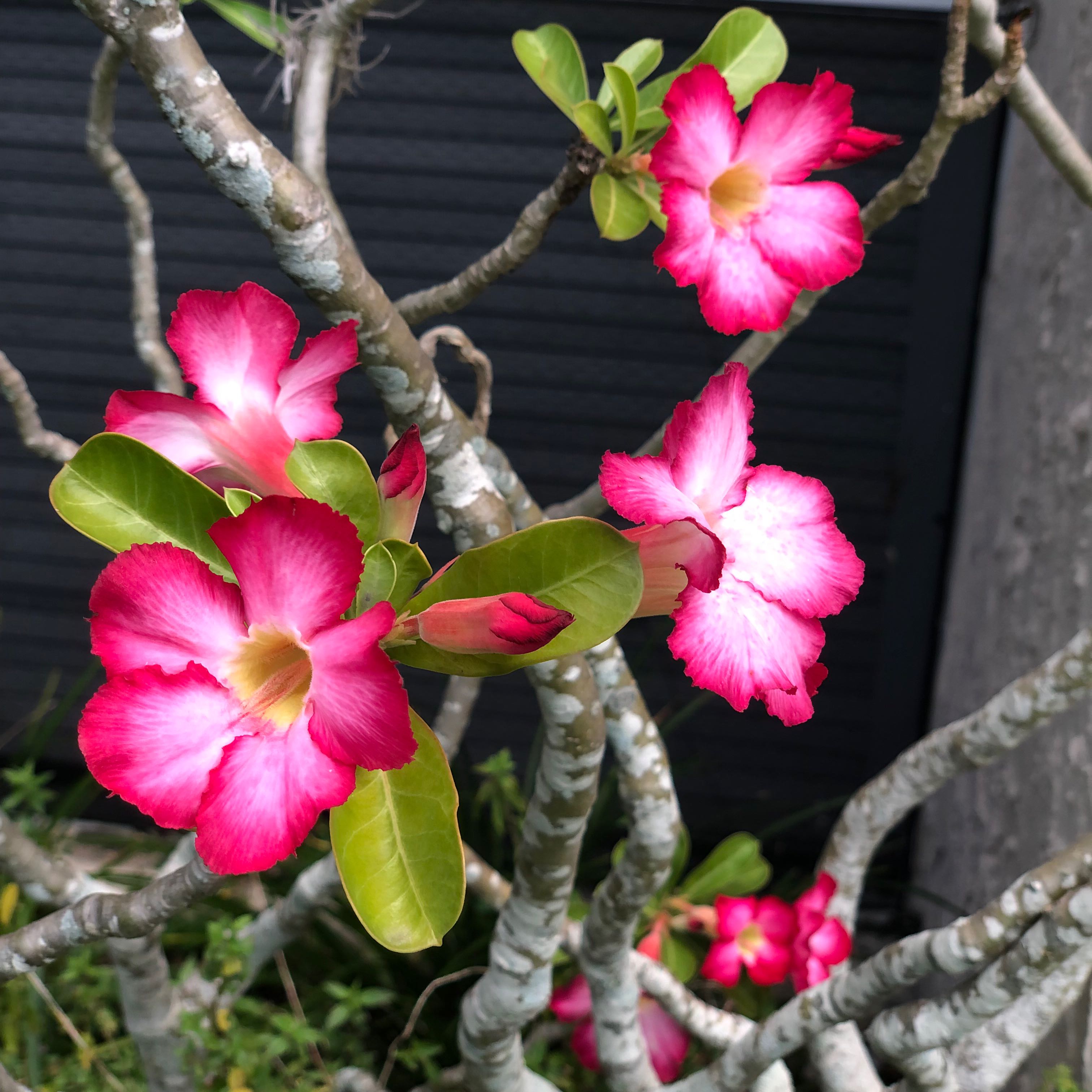
Desert Rose Plant

What's Eating Your Desert Rose?

Adenium obesum
Reviewed by Kiersten Rankel M.S.
Quick Answer

For desert rose, the most likely culprits are mealybugs (cottony tufts deep in the leaf axils where leaves meet the woody branches) and oleander aphids, the bright yellow-orange aphid that swarms members of the Apocynaceae family. Spider mites show up on the glossy leaves in dry winter heat. Scale clings to the gray bark of the caudex and branch tips.

Stay on top of plant care
Get seasonal reminders for watering and fertilizing, personalized for your plants.
Try Greg Free

What does the damage look like?

Tap the closest match to jump straight to the fix.

Pests, ranked by impact

Cluster of long-tailed mealybugs (Pseudococcus longispinus) showing the white cottony wax on a leaf

Mealybugs

Damage
High
Removal
Hard
What it looks like

Soft white insects coated in cottony fluff, 2 to 4 mm long. Wedge into the leaf axils where leaves emerge from the woody branches and along the seam where the swollen caudex meets the soil. Root mealybugs also colonize the surface roots tucked under the caudex.

What the damage looks like

White cottony tufts visible in leaf axils and at branch crotches. Sticky shiny film on lower leaves. New leaf flushes emerge stunted or pale. Heavy infestations stop bloom production and can kill the caudex from the root mealybug side if left alone for a season.

How to get rid of them
Option 1

Cotton swab dipped in 70% isopropyl alcohol

Dab every visible mealybug. The alcohol melts the waxy coating and kills on contact. Pull the leaf axils gently apart to reach colonies tucked against the woody branches. Repeat every 3 days for 3 weeks to catch newly hatched eggs. Desert rose's tough gray bark tolerates the alcohol with no marking.

Option 2

Insecticidal soap + neem oil rotation, 4 weeks

Spray ready-to-use insecticidal soap on the underside of leaves and into every leaf axil at lights-out. Alternate weekly with neem oil. Continue 4 weeks because eggs hatch in protected pockets along the branches over time and need ongoing pressure.

Option 3

Bare-root and check for root mealybugs if growth stalls

1

Slip the desert rose out of its pot and brush soil off the roots and caudex base.

2

Look for white cottony specks against the roots. These are root mealybugs and they kill the plant from below.

3

Rinse the roots with a stream of room-temperature water, then drench in a soap-water solution (1 teaspoon dish soap per quart) for 10 minutes.

4

Repot in fresh fast-draining cactus mix and hold off watering for 5 days while the wash dries.

Dense colony of aphids clustered on a plant stem

Aphids

Damage
Medium
Removal
Easy
What it looks like

Bright yellow-orange aphids with black legs and antennae, 2 to 3 mm long. Aphis nerii feeds almost exclusively on the Apocynaceae family, so finding them on a desert rose is a near-certain match. Cluster densely on new shoot tips, flower buds, and the underside of young leaves.

What the damage looks like

Curled distorted new leaves and twisted flower buds that drop before opening. A sticky shiny film coats the leaves and the gray bark below the cluster, sometimes with sooty black mold. The bright color of the colony is the giveaway. No other aphid on a desert rose looks like this.

How to get rid of them
Option 1

Blast with a strong stream of water at the sink

Carry the desert rose to the sink or shower and spray a forceful stream of room-temperature water on every shoot tip and bud cluster for 30 seconds. Oleander aphids are loosely attached and most can't crawl back. Repeat every 4 days for 2 weeks. Desert rose's succulent leaves and woody bark shrug off the rinse.

Option 2

Insecticidal soap on shoot tips, weekly for 3 weeks

Spray ready-to-use insecticidal soap (Safer Brand, ~$10) on every new shoot, bud, and underside of young leaves at lights-out. Aphids have soft bodies and the soap kills on contact. Repeat weekly for 3 weeks. Avoid spraying in direct sun on a sunny windowsill because soap plus sun can mark the glossy leaves.

Option 3

Pinch off the worst-infested shoot tips

If a single shoot tip is coated, snip it off with clean scissors and bag it for the trash. Desert rose branches readily and you'll lose a few buds, not the plant. This drops the breeding population fast and gives the spray treatments less work to do.

Spider mite infestation on a stem with fine silk webbing and pale speckled leaf damage

Spider mites

Damage
Medium
Removal
Moderate
What it looks like

Almost invisible without a hand lens. Yellow-green to red-orange specks running along the underside of the glossy oval leaves clustered at branch tips. Indoor heated air through winter dries the leaves and triggers a population boom on desert roses kept indoors as bonsai specimens.

What the damage looks like

Pale tiny pale dots across the upper leaf surface. Fine webbing strung between leaves at the branch tips. Heavy infestations bronze the leaves and force premature leaf drop, which weakens the next bloom flush. Heat-stressed plants near a winter window crash the fastest.

How to get rid of them
Option 1

Hard cool shower of the leafy canopy, weekly for 3 weeks

Take the desert rose to the shower and aim a forceful stream of cool water at the underside of every leaf for a full minute. The succulent leaves and tough bark handle a hard rinse with no damage, and mites can't reattach quickly when knocked off. Repeat weekly for 3 weeks. Let the caudex and soil drain fully before returning to its spot.

Option 2

Neem oil at lights-out, every 5 days for 3 rounds

1

Mix 2 tablespoons cold-pressed neem oil and 1 teaspoon dish soap per gallon of water.

2

Spray top and bottom of every leaf at lights-out, especially the leaves clustered at branch tips where mites breed.

3

Repeat every 5 days for 3 rounds. That covers the full egg-to-adult cycle.

Option 3

Move away from the winter heat vent

Hot dry air streaming off a forced-air vent is the climate spider mites breed in. Shift the desert rose at least 4 feet from any vent or radiator. The plant still wants bright light but the cooler humidity drops the mite reproduction rate sharply.

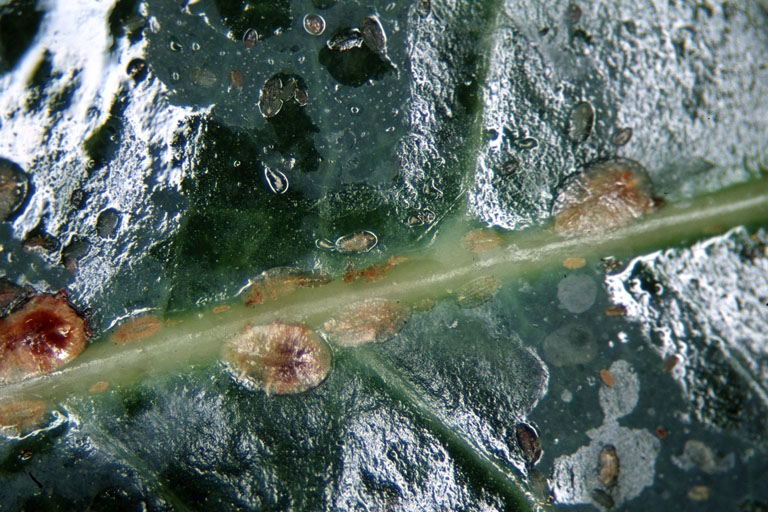
Brown soft scale (Coccus hesperidum) clustered on a plant stem

Scale insects

Damage
Medium
Removal
Moderate
What it looks like

Hard or soft brown bumps stuck along the smooth gray bark of the caudex and the slimmer branches above it, 1 to 3 mm wide. Look like tiny barnacles fused to the bark. Don't move because they're glued in place. Often hide in the small bark fissures along the upper branches.

What the damage looks like

Yellowed leaves on the branch directly above a cluster. A sticky shiny film on lower leaves and the pot rim, sometimes with sooty black mold. Heavy infestations cause premature leaf drop over months and weaken the caudex's stored reserves so the next bloom flush is thin.

How to get rid of them
Option 1

Scrape with a fingernail or soft toothbrush

Run a fingernail or soft toothbrush along the gray bark and branches to pop every visible bump off. Each one removed is one less egg-layer. The desert rose's tough bark handles firm scraping with no damage, and you can see exactly where the colonies are.

Option 2

Cotton swab + 70% alcohol, weekly for 3 weeks

After scraping, dab any remaining bumps with a cotton swab dipped in 70% isopropyl alcohol. The alcohol penetrates the waxy seal and kills the insect underneath. Pay close attention to the bark fissures along the upper branches. Repeat weekly for 3 weeks to catch newly hatched crawlers.

Option 3

Horticultural oil spray, weekly for 3 weeks

Spray horticultural oil (Bonide All Seasons, ~$15) on the bark, branches, and every leaf surface. Smothers crawlers and adults. Apply at lights-out, every 7 days for 3 weeks. Avoid spraying in direct sun because the oil plus sun can scorch the glossy leaves.

Stay ahead of all of them

Four habits that keep desert rose pests rare and easy to catch.
1

Leaf-axil and bark check, every Sunday

Mealybugs hide in the axils where leaves emerge from the woody branches and scale clings to the gray bark of the caudex. A weekly 30-second scan catches colonies while they're still small.

2

Quarantine new desert roses for 2 weeks

Mealybugs and oleander aphids travel home from the nursery on the plant you bought. Two weeks of isolation catches anything before it spreads to your other Apocynaceae plants like plumeria or hoya.

3

Wipe glossy leaves with a damp cloth monthly

Desert rose leaves are smooth and glossy and clean up easily. The wipe catches dust, early spider mites, and aphid honeydew before they multiply, and gives you a close look at every leaf axil.

4

Let the soil dry hard between waterings

The caudex stores water for weeks. Wet soil rots the root system from below, which is the number one killer of indoor desert roses, and damp conditions also feed root mealybugs and fungus gnats. Drier soil keeps both threats down.

Stay on top of plant care
Get seasonal reminders for watering and fertilizing, personalized for your plants.
Try Greg Free

About This Article

Kiersten Rankel M.S.
Botanical Data Lead at Greg · Plant Scientist
About the Author
Kiersten Rankel holds an M.S. in Ecology & Evolutionary Biology from Tulane University. A certified Louisiana Master Naturalist, she has over a decade of experience in science communication, with research spanning corals, cypress trees, marsh grasses, and more. At Greg, she curates species data and verifies care recommendations against botanical research.
See Kiersten Rankel's full background on LinkedIn.
Editorial Process
Pest identification and treatment guidance verified against Adenium obesum field reports from Greg's botanical database, cross-referenced with university extension sources and published horticultural research.