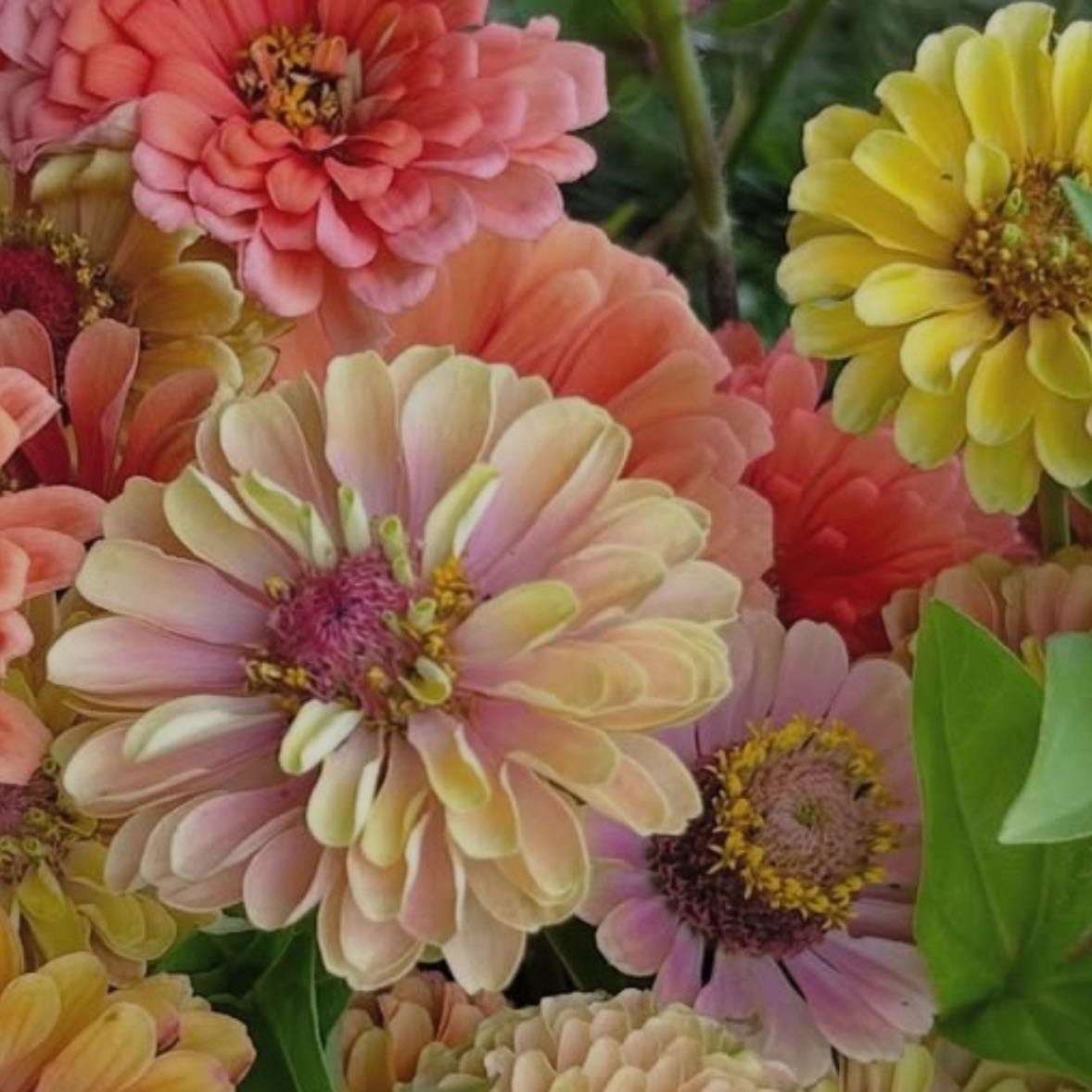
Common Zinnia

What's Eating Your Common Zinnia?

Zinnia elegans
Reviewed by Kiersten Rankel M.S.
Quick Answer

For zinnias, the most likely culprits are Japanese beetles (skeletonizing leaves and chewing ragged holes through ray florets in midsummer) and thrips (silvery scarred petals and distorted opening blooms). Spider mites explode on heat-stressed plants in dry summer weather. Aphids cluster on bud stalks and the underside of new leaves through spring and summer.

Stay on top of plant care
Get seasonal reminders for watering and fertilizing, personalized for your plants.
Try Greg Free

What does the damage look like?

Tap the closest match to jump straight to the fix.

Pests, ranked by impact

Metallic green and copper Japanese beetle (Popillia japonica) on a lantana flower

Japanese beetles

Damage
High
Removal
Moderate
What it looks like

Half-inch metallic green beetles with copper-bronze wing covers and small white tufts along each side of the abdomen. Cluster in groups on top of zinnia blooms and on the upper leaf surface. Active on warm sunny days from late June through August.

What the damage looks like

Leaves skeletonized to lacy brown veins between the opposite leaf pairs. Ragged chewed holes through ray florets and missing petals on open blooms. Heavy feeding ruins the cut-flower harvest because beetles target the showy flower heads first.

How to get rid of them
Option 1

Hand-pick at dawn into soapy water, daily for 6 weeks

1

Walk the zinnia bed at dawn while beetles are sluggish and slow to fly off.

2

Tap or knock each beetle directly into a wide jar half-full of soapy water (1 tablespoon dish soap per quart). Beetles drop straight down when startled, so hold the jar under each cluster before you reach in.

3

Repeat every morning through July and August. Beetles emerge over a 6-week window and finding a few daily beats finding many on Saturday.

Option 2

Neem oil spray on foliage and buds at dusk, weekly

1

Mix 2 tablespoons cold-pressed neem oil and 1 teaspoon dish soap per gallon of water.

2

Spray the upper leaf surface, the opposite leaf pairs, and unopened buds at dusk. Skip open blooms during pollinator hours.

3

Repeat weekly through peak emergence. Neem deters new feeding and disrupts beetle reproduction without killing bees on the open blooms.

Option 3

Skip the pheromone traps

Hardware-store Japanese beetle traps (Spectracide, RESCUE) attract more beetles than they catch. Studies from extension services show traps draw beetles in from neighboring yards and increase feeding pressure on plants nearby. If a neighbor has one running, your zinnias take the spillover.

Common myth

Pheromone traps protect the garden.

The lure pulls beetles in from hundreds of yards away. Most fly past the trap and feed on whatever bloom catches their eye, which on zinnias is every bloom. Hand-picking at dawn is slower but actually reduces the local population.

Spider mite infestation on a stem with fine silk webbing and pale speckled leaf damage

Spider mites

Damage
High
Removal
Moderate
What it looks like

Almost invisible without a hand lens. Yellow-green to red specks running along the underside of zinnia leaves, especially on lower opposite leaf pairs near the stiff main stem. Hot dry summer weather and drought-stressed plants trigger population booms.

What the damage looks like

Tiny pale yellow dots tiny pale dots the upper leaf surface, then bronze-gray patches that spread leaf by leaf up the plant. Fine webbing strung between the opposite leaves and along stem nodes in heavy infestations. Defoliated plants stop producing usable cut blooms for the rest of summer.

How to get rid of them
Option 1

Strong water spray under leaves, every 3 days for 2 weeks

Aim a hose nozzle straight up at the underside of every leaf along each stem. Mites can't reattach quickly when knocked off and dry leaf surfaces are exactly what they want. Repeat every 3 days for 2 weeks. Water the foliage in the morning so leaves dry by evening, since zinnia leaves stay wet long enough overnight to invite powdery mildew.

Option 2

Insecticidal soap on leaf undersides, weekly for 3 weeks

Spray ready-to-use insecticidal soap (Safer or Garden Safe, ~$10) on the underside of every leaf and along the stiff main stem. Apply at dusk so the soap works through the cooler night before evaporating in heat. Repeat weekly for 3 weeks to catch the egg-to-adult cycle.

Option 3

Deep-water the bed weekly through heat waves

Water-stressed zinnias attract spider mites the way no other condition does. Soak the bed to 6 inches deep once a week through July and August, watering at the base early in the day. Stiff stems wilt slightly before showing pest pressure, so a slight afternoon droop is the early signal to water deeply.

Slender adult thrips (Frankliniella sp.) on a flower petal

Thrips

Damage
High
Removal
Hard
What it looks like

Slender 1 to 2 mm insects, pale yellow to dark brown, that slip into closed buds and the tight center of disc florets where they're nearly impossible to see. Western flower thrips (Frankliniella) is the species damaging zinnia blooms across most of North America.

What the damage looks like

Silver-white streaks and brown scars across ray florets, often only on the side that was facing up in bud. Buds open lopsided or fail to open at all. Black pinpoint specks (thrip droppings) scattered across petals confirm the diagnosis. Damage is permanent because zinnia is grown for the bloom and ruined petals don't recover.

How to get rid of them
Option 1

Deadhead damaged buds and blooms aggressively

Cut every scarred bud and warped bloom back to the next leaf pair. Bag and trash, do not compost. Thrips feed and lay eggs inside the developing bud, so removing damaged blooms removes the next generation before it emerges. Aggressive deadheading also pushes the plant to keep producing new buds, which is the harvest pattern zinnias want anyway.

Option 2

Spinosad spray on buds at dusk, every 5 days for 3 rounds

1

Spinosad (Captain Jack's Deadbug Brew or Monterey Garden Insect Spray, ~$12 to $15) penetrates the tight bud spaces where thrips hide.

2

Spray developing buds and the top of the plant at dusk so the residue dries before pollinators arrive next morning.

3

Repeat every 5 days for 3 rounds. Spinosad covers the egg-to-adult cycle and is one of the few products that reaches thrips inside closed buds.

Option 3

Blue sticky cards above the bed

Thrips are drawn to blue more than yellow. Hang blue sticky cards (Trappify or Stikem, ~$10 for a pack) just above bloom height, one card per 6 feet of bed. The cards monitor thrip pressure and trap the flying adults moving between zinnia heads. Replace when the surface fills.

Dense colony of aphids clustered on a plant stem

Aphids

Damage
Medium
Removal
Easy
What it looks like

Tiny pear-shaped insects 1 to 3 mm long, in shades of green, black, or peachy pink. Cluster densely on bud stalks just below unopened flower heads and on the soft underside of young leaves at the top of each stem. The hairy scratchy surface of mature zinnia leaves slows them down, but new growth is fair game.

What the damage looks like

New leaves at the top of each stem curl, twist, and yellow as aphids drain sap. A sticky shiny film coats the bud stalk and the leaves below it. Black sooty mold grows on the residue over a few weeks. Heavy infestations on bud stalks cause buds to abort or open misshapen.

How to get rid of them
Option 1

Strong water blast on bud stalks, every 2 to 3 days for 2 weeks

Hold a hose nozzle 12 inches from each affected bud stalk and spray at high pressure. Most aphids dislodge and don't make it back up the stiff stems. Repeat every 2 to 3 days for 2 weeks. The scratchy zinnia leaf hairs make it hard for them to climb back up. Cheapest fix and works without sprays.

Option 2

Insecticidal soap at dusk, weekly for 2 weeks

Spray ready-to-use insecticidal soap on bud stalks and the underside of upper leaves at dusk. Skip open blooms to protect bees. Two weekly applications knock the population down. Soap works on contact only, so coverage on the actual aphid clusters matters more than volume.

Option 3

Companion plant alyssum or yarrow within 3 feet

Plant sweet alyssum, dill, or yarrow within 3 feet of the zinnia bed. These attract ladybugs, lacewings, and parasitic wasps that hunt aphids. Established plantings keep aphid pressure low without sprays and pair well visually with the cut-flower garden.

Stay ahead of all of them

Four habits that keep zinnia pests rare and the cut-flower harvest going all summer.
1

Deadhead spent blooms every 3 days

Cut every fading bloom back to the next leaf pair. The plant keeps pushing new buds and you remove the hiding spots thrips and aphids use between feedings. Aggressive deadheading is also how zinnias produce the longest cut-flower run.

2

Water at the base, never overhead

Soak the soil with a wand or drip line, keeping leaves dry. Wet zinnia leaves invite powdery mildew and damp leaf surfaces help spider mites and aphids settle in. Morning watering at the base lets the soil drink while leaves stay clean and crisp.

3

Plant marigolds along the zinnia bed edge

Japanese beetles avoid French marigolds, and a 12-inch border of marigolds along the sunny side of the zinnia bed reduces beetle landings. Plant at the same time as zinnias after last frost. The combo also looks good in the cut-flower row.

4

Check bud stalks and leaf undersides every Sunday

Aphids cluster on bud stalks first, spider mites on lower leaf undersides first, and thrips show up as silver streaks on the first opening blooms. A 30-second scan each Sunday catches every pest in this article while the population is still small enough to spray once or skip entirely.

Stay on top of plant care
Get seasonal reminders for watering and fertilizing, personalized for your plants.
Try Greg Free

About This Article

Kiersten Rankel M.S.
Botanical Data Lead at Greg · Plant Scientist
About the Author
Kiersten Rankel holds an M.S. in Ecology & Evolutionary Biology from Tulane University. A certified Louisiana Master Naturalist, she has over a decade of experience in science communication, with research spanning corals, cypress trees, marsh grasses, and more. At Greg, she curates species data and verifies care recommendations against botanical research.
See Kiersten Rankel's full background on LinkedIn.
Editorial Process
Pest identification and treatment guidance verified against Zinnia elegans field reports from Greg's botanical database, cross-referenced with university extension sources and published horticultural research.