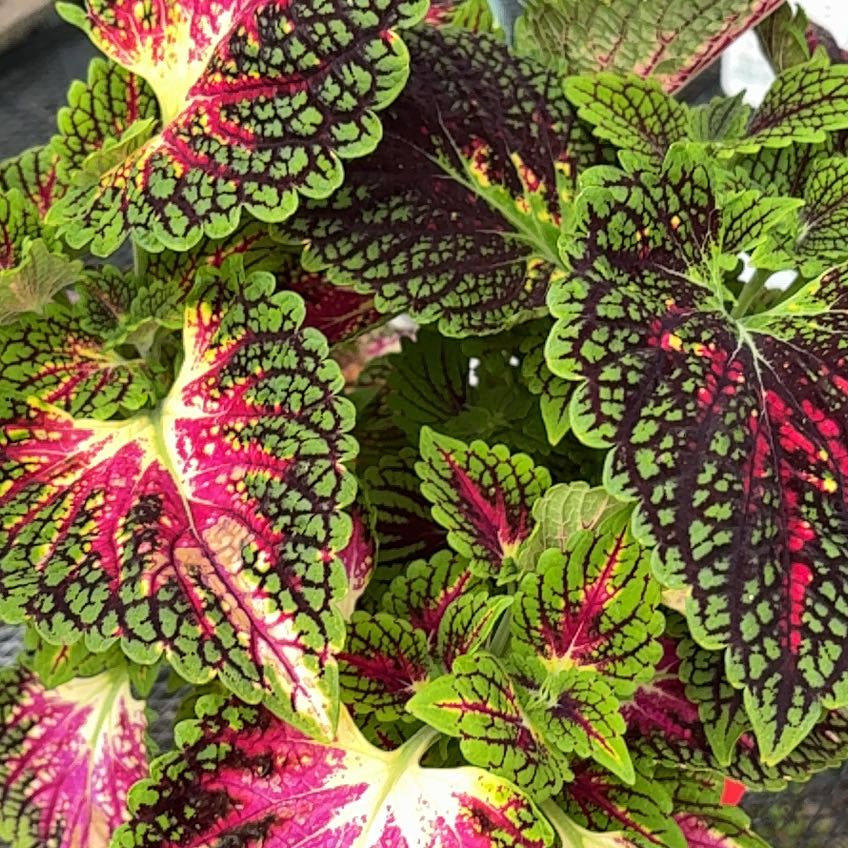
Coleus comosus

What's Eating Your Coleus?

Coleus spp.
Reviewed by Kiersten Rankel M.S.
Quick Answer

For coleus, the most likely culprits are whiteflies (a cloud of tiny white insects flying up when you brush the leaves) and spider mites in hot dry weather (pale specks and webs that defoliate stressed plants fast). Aphids cluster on tender new growth and pinched flower spike stubs. Slugs chew young plants and lower leaves overnight.

Stay on top of plant care
Get seasonal reminders for watering and fertilizing, personalized for your plants.
Try Greg Free

What does the damage look like?

Tap the closest match to jump straight to the fix.

Pests, ranked by impact

Cluster of silverleaf whiteflies (Bemisia tabaci) on the underside of an eggplant leaf

Whiteflies

Damage
High
Removal
Hard
What it looks like

Tiny white moth-like insects, 1 to 2 mm long, that erupt in a cloud when you brush a coleus leaf. The diagnostic visual for coleus owners. Adults rest on the underside of the brightest variegated leaves. Eggs and pale scale-like nymphs sit flat on the same leaf undersides.

What the damage looks like

A sticky shiny film on the upper leaf surface below the cluster, then black sooty mold over the residue. The mold ruins the pink, red, and chartreuse variegation coleus is grown for. Yellowing leaves drop early. Whiteflies also vector viruses between coleus and nearby tomato or pepper.

How to get rid of them
Option 1

Yellow sticky traps and underleaf soap, weekly for 4 weeks

1

Hang yellow sticky traps (Trappify or Stiky Strips, ~$10) at canopy height around the planting. Adults fly to yellow and stick.

2

Spray ready-to-use insecticidal soap (Safer or Bonide, ~$10) on the underside of every leaf at dusk. Eggs and nymphs only die from direct contact.

3

Repeat the soap spray every 4 days for 4 weeks. That spans the egg-to-adult cycle in summer heat.

Option 2

Hose blast at dawn, every 3 days for 2 weeks

Hold a hose nozzle 12 inches from the underside of each plant and spray at firm pressure. Adults fly off and most don't return. Coleus leaves are soft, so use a fan setting, not a jet. The dawn rinse dries before evening to keep slugs and downy mildew pressure down. Repeat every 3 days for 2 weeks.

Option 3

Pinch flower spikes weekly through summer

Whiteflies cluster densely on the tender bracts of coleus flower spikes. Pinch every spike back to the leaf node as soon as you see it forming. The plant pushes more colorful foliage instead of bloom, and you remove the pest's favorite hideout in one motion.

Spider mite infestation on a stem with fine silk webbing and pale speckled leaf damage

Spider mites

Damage
High
Removal
Moderate
What it looks like

Almost invisible without a hand lens. Yellow-green to red-orange specks running along the underside of leaves and where the leaf meets the square stem. Hot dry weather and a stressed coleus (under-watered or in too much sun) trigger a population boom in days.

What the damage looks like

Tiny pale yellow dots across the upper leaf surface, fading the bright pink and chartreuse variegation to a dull bronze. Fine webbing strung between leaf pairs and along the square stem in heavy cases. Stressed coleus can defoliate in 2 to 3 weeks, ending the display for the season.

How to get rid of them
Option 1

Hose underside of every leaf, every 3 days for 2 weeks

Spray cool water on the underside of every leaf for 30 seconds. Mites can't reattach quickly when knocked off. Coleus is soft so use a gentle fan setting. The rinse also raises humidity, which mites hate. Repeat every 3 days for 2 weeks. The fastest fix and works without chemicals.

Option 2

Insecticidal soap at dusk, every 5 days for 3 rounds

1

Use ready-to-use insecticidal soap (Safer or Bonide, ~$10). Test one leaf first because soft coleus leaves can burn in direct sun.

2

Spray the underside of every leaf and along the square stem at dusk. Soap only kills on direct contact.

3

Repeat every 5 days for 3 rounds. That covers the full egg-to-adult cycle in summer heat.

Option 3

Move plants out of afternoon sun and water deeply

Mites attack stressed coleus first. Coleus prefers morning sun and afternoon shade in zones 8 to 11. Move pots to dappled afternoon shade and water deeply at the base when the top inch of soil dries. A hydrated plant in shade resists mite outbreaks all summer.

Dense colony of aphids clustered on a plant stem

Aphids

Damage
Medium
Removal
Easy
What it looks like

Tiny pear-shaped insects 1 to 3 mm long, in shades of green, brown, or black. Cluster densely on tender new growth at the tips of square stems and on the soft bracts of any flower spikes you missed pinching. Soft coleus tissue is exactly what aphids prefer.

What the damage looks like

New leaves curl, twist, and lose color as aphids drain sap. A sticky shiny film coats the upper surface of leaves below the cluster, then black sooty mold grows on the residue. The mold dulls the pink and chartreuse variegation that makes coleus worth growing.

How to get rid of them
Option 1

Hose blast every 2 to 3 days for 2 weeks

Hold a hose nozzle 12 inches from the affected new growth and spray at firm pressure. Most aphids dislodge and don't make it back. Use a fan setting because coleus stems snap easily. Repeat every 2 to 3 days for 2 weeks. The fastest, cheapest fix and works without chemicals.

Option 2

Insecticidal soap on new growth, every 5 days for 2 rounds

Spray ready-to-use insecticidal soap (Safer or Bonide, ~$10) on the tip of every stem and the underside of new leaves at dusk. Coleus tolerates soap well in shade. Test one leaf first if your plants get afternoon sun. Repeat every 5 days for 2 rounds.

Option 3

Pinch flower spikes weekly to remove aphid hideouts

Aphids cluster on the soft bracts of coleus flower spikes more than anywhere else on the plant. Pinch every spike back to the leaf node as soon as you see it forming. The plant pushes denser variegated foliage and you cut off the colony in one motion.

Large red-brown slug (Arion rufus) crawling on a rhubarb leaf

Slugs

Damage
Medium
Removal
Moderate
What it looks like

Soft-bodied gray or brown mollusks, 1 to 3 inches long, that hide under mulch, pots, and the lower coleus leaves during the day. Active at night and in damp shaded conditions, which is exactly where coleus is usually planted. Young transplants take the heaviest hit.

What the damage looks like

Ragged irregular holes chewed out of the lower leaves overnight. Silvery dried slime trails on leaves and on the soil surface in the morning. Young transplants can be eaten down to the stem in a single night, ending the planting before it has a chance to root in.

How to get rid of them
Option 1

Iron phosphate bait around plants, refresh weekly

Sprinkle iron phosphate slug bait (Sluggo or Garden Safe, ~$12) on the soil within 12 inches of every coleus. Safe for pets, kids, and pollinators, unlike older metaldehyde baits. Slugs eat the bait, stop feeding, and die within 3 to 6 days. Refresh weekly through spring and after any rain.

Option 2

Beer trap and overnight hand-pick

1

Sink a shallow tuna can or yogurt cup level with the soil within 3 feet of the planting. Fill with cheap beer.

2

Walk the bed by flashlight an hour after dark twice in the first week. Drop slugs into a jar of soapy water.

3

Empty and refill the beer trap every 2 to 3 days through spring while transplants are tender.

Option 3

Water at the base in the morning, never overhead at night

Slugs follow moisture. Watering coleus at the base in the morning lets the soil surface dry before nightfall, which slows slug movement and reduces feeding. Skip evening watering and overhead sprinklers entirely. The same habit cuts downy mildew pressure on coleus, which is the other big summer threat.

Stay ahead of all of them

Four habits that keep coleus pests rare and protect the variegated foliage you grow this plant for.
1

Pinch flower spikes weekly through summer

Coleus flower spikes are the favorite hideout for whiteflies and aphids on the plant. Pinching every spike back to the leaf node as soon as it forms removes the colony and pushes more pink and chartreuse foliage. One habit, two wins.

2

Underleaf check, every Sunday in summer

Whiteflies, aphids, and spider mites all hide on the underside of coleus leaves where the bright variegation hasn't even shown yet. A 30-second flip-and-look on each plant catches infestations the week they start, before they touch the show foliage above.

3

Water at the base in the morning

Coleus loves moist soil but slugs and downy mildew love wet leaves. Water deeply at the soil line in the morning so the surface dries before night. Skip overhead sprinklers and evening watering entirely. Cuts slug feeding and mildew pressure in one habit.

4

Move stressed plants out of afternoon sun

Spider mites attack stressed coleus first. Coleus wants morning sun and afternoon shade in zones 8 to 11. Move pots to dappled afternoon shade and the bright variegation actually deepens, not fades. A relaxed plant resists mite outbreaks all summer.

Stay on top of plant care
Get seasonal reminders for watering and fertilizing, personalized for your plants.
Try Greg Free

About This Article

Kiersten Rankel M.S.
Botanical Data Lead at Greg · Plant Scientist
About the Author
Kiersten Rankel holds an M.S. in Ecology & Evolutionary Biology from Tulane University. A certified Louisiana Master Naturalist, she has over a decade of experience in science communication, with research spanning corals, cypress trees, marsh grasses, and more. At Greg, she curates species data and verifies care recommendations against botanical research.
See Kiersten Rankel's full background on LinkedIn.
Editorial Process
Pest identification and treatment guidance verified against Coleus spp. field reports from Greg's botanical database, cross-referenced with university extension sources and published horticultural research.