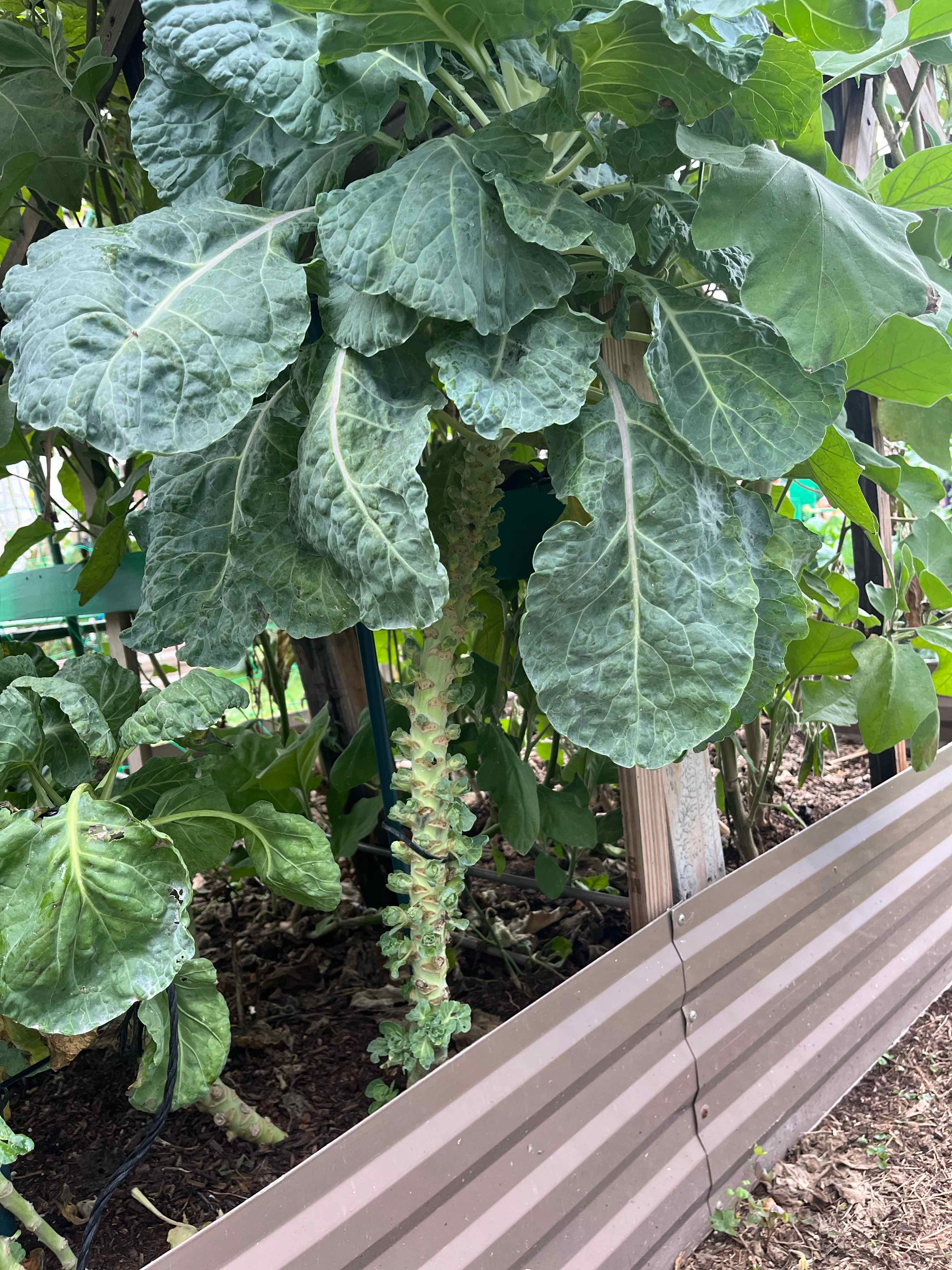
Brussel Sprout

What's Eating Your Brussel Sprout?

Brassica Oleracea Var. Gemmifera
Reviewed by Kiersten Rankel M.S.
Quick Answer

For Brussels sprouts, the most likely culprits are cabbage worms and loopers (green caterpillars chewing big holes in the cabbage-blue leaves) and cabbage aphids (gray-green waxy clusters packed deep into the developing sprouts). Harlequin bugs in the southern US drain sap from leaves and stalk. Flea beetles pinhole new leaves, and slugs chew ragged holes overnight.

Stay on top of plant care
Get seasonal reminders for watering and fertilizing, personalized for your plants.
Try Greg Free

What does the damage look like?

Tap the closest match to jump straight to the fix.

Pests, ranked by impact

Macro photo of a caterpillar resting on a green leaf

Cabbage worms and loopers

Damage
High
Removal
Easy
What it looks like

Two caterpillars that show up together. Cabbage worms (Pieris rapae) are velvety green with a faint yellow stripe, 1 inch long. Cabbage loopers are smooth green with white side stripes and inch along like a measuring worm. Both blend into the cabbage-blue waxy leaves and hide along the central vein and tucked into the developing sprouts.

What the damage looks like

Big ragged holes chewed through the broad lower leaves, then progress up the stalk into the developing sprouts in the leaf axils. Dark green pellet droppings on lower leaves and at the base of each sprout give it away. Heavy feeding ruins individual sprouts and stunts head formation.

How to get rid of them
Option 1

Floating row cover from transplant to harvest

Drape lightweight row cover (Agribon AG-19, ~$25 for a 10x25 ft roll) over hoops the day you transplant. Tuck and bury the edges so the white cabbage moths can't lay eggs. The cover stays on through head formation. This is the single most effective brassica defense and stops worms, loopers, flea beetles, and harlequin bugs at once.

Option 2

Bt spray on leaves and into sprout axils, every 7 days

1

Mix 1 teaspoon Bt (Monterey or Safer Caterpillar Killer, ~$15) per quart of water with a drop of dish soap to help it stick to the waxy cabbage-blue leaves.

2

Spray the underside of every leaf and let the spray run down into the leaf axils where sprouts form. That's where the larvae hide.

3

Repeat every 7 days from transplant through harvest, and after rain. Bt kills only caterpillars and is safe for bees and ladybugs.

Option 3

Hand-pick at dusk twice a week

Walk the bed an hour before sunset twice a week. Look along the central vein on the underside of each leaf and inside developing sprouts. Pick off worms and loopers and drop into a jar of soapy water. A small bed stays clean with 5 minutes of picking on Tuesday and Saturday.

Dense colony of aphids clustered on a plant stem

Aphids

Damage
High
Removal
Hard
What it looks like

Cabbage aphid (Brevicoryne brassicae) is a brassica specialist. Gray-green soft-bodied insects 2 mm long, dusted with a whitish wax that matches the cabbage-blue leaves. Pack into dense colonies on the underside of leaves and deep inside the developing sprouts in each leaf axil. The wax coating makes them hard to wash off and hard to spot.

What the damage looks like

Yellowed and curled leaves, then waxy gray colonies clustered on the developing sprouts up the stalk. Once aphids settle inside the sprouts, the harvest is contaminated and very hard to wash clean. A sticky shiny film coats lower leaves and the soil below. Heavy infestations stunt sprout formation entirely.

How to get rid of them
Option 1

Strong water blast into sprouts every 3 days for 2 weeks

Hold a hose nozzle 12 inches from each sprout and blast at high pressure, working from the base of the stalk upward. The waxy coating on cabbage aphids resists soap, but a strong water jet dislodges them and they don't make it back. Repeat every 3 days for 2 weeks. Catching aphids before they pack into the sprout heads is the only way to keep the harvest clean.

Option 2

Insecticidal soap on undersides and into axils, weekly

1

Mix ready-to-use insecticidal soap (Safer Brand, ~$10) and add a drop of extra dish soap. The cabbage-blue waxy leaves repel water, so the extra surfactant helps the spray stick.

2

Spray the underside of every leaf and tilt the nozzle up into each leaf axil where sprouts form. Coverage is everything with aphids.

3

Repeat weekly for 4 weeks. Soap kills only on contact, so any aphid you miss survives.

Option 3

Plant sweet alyssum between rows in spring

Sow sweet alyssum 12 inches from the brassica row at transplant time. The flowers attract hoverflies and parasitic wasps that feed on cabbage aphids. Established alyssum keeps aphid pressure low for the rest of the season without sprays.

Shield-shaped stink bug (Halyomorpha sp., Pentatomidae) on a plant

Harlequin bug

Damage
High
Removal
Moderate
What it looks like

Bright black-and-orange shield-shaped true bug, about 1/3 inch long. The pattern is unmistakable up close and looks like a tiny harlequin's costume. Eggs look like rows of black-and-white striped barrels glued to the underside of leaves. Iconic brassica pest in the southern US, especially zones 7 and warmer in late summer and fall.

What the damage looks like

Pale yellow or white blotches around each feeding spot where the bug pierces the leaf and drains sap. Leaves wilt, stalks weaken, and severe infestations stunt the plant before sprouts form. Unlike chewing pests, the leaves look intact at first. The blotches are the tell.

How to get rid of them
Option 1

Hand-pick adults and crush egg rows, every other day

1

Walk the bed in the morning when the bugs are sluggish from cool overnight temperatures. Pick adults off by hand and drop into soapy water.

2

Flip leaves and look for the striped barrel egg rows on the underside. Crush every row you find with your thumbnail. Each row destroyed is 12 future bugs gone.

3

Repeat every other day during the late-summer peak in zones 7 and warmer. Diligent hand-picking keeps a small bed clean without sprays.

Option 2

Pyrethrin spray for heavy infestations

Spray pyrethrin (Pyganic, ~$25) on the bugs directly at dusk. Pyrethrin breaks down quickly in sunlight and is one of the few sprays that knocks down adult harlequin bugs reliably. Reapply after 5 to 7 days if you still see adults. Avoid spraying open flowers and use only when bee activity is low.

Option 3

Pull and destroy spent brassicas before fall

Harlequin bugs overwinter in spent brassica residue. After harvest, pull every cabbage-family plant including roots, bag, and dispose. Do not compost. Removing the overwinter habitat cuts next year's population in half and is the easiest long-term control in southern gardens.

Tiny shiny black flea beetle (Altica sp.) on a green leaf

Flea beetles

Damage
Medium
Removal
Moderate
What it looks like

Tiny shiny black or bronze beetles, 1 to 2 mm long. Jump like fleas when you brush a leaf, which is the fastest way to confirm them. Cluster on the upper surface of leaves, especially on younger plants. Most damaging on seedlings and freshly transplanted Brussels sprouts in early spring.

What the damage looks like

Hundreds of tiny round pinholes peppering the leaves, like buckshot. On seedlings the damage can kill the plant outright. Mature Brussels sprouts shrug off light feeding because the cabbage-blue waxy leaves keep growing. Cosmetic on established plants, serious on transplants in their first 3 weeks.

How to get rid of them
Option 1

Floating row cover for the first 3 weeks after transplant

Cover transplants with row cover (Agribon AG-19, ~$25) the day they go in the ground. Bury the edges so beetles can't crawl under. Keep the cover on for at least 3 weeks until plants are established. Once leaves are tough and broad, flea beetle damage stops mattering.

Option 2

Yellow sticky traps at plant height

Stake yellow sticky traps (Trappify, ~$10 for 20) at the height of the plants. Flea beetles are drawn to yellow and stick fast. Replace traps every 2 weeks. Useful as a monitoring tool and a small dent in the population, but row cover does the heavy lifting.

Option 3

Diatomaceous earth dusted on dry leaves

1

Wait for a dry morning. Diatomaceous earth (Safer Garden Dust, ~$12) only works dry.

2

Dust food-grade DE lightly across the upper leaf surfaces of the affected plants.

3

Reapply after every rain. The fine particles abrade flea beetle bodies and dehydrate them. Stop once plants are 8 inches tall and outgrowing the damage.

Large red-brown slug (Arion rufus) crawling on a rhubarb leaf

Slugs

Damage
Medium
Removal
Easy
What it looks like

Soft gray, brown, or tan mollusks, 1 to 4 inches long. Active at night and in the early morning before the sun warms the bed. Hide under mulch, stones, low leaves, and the cool soil at the base of the stalk during the day. Worse in wet falls, which is exactly Brussels sprouts season.

What the damage looks like

Big ragged holes chewed in lower leaves overnight, with no clean cut. Silvery slime trails on leaves, the stalk, and the soil at the base of the plant. The fall growing window for Brussels sprouts (cool, wet, into frost) is peak slug weather and damage builds fast.

How to get rid of them
Option 1

Iron phosphate slug bait, scattered weekly

Scatter iron phosphate slug bait (Sluggo, ~$12) thinly around the base of each plant in the evening. The bait kills slugs within 3 to 6 days and is safe for pets, birds, and earthworms. Reapply weekly through the wet fall growing window.

Option 2

Beer trap sunk to soil level

1

Sink a shallow container (a tuna can or yogurt cup) into the soil so the rim sits flush with the surface.

2

Fill halfway with cheap beer. Slugs are drawn to the yeast, fall in, and drown.

3

Empty and refill every 2 days through wet weather. Place one trap per 4 feet of row.

Option 3

Hand-pick at dusk after watering

Slugs come out an hour after sunset, especially after watering. Walk the bed with a flashlight, pick slugs off the lower leaves and stalk, and drop into a jar of soapy water. A 5-minute pick twice a week clears a small bed without bait.

Stay ahead of all of them

Four habits that keep Brussels sprouts pests rare through the long fall season.
1

Floating row cover from transplant to head formation

The single highest-leverage habit for any brassica. Drape row cover the day you transplant and leave it on until sprouts are forming up the stalk. Excludes cabbage moths, harlequin bugs, and flea beetles in one move. The fall pest pressure on Brussels sprouts is heavy and the cover does most of the work for you.

2

Sprout-axil scout, every Sunday

Cabbage aphids and worms hide deep in the leaf axils where each sprout forms. A weekly 30-second look at three or four axils up the stalk catches colonies before they pack into the heads. Once aphids settle inside a sprout, the harvest from that node is lost.

3

Pull spent brassicas at season end

Harlequin bugs and cabbage aphids overwinter in spent brassica residue. After harvest, pull every Brussels sprouts, cabbage, kale, or broccoli plant including the roots, bag, and dispose. Do not compost. This single fall task cuts next year's pressure in half.

4

Time the planting for cool fall ripening

Brussels sprouts taste best after a few light frosts and grow best in cool weather. Set transplants 90 to 110 days before your average first frost. Cool fall temperatures slow flea beetles and cabbage moths and let the plant outpace damage as it heads up the stalk.

Stay on top of plant care
Get seasonal reminders for watering and fertilizing, personalized for your plants.
Try Greg Free

About This Article

Kiersten Rankel M.S.
Botanical Data Lead at Greg · Plant Scientist
About the Author
Kiersten Rankel holds an M.S. in Ecology & Evolutionary Biology from Tulane University. A certified Louisiana Master Naturalist, she has over a decade of experience in science communication, with research spanning corals, cypress trees, marsh grasses, and more. At Greg, she curates species data and verifies care recommendations against botanical research.
See Kiersten Rankel's full background on LinkedIn.
Editorial Process
Pest identification and treatment guidance verified against Brassica Oleracea Var. Gemmifera field reports from Greg's botanical database, cross-referenced with university extension sources and published horticultural research.