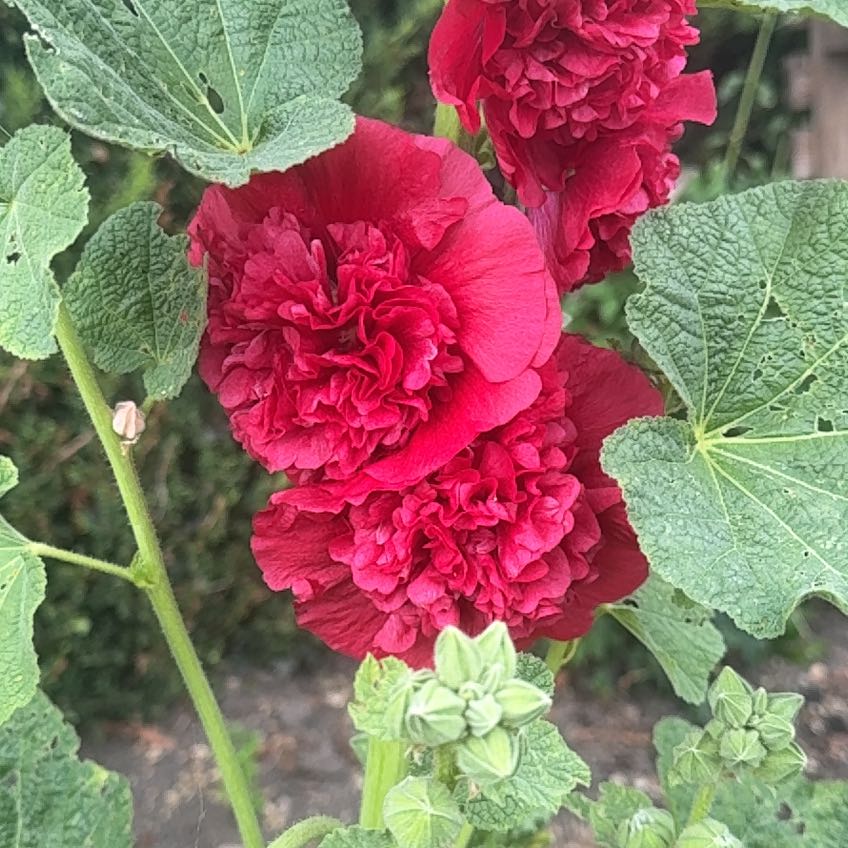
Hollyhock

What's Eating Your Hollyhock?

Alcea rosea
Reviewed by Kiersten Rankel M.S.
Quick Answer

For hollyhock, the most likely culprits are Japanese beetles (metallic green and copper, skeletonizing leaves and chewing flowers in midsummer) and hollyhock weevils (tiny black beetles drilling into seed pods). Aphids cluster on the tall flower stalks and new growth. Spider mites flare in the lower foliage during hot dry weather.

Stay on top of plant care
Get seasonal reminders for watering and fertilizing, personalized for your plants.
Try Greg Free

What does the damage look like?

Tap the closest match to jump straight to the fix.

Pests, ranked by impact

Metallic green and copper Japanese beetle (Popillia japonica) on a lantana flower

Japanese beetles

Damage
High
Removal
Moderate
What it looks like

Metallic green head and copper-bronze wing covers, about 1/2 inch long, with small white tufts along each side. Feed in dense groups on the upper leaves and on open hollyhock blooms in full sun. Most active June through August.

What the damage looks like

Leaves reduced to lacy skeletons with only the veins remaining, working down from the top of the flower spike. Chewed petals on pink, red, and white blooms. Beetles cluster in groups on the same leaf, so damage is patchy and intense rather than even.

How to get rid of them
Option 1

Hand-pick into soapy water at dawn

1

Walk the hollyhock bed first thing in the morning when beetles are slow and clumsy.

2

Hold a jar of soapy water under each cluster and tap the leaf or bloom. Beetles drop straight in.

3

Repeat daily through July and August. Removing early arrivals keeps the pheromone trail from drawing in more.

Option 2

Neem oil spray at dusk, every 5 days

Mix 2 tablespoons cold-pressed neem oil and 1 teaspoon dish soap per gallon of water. Spray the upper leaves and open blooms at dusk when pollinators are gone. Neem deters feeding without killing the beneficial insects that pollinate the flower spikes. Repeat every 5 days through peak season.

Option 3

Skip Japanese beetle traps

The pheromone lures pull beetles in from a wide radius and a fraction stop to feed on your hollyhocks before reaching the trap. University trials show traps increase damage on nearby plants. Hand-pick instead, or place traps at the far edge of a large property.

Common myth

Japanese beetle traps protect your plants.

The pheromone draws in far more beetles than any trap can catch, and many stop to feed on hollyhock leaves and blooms on the way. Hand-picking and neem oil keep more beetles off the flower spikes than any trap does.

Small leaf weevil resting on a green leaf

Hollyhock weevil

Damage
Medium
Removal
Hard
What it looks like

Small black weevil about 3 mm long with a long curved snout and orange-red legs. Specific to hollyhocks and a few mallow relatives. Adults chew small pinholes in leaves and flower buds. Females drill into developing seed pods to lay eggs, and larvae feed inside.

What the damage looks like

Pinhole punctures scattered across heart-shaped lower leaves and on tight flower buds before they open. Round seed pods on the spent spikes feel light and rattle, with small exit holes once larvae mature. The plant blooms fine, but the pods are hollowed out and seed saving fails.

How to get rid of them
Option 1

Knock weevils into soapy water in late spring

1

Hold a jar of soapy water under the basal rosette and lower leaves in May and early June.

2

Tap the stem sharply. Weevils play dead and drop straight in.

3

Repeat every few days through bud formation. Catching adults before they reach the developing seed pods is the only effective window.

Option 2

Cut and bag spent flower spikes before pods mature

Cut the flower spikes after bloom and bag the seed pods in the trash. Do not compost. Larvae overwinter inside fallen pods and emerge as adults the next spring. Removing the pods breaks the cycle and is the single most effective long-term control.

Option 3

Clean up the basal rosette in fall

Rake fallen leaves and old pods from around the basal rosette in late fall. Adult weevils overwinter in plant debris at the soil line. A clean planting in November means fewer adults waking up to attack next year's flower spikes.

Dense colony of aphids clustered on a plant stem

Aphids

Damage
Medium
Removal
Easy
What it looks like

Tiny pear-shaped insects 1 to 3 mm long, in shades of green, yellow, or black. Cluster densely along the upper flower stalk, on flower buds, and on the underside of the heart-shaped lower leaves. Most visible in late spring as the spike rises from the rosette.

What the damage looks like

A sticky shiny film coats the flower stalk and any leaves below the cluster. Buds may distort or fail to open fully. Black sooty mold grows on the residue over a few weeks. Heavy clusters on the rising spike can stunt the bloom display for the year.

How to get rid of them
Option 1

Strong water blast every 2 to 3 days for 2 weeks

Hold a hose nozzle 12 inches from the affected stalk and spray at high pressure. Most aphids dislodge and don't make it back up the 6 to 8 foot spike. Repeat every 2 to 3 days for 2 weeks. The fastest, cheapest fix and works without chemicals.

Option 2

Insecticidal soap on the stalk and leaf undersides

Spray ready-to-use insecticidal soap (Safer Brand, ~$10) on the flower stalk, buds, and underside of every lower leaf at dusk. Coat fully because soap kills only on direct contact. Repeat every 5 days for 2 weeks until clusters are gone.

Option 3

Plant alyssum or yarrow in the bed

Tuck alyssum, yarrow, or dill into the cottage garden bed alongside the hollyhocks. These flowers attract ladybugs and lacewings that feed on aphids. Established plantings keep aphid pressure low without sprays and pull in the pollinators hollyhocks rely on.

Spider mite infestation on a stem with fine silk webbing and pale speckled leaf damage

Spider mites

Damage
Medium
Removal
Moderate
What it looks like

Almost invisible without a hand lens. Yellow-green to red-orange specks running along the underside of the heart-shaped lower leaves of the basal rosette. Hot dry weather and drought stress trigger population booms, especially on hollyhocks growing against a sunny wall.

What the damage looks like

Tiny pale yellow dots stipple the upper surface of the lower leaves, then bronze patches spread between the palmate veins. Fine webbing strung between leaf and stem in heavy infestations. The flower spike usually finishes blooming, but the rosette weakens and re-blooming next year suffers.

How to get rid of them
Option 1

Hose the lower leaves weekly for 3 weeks

Direct a strong hose spray at the underside of the heart-shaped lower leaves. Mites can't reattach quickly when knocked off, and the rinse humidity slows survivors. Hollyhocks tolerate a hard rinse. Repeat weekly for 3 weeks. Skip if rust disease is already present, as wet leaves spread rust.

Option 2

Mulch and water deeply at the base

Spread 2 inches of bark or straw mulch around the basal rosette. Water deeply at the soil line once a week instead of light frequent watering. Drought-stressed hollyhocks attract spider mites, and a steady soil moisture level breaks the cycle without raising humidity around the foliage.

Option 3

Neem oil at dusk, every 5 days for 3 rounds

1

Mix 2 tablespoons cold-pressed neem oil and 1 teaspoon dish soap per gallon of water.

2

Spray the underside of the lower leaves at dusk, focusing on the basal rosette where mites cluster.

3

Repeat every 5 days for 3 rounds. Covers the full egg-to-adult life cycle.

Stay ahead of all of them

Four habits that keep hollyhock pest pressure low through the long bloom season.
1

Walk the spike daily through July and August

Japanese beetles arrive in groups and a daily 30-second pass keeps populations from snowballing on the open blooms. Catch the first arrivals before they release pheromones that pull in more.

2

Cut and bag spent flower spikes

Hollyhock weevil larvae overwinter inside the round seed pods on spent spikes. Cutting and trashing the spikes after bloom is the single most effective break in the weevil cycle and protects next year's seed set.

3

Mulch and deep-water the basal rosette

A 2 inch mulch ring and weekly deep watering keep the rosette from drought-stressing in midsummer heat. Stressed hollyhocks attract spider mites and aphids, and steady soil moisture keeps the 6 to 8 foot spike rising strong.

4

Clean up debris around the rosette in fall

Hollyhock weevils and many other pests overwinter in old leaves and pods at the soil line. Raking the basal rosette clean in November means fewer adults emerging next spring to attack the rising flower spikes.

Stay on top of plant care
Get seasonal reminders for watering and fertilizing, personalized for your plants.
Try Greg Free

About This Article

Kiersten Rankel M.S.
Botanical Data Lead at Greg · Plant Scientist
About the Author
Kiersten Rankel holds an M.S. in Ecology & Evolutionary Biology from Tulane University. A certified Louisiana Master Naturalist, she has over a decade of experience in science communication, with research spanning corals, cypress trees, marsh grasses, and more. At Greg, she curates species data and verifies care recommendations against botanical research.
See Kiersten Rankel's full background on LinkedIn.
Editorial Process
Pest identification and treatment guidance verified against Alcea rosea field reports from Greg's botanical database, cross-referenced with university extension sources and published horticultural research.