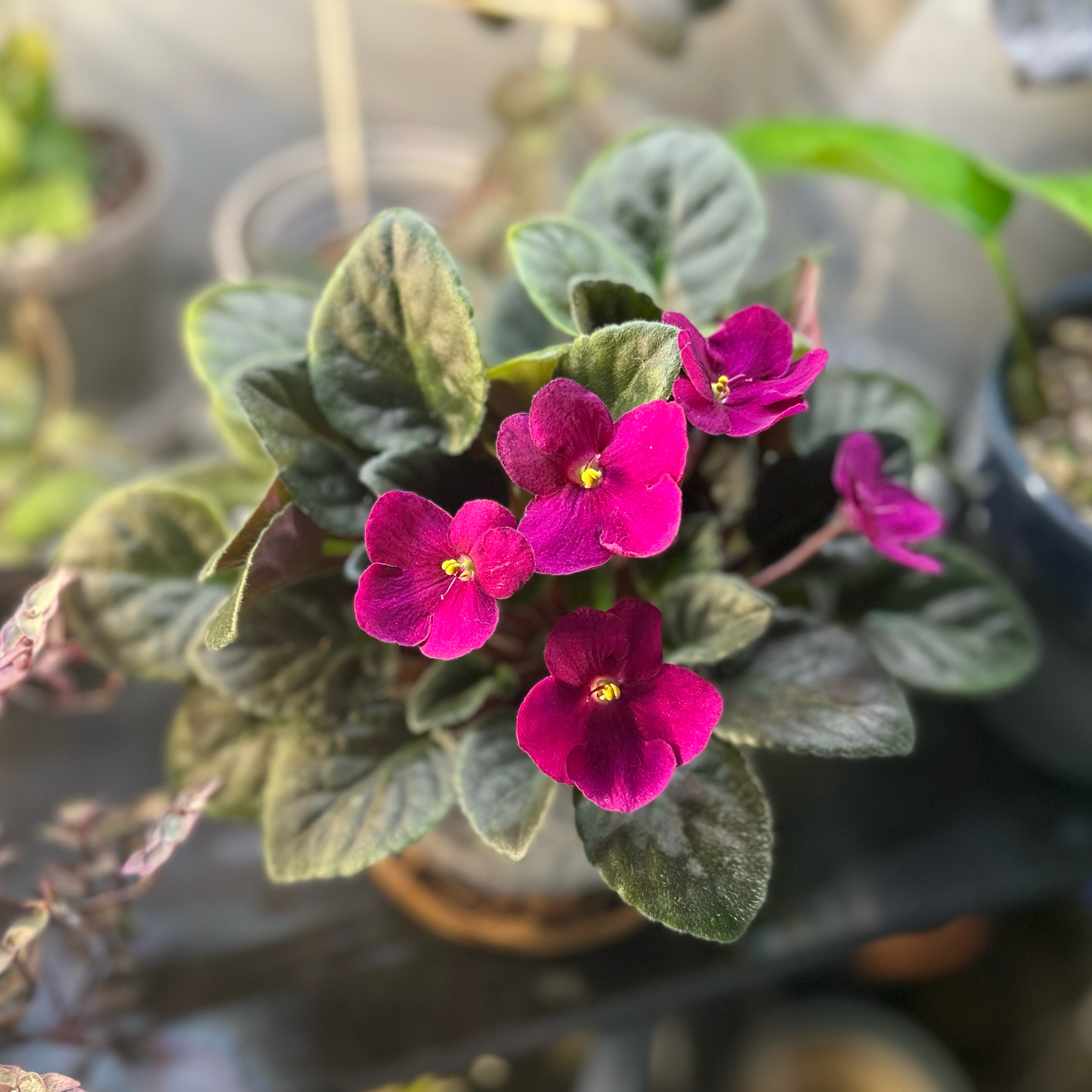
African Violet

What's Eating Your African Violet?

Streptocarpus ionathus
Reviewed by Kiersten Rankel M.S.
Quick Answer

For African violet, the most likely culprits are thrips (silver streaks and scarred blooms), cyclamen mites (cupped distorted new leaves at the crown center), and mealybugs hiding in the rosette where petioles meet the rhizome. Fungus gnats hovering near the soil signal the wet conditions that also cause crown rot.

Stay on top of plant care
Get seasonal reminders for watering and fertilizing, personalized for your plants.
Try Greg Free

What does the damage look like?

Tap the closest match to jump straight to the fix.

Pests, ranked by impact

Slender adult thrips (Frankliniella sp.) on a flower petal

Thrips

Damage
High
Removal
Hard
What it looks like

Slender pale to dark insects 1 to 2 mm long. Walk along surfaces rather than fly. Hide deep inside the velvet bloom petals and in the rosette center where new bloom stalks emerge. Tap a flower over white paper to see them drop and dart.

What the damage looks like

Silver or bronze streaks on upper leaf surfaces with tiny black dots (thrips droppings) next to them. Bloom petals turn streaked, blotchy, or fail to open. New flower buds abort. The damage scars the iconic blooms African violets are grown for.

How to get rid of them
Option 1

Blue sticky traps just above the rosette

Hang blue sticky cards (Stikem or Trappify, ~$10 per pack) just above the leaf canopy. Thrips are attracted to blue and stick on contact. Replace every 2 weeks. Reduces the population while you treat with spinosad.

Option 2

Spinosad soil drench, every 10 days for 3 rounds

1

Mix spinosad (Captain Jack's or Monterey Garden Insect Spray, ~$12 to $15) at the label rate for soil drench.

2

Pour into the saucer for bottom-watering so the solution wicks up to the roots without wetting the fuzzy leaves.

3

Repeat every 10 days for 3 rounds. The plant takes spinosad up systemically and thrips die when they feed.

Option 3

Pinch off every open and forming bloom

Thrips breed inside the petals. Removing all blooms and bud stalks for 4 to 6 weeks starves the population while soil drenches finish the job. Heartbreaking but the plant rebounds with clean new bloom stalks once thrips are gone.

Cluster of long-tailed mealybugs (Pseudococcus longispinus) showing the white cottony wax on a leaf

Mealybugs

Damage
High
Removal
Hard
What it looks like

Soft white insects covered in cottony fluff, 2 to 4 mm long. Cluster in the central crown where new leaves push up from the rhizome and along the bases of leaf petioles. A separate species, the root mealybug, lives on the rhizome and roots and is harder to spot until you unpot.

What the damage looks like

White cottony tufts in the crown and at petiole bases. New leaves emerge stunted or yellowed. Sticky shiny film on lower leaves. Root mealybugs on the rhizome cause unexplained wilt and slow decline even when the soil and watering look right.

How to get rid of them
Option 1

Cotton swab dipped in 70% isopropyl alcohol

Dab every visible mealybug. Never spray alcohol on the fuzzy leaves because it spots and damages the surface. Use the swab to target only the bugs, working into the crown and petiole bases. Repeat every 3 days for 3 weeks to catch newly hatched crawlers.

Option 2

Systemic imidacloprid drench for crown and root mealybugs

1

Mix Bonide Systemic Houseplant Insect Control (~$10) at the label rate for African violets.

2

Pour into the saucer for bottom-watering. The plant takes the active ingredient into its tissue, killing mealybugs that feed on any part including the rhizome.

3

Reapply at 8 weeks. The systemic reaches root mealybugs that surface treatments can't touch.

Option 3

Isolate at least 6 feet from your collection

Mealybugs spread by crawling between touching leaves and along the windowsill. Move the African violet far from other plants. Wipe the windowsill, the saucer, and any tools with alcohol. Inspect neighboring plants weekly for the next month.

Common myth

Spray rubbing alcohol all over the plant.

Alcohol on African violet's fuzzy leaves causes permanent brown spotting and dead patches that don't grow back. Use a cotton swab to target only the bugs. Never spray any liquid directly on the foliage.

Spider mite infestation on a stem with fine silk webbing and pale speckled leaf damage

Spider mites

Damage
High
Removal
Hard
What it looks like

Microscopic mites you cannot see without magnification. Live and feed in the rosette center on the youngest leaves and forming bloom stalks. The damage is so distinctive it is usually the first sign. Confirm by hand lens or by the pattern of new growth.

What the damage looks like

New leaves emerge cupped, curled inward, hairy on the wrong side, or grayish and stunted. Bloom stalks shorten and flowers open distorted or not at all. The older leaves look fine. Damage radiates from the crown outward as new leaves keep deforming. Usually permanent on affected leaves.

How to get rid of them
Option 1

Discard heavily affected plants

Cyclamen mites are extremely hard to clear and spread fast between violets. If more than half the rosette shows distorted new growth, bag the whole plant and throw it out. Wipe the windowsill and saucer with alcohol. Saving one plant is rarely worth losing your whole collection.

Option 2

Hot water submersion at 110 degrees F for 15 minutes

1

Heat water to exactly 110 degrees F (43 degrees C) using a kitchen thermometer. Higher cooks the plant, lower doesn't kill the mites.

2

Submerge the entire plant including pot and soil for 15 minutes, holding the water at 110 with a kettle top-up if it cools.

3

Drain, set in normal light, and watch for clean new growth over 6 to 8 weeks. Isolate the plant from your collection during recovery.

Option 3

Avermectin miticide drench (Avid)

Avid (~$30 from a specialty grower supply) is the standard cyclamen mite treatment for collection holders. Mix at label rate and bottom-water. Toxic, so use gloves and ventilation. Repeat at 14 days. Skip this one if the plant is in a kitchen or kid space and use the heat treatment instead.

Adult dark-winged fungus gnat (Sciaridae) close-up

Fungus gnats

Damage
Medium
Removal
Easy
What it looks like

Tiny dark flies, 1 to 3 mm long, hovering near the pot and flying up when you water. Larvae are barely-visible white worms in the top inch of damp soil. Thrive in the consistently moist soil African violets need.

What the damage looks like

Adults are mostly a nuisance. The bigger problem is what their presence signals. Fungus gnats only thrive in damp soil, and damp soil at the crown is what causes African violet crown rot. Crown rot kills the plant from the rosette down and is much harder to reverse than the gnats.

How to get rid of them
Option 1

Bottom-water and let the top inch dry between sessions

Set the pot in a tray of room-temperature water for 30 minutes, then drain fully. The top inch of soil stays dry, killing larvae and stopping adults from laying eggs. Bottom-watering is already the African violet rule because wet leaves cause crown rot. Use this for both problems at once.

Option 2

Yellow sticky traps just above the soil

Stick yellow cards (Trappify, ~$10) right above the soil surface, well below the leaves so the cards never touch the foliage. Adults stick on takeoff and landing. Reduces the breeding population while bottom-watering kills the larvae.

Option 3

Mosquito Bits sprinkled on soil

Mosquito Bits (Bt-i, ~$15) is a bacteria-based larvicide that kills fungus gnat larvae specifically. Sprinkle a teaspoon on the soil and let it activate during the next bottom-water. Safe for African violet, pets, and beneficial soil microbes.

Common myth

Drench the soil with hydrogen peroxide.

It kills larvae but also kills the beneficial fungi and bacteria African violet roots need. Worse, drenching saturates the rhizome, which is exactly what causes crown rot. Bottom-water and let the top dry instead.

Stay ahead of all of them

Four habits that keep African violet pests rare and catch them before the blooms get scarred.
1

Crown and petiole-base check, every Sunday

Mealybugs hide in the rosette center where new leaves emerge and at the bases of leaf petioles. A weekly 30-second scan with the plant tilted toward the light catches colonies while they are still small. Look for cyclamen mite distortion on the youngest leaves at the same time.

2

Quarantine every new African violet for 4 weeks

Cyclamen mites and thrips travel home from shows, swaps, and nurseries on the plant you bought. African violets share pests fast because growers often crowd them on one shelf. Keep new plants on a separate windowsill for 4 weeks before introducing them to your collection.

3

Bottom-water only, never wet the leaves

Wet fuzzy leaves spot and rot, and water trapped in the crown causes crown rot. Bottom-watering keeps the foliage dry, which also makes mealybugs and thrips easier to spot because the surface stays clean and inspectable.

4

Water when the soil is dry one inch down

Stick a finger or wooden skewer into the soil. If it comes out dry an inch down, water by saucer. Letting the surface dry between waterings prevents fungus gnats from breeding and protects the rhizome from rot, which is the leading killer of healthy African violets.

Stay on top of plant care
Get seasonal reminders for watering and fertilizing, personalized for your plants.
Try Greg Free

About This Article

Kiersten Rankel M.S.
Botanical Data Lead at Greg · Plant Scientist
About the Author
Kiersten Rankel holds an M.S. in Ecology & Evolutionary Biology from Tulane University. A certified Louisiana Master Naturalist, she has over a decade of experience in science communication, with research spanning corals, cypress trees, marsh grasses, and more. At Greg, she curates species data and verifies care recommendations against botanical research.
See Kiersten Rankel's full background on LinkedIn.
Editorial Process
Pest identification and treatment guidance verified against Streptocarpus ionathus field reports from Greg's botanical database, cross-referenced with university extension sources and published horticultural research.