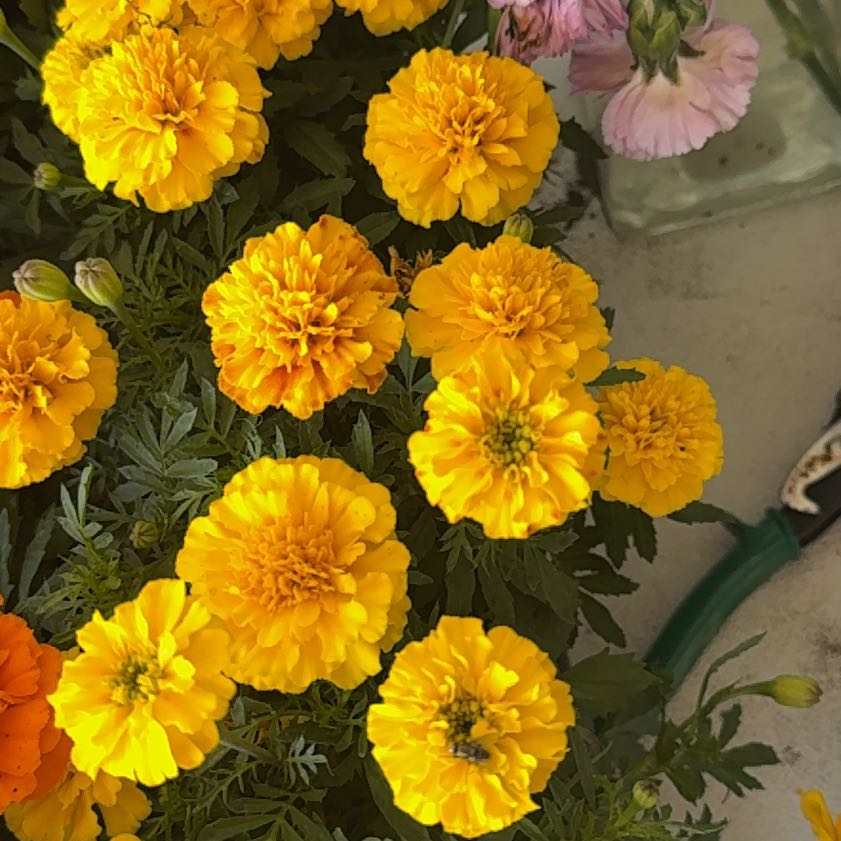
African Marigold

What's Eating Your African Marigold?

Tagetes erecta
Reviewed by Kiersten Rankel M.S.
Quick Answer

For African marigold, the most likely culprit is spider mites in hot dry summer weather (pale tiny pale dots and webbing across the pinnate leaves). Aphids cluster on flower buds and stalks during peak bloom. Slugs chew young plants and lower leaves overnight. Japanese beetles skeletonize the orange pompom flower heads despite the plant's pungent oils.

Stay on top of plant care
Get seasonal reminders for watering and fertilizing, personalized for your plants.
Try Greg Free

What does the damage look like?

Tap the closest match to jump straight to the fix.

Pests, ranked by impact

Spider mite infestation on a stem with fine silk webbing and pale speckled leaf damage

Spider mites

Damage
High
Removal
Moderate
What it looks like

Almost invisible without a hand lens. Yellow-green to red-orange specks on the underside of the pinnate leaflets and clustered along the leaf rachis. Hot dry summer weather is the iconic marigold trigger because heat-stressed plants lose the leaf-oil defense fast.

What the damage looks like

Tiny pale yellow dots peppering the upper leaf surface, then bronze patches that spread across whole leaflets. Fine webbing strung between the leaf rachis and stem in heavy infestations. Stressed plants drop lower leaves quickly, and bloom slows as the plant pulls energy back to survive.

How to get rid of them
Option 1

Shower the foliage at the base, every 3 days for 2 weeks

Aim a hose nozzle at the underside of leaves and spray for 30 seconds per plant. Water at the base of the plant the rest of the time so the foliage stays dry between rinses. Mites cannot reattach when knocked off, and the rinse cools heat-stressed plants. Repeat every 3 days for 2 weeks.

Option 2

Neem oil at dusk, every 5 days for 3 rounds

1

Mix 2 tablespoons cold-pressed neem oil and 1 teaspoon dish soap per gallon of water.

2

Spray the underside of every leaflet at dusk, paying attention to the leaf-rachis junction where mites cluster.

3

Repeat every 5 days for 3 rounds. That covers the full egg-to-adult life cycle.

Option 3

Mulch and water deeply at the base

Lay 2 inches of mulch around each marigold and water the soil at the base, not the foliage. Deep weekly watering during heat waves keeps the plant from drought-stressing into a mite explosion. Marigolds are drought-tolerant but heat plus dry foliage is the exact climate mites breed in.

Dense colony of aphids clustered on a plant stem

Aphids

Damage
Medium
Removal
Easy
What it looks like

Tiny pear-shaped insects 1 to 3 mm long, in shades of green, black, or yellow. Cluster densely on flower buds, the soft stalks just below the terminal flower head, and on the underside of young leaflets. Peak pressure during the heaviest bloom flush.

What the damage looks like

Distorted, stunted flower buds that fail to open or open misshapen. A sticky shiny film on the leaves and on whatever is below the plant. Black sooty mold grows on the residue over a few weeks. Heavy infestations weaken bloom and shorten the flowering season.

How to get rid of them
Option 1

Strong water blast every 2 to 3 days for 2 weeks

Hold a hose nozzle 12 inches from the affected buds and stalks and spray at high pressure. Most aphids dislodge and don't make it back to the plant. Repeat every 2 to 3 days for 2 weeks. The fastest, cheapest fix and works without chemicals.

Option 2

Insecticidal soap on buds and stalks at dusk

Spray ready-to-use insecticidal soap (Safer Brand, ~$10) on flower buds, stalks, and the underside of nearby leaflets at dusk. Repeat every 5 days for 3 rounds. Marigold's pungent oils tolerate soap sprays well, but spray at dusk to avoid leaf burn in afternoon sun.

Option 3

Deadhead spent blooms weekly

Pinch off faded flower heads at the base of the stalk every week. Spent blooms are where aphids hide between feedings, and removing them cuts the population at its hiding spots. Bonus: deadheading extends the bloom season by weeks.

Large red-brown slug (Arion rufus) crawling on a rhubarb leaf

Slugs

Damage
Medium
Removal
Moderate
What it looks like

Soft brown or gray mollusks 1 to 4 inches long. Active at night and on cool damp mornings. Hide under mulch, stones, and leaf debris during the day. Young marigold transplants and the lower pinnate leaves nearest the soil are the favorite targets.

What the damage looks like

Ragged irregular holes chewed in young leaves and lower foliage overnight. Silvery dried slime trails on leaves, stems, and the soil surface confirm the pest. Heavy pressure can mow down freshly transplanted seedlings before they establish.

How to get rid of them
Option 1

Iron phosphate bait around the bed

Sprinkle iron phosphate slug bait (Sluggo or Monterey Sluggo, ~$15) in a thin band around each plant and along the bed edge. Reapply after heavy rain. Pet-safe and breaks down into fertilizer, unlike older metaldehyde baits. Reduces the population within a week.

Option 2

Beer trap at soil level, refresh every 2 days

1

Sink a shallow tuna can or yogurt cup into the soil so the rim is level with the ground.

2

Fill halfway with cheap beer. Slugs are drawn to the yeast, fall in, and drown.

3

Empty and refill every 2 days through the active season. Set one trap per 4 to 6 marigolds.

Option 3

Pull mulch back from the stem and water in the morning

Slugs need cool damp daytime hiding spots. Keep mulch 3 inches away from each plant's stem and water in the morning so the soil surface dries by night. Marigolds tolerate dry surface soil well because their roots run deeper than the slug zone.

Metallic green and copper Japanese beetle (Popillia japonica) on a lantana flower

Japanese beetles

Damage
Medium
Removal
Moderate
What it looks like

Iridescent metallic green-and-copper beetles, half an inch long, with white tufts of hair along the sides. Feed in groups on the dense pompom flower heads of African marigold, especially the orange and yellow varieties. Active mid-June through August in most of the eastern and central US.

What the damage looks like

Petals chewed into ragged lace, often whole flower heads reduced to a brown skeleton. Pinnate leaves skeletonized between the veins, leaving a fishbone pattern. Despite the plant's pungent oils, beetles still target the flowers because the dense pompom shape concentrates feeding groups.

How to get rid of them
Option 1

Hand-pick into soapy water at dawn

1

Walk the bed at dawn while beetles are still sluggish from cool overnight temperatures.

2

Hold a jar of soapy water under each beetle and tap. They drop straight in.

3

Repeat every morning through the active flight period (mid-June to mid-August). Daily picking keeps the local population from snowballing.

Option 2

Neem oil spray on flower heads at dusk

Spray cold-pressed neem oil on the pompom flower heads and the upper foliage at dusk. Neem deters feeding without killing pollinators that have already gone home for the night. Repeat after rain or every 7 days through the active period.

Option 3

Skip the pheromone traps

Resist the urge to hang Japanese beetle bag traps near your marigolds. Research from Iowa State Extension shows the lures attract more beetles to your yard than they catch. If a neighbor wants to hang one, ask them to put it at the far edge of their property, not yours.

Common myth

Marigolds repel all garden pests.

Marigolds do release thiophenes that suppress some soil nematodes when planted near tomatoes and beans. But the plant itself still gets hit by spider mites, aphids, slugs, and Japanese beetles. The pungent oils deter some pests, not all. Treat your marigolds for what actually shows up, not what folklore promises.

Stay ahead of all of them

Three habits that keep African marigold pest pressure low through a long bloom season.
1

Companion plant marigolds near tomatoes, basil, and beans

Marigold root exudates suppress some soil-borne nematodes that attack tomato and bean roots. Plant marigolds in clusters within 18 inches of those crops at transplant time. The benefit is real for the neighbors, even though marigolds themselves still need pest watch.

2

Deadhead spent blooms weekly

Pinch off faded pompom heads at the base of the stalk every week. Deadheading extends bloom by weeks and removes the spent flower hiding spots where aphids and small pests cluster between feedings. The easiest single habit for marigold.

3

Water at the base, mulch lightly

Marigolds tolerate drought but heat plus wet foliage is the exact climate spider mites and slugs thrive in. Soak the soil at the base of each plant once a week and lay a thin 2-inch mulch ring (kept 3 inches from the stem) to conserve moisture without feeding slugs.

4

Inspect new flower buds twice a week

Aphids and Japanese beetles both target the soft new buds and unopened flower heads first. A 10-second look at the top of each plant twice a week catches infestations before the whole pompom is lost. Marigolds bloom hard from June to frost, so the inspection runs all summer.

Stay on top of plant care
Get seasonal reminders for watering and fertilizing, personalized for your plants.
Try Greg Free

About This Article

Kiersten Rankel M.S.
Botanical Data Lead at Greg · Plant Scientist
About the Author
Kiersten Rankel holds an M.S. in Ecology & Evolutionary Biology from Tulane University. A certified Louisiana Master Naturalist, she has over a decade of experience in science communication, with research spanning corals, cypress trees, marsh grasses, and more. At Greg, she curates species data and verifies care recommendations against botanical research.
See Kiersten Rankel's full background on LinkedIn.
Editorial Process
Pest identification and treatment guidance verified against Tagetes erecta field reports from Greg's botanical database, cross-referenced with university extension sources and published horticultural research.