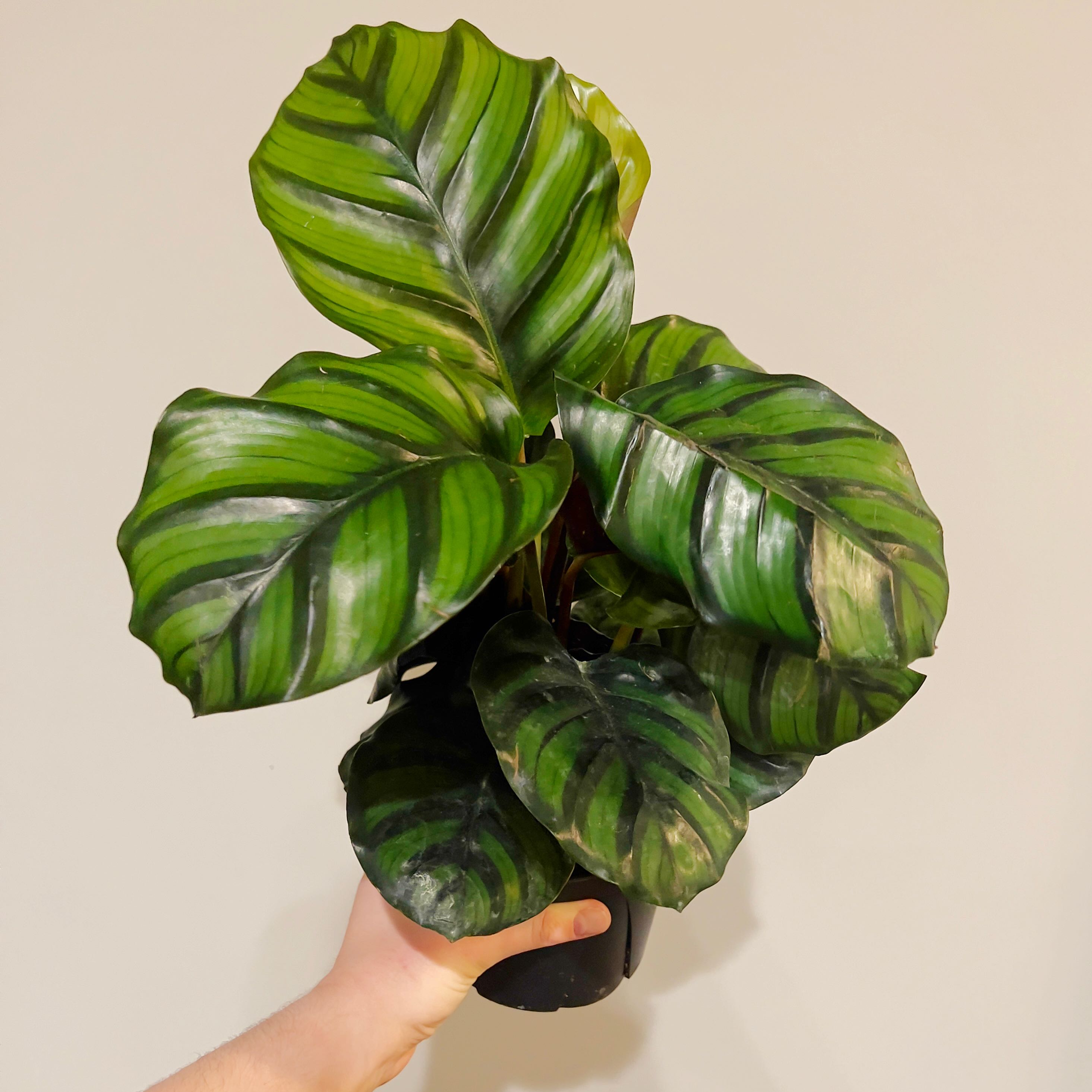
How to Water Calathea Fasciata
Goeppertia fasciata
Reviewed by Kiersten Rankel M.S.
Quick Answer
Water your Calathea fasciata every 5–7 days when the top inch of soil feels dry. Use distilled, filtered, or rainwater. Calatheas are sensitive to chlorine and fluoride and will brown at the edges on tap water.
Aim for consistently moist soil but never soggy, and pair watering with humidity above 50 percent.

Stay on top of plant care
Get seasonal reminders for watering and fertilizing — personalized for your plants.
How Often and How Much to Water
Adjust the sliders below for your pot size, light, and setting. The numbers assume a rich moisture-retaining mix and a pot with drainage.
Setting
Every
9days
Use
1cup
Your Watering Rhythm Across the Year
Soil dries faster in the growing season, which varies by region. Slow down watering in the off-season to avoid overwatering.
Pacific
Mountain
Midwest
Northeast
Southeast
JFMAMJJASOND
Growing season
Growing season
9days
Resting season
3–4weeks
How to Water Your Calathea fasciata
Use room-temperature filtered water at the soil line. Cold water and tap chemicals are the two biggest sources of edge burn on Calathea fasciata.
1
Use distilled, filtered, or collected rainwater. Tap water with chlorine or fluoride causes edges to brown over time and the damage doesn't reverse.
2
Pour at the soil line at room temperature. Cold water can shock the roots and stunt new leaf growth.
3
Soak slowly until water runs out the drainage holes. The whole rootball should be wetted, not just the surface.
4
Empty the saucer after 10 minutes so the roots aren't sitting in standing water. Pair watering with humidity above 50 percent from a humidifier.
Should You Water Your Calathea fasciata Today?
Going dry crisps the edges and the damage doesn't reverse. Check daily during heating season because dry indoor air pulls water out of the leaves faster than the soil shows it.
Hold off
Top inch of soil still damp to the touch
Leaves splayed open and lifted
Edges still smooth and uniformly colored
Pot feels heavy when lifted
Ready for water
Top inch of soil dry to the touch
Leaves curling inward or rolling up
Whole plant drooping during the day
Pot feels noticeably lighter
If Something Looks Off
Underwater and overwater both show as drooping and yellowing on Calathea fasciata. The soil moisture and the speed of decline tell which problem you have.
Underwatered
Soil
Dry through the top inch with the surface pulling away from the pot
Leaves
Curled inward like cigars with crispy brown edges on older leaves
Pace
Slow decline over a few days that mostly recovers within hours of a deep soak
Next steps
Soak the rootball thoroughly with room-temperature filtered water until water runs out the drainage holes
Move out of direct sun while the plant rehydrates
Expect leaves to relax their curl within 4 to 8 hours
Existing brown edges won't green back up, but the leaves still photosynthesize from the green parts. Wait for new growth before fertilizing
Overwatered
Soil
Stays dark and damp for over a week with a sour smell
Leaves
Whole leaves yellowing uniformly with stems turning brown at the soil line
Pace
Sudden collapse over days that worsens even after you stop watering
Next steps
Stop watering and move to a bright spot with airflow
Slip out of the pot and trim any black mushy roots back to firm white tissue
Repot in fresh moisture-retaining mix in a clean pot with drainage holes
Wait until the top inch of soil is just slightly dry before the next watering
Watch for fungus gnats hovering above the soil, a near-universal sign the mix has stayed too wet too long
Got More Questions?
Why are my Calathea fasciata leaves browning at the edges even with filtered water?
Most often low humidity, not water quality. Calathea fasciata wants 50 percent humidity or higher and crisps fast in dry indoor air, especially during heating season.
Run a humidifier near the plant. Misting and pebble trays do little to raise ambient humidity and misting can encourage fungal spots on Calathea leaves.
Can I use tap water on my Calathea fasciata?
Not reliably. Tap water with chlorine or fluoride causes edges to brown over time, and Calathea is one of the most sensitive houseplant genera.
Switch to distilled, filtered through a reverse osmosis or activated carbon filter, or collected rainwater. Letting tap water sit overnight removes only chlorine, not fluoride.
Why don't my Calathea leaves move at night the way they used to?
Light and temperature drive the leaf movement. Calathea fasciata raises its leaves at night under normal day-night cycles, but dim conditions or steady temperature blunts the response.
Move to a spot with brighter indirect daytime light. The night raise is most pronounced when daytime light is strong enough to trigger the rhythm.
Can I grow my Calathea fasciata in a self-watering pot?
It can work but easy to overdo. Calatheas like consistent moisture but rot fast when the rootball stays saturated.
If you use one, keep the reservoir half full at most and let it run dry between refills. A regular pot with attentive watering is more reliable for most growers.
How long can my Calathea fasciata go without water?
About a week before significant edge crispness sets in. In high humidity it stretches to 10 days, in dry indoor air it can be 4 to 5 days.
Deep-water with filtered water before any vacation, run a humidifier on a timer, and group with other plants to slow water loss. Calathea is one of the least vacation-tolerant houseplants.
Why are my Calathea fasciata leaves looking faded?
Most often light, sometimes water stress. Direct sun bleaches the patterns out and washes the colors. Bright indirect light keeps the contrast vivid.
If light is fine, check soil moisture and humidity. Faded combined with curled leaves points to dry air. Faded combined with yellowing points to over-watering.
Stay on top of plant care
Get seasonal reminders for watering and fertilizing — personalized for your plants.
About This Article

Kiersten Rankel M.S.
Botanical Data Lead at Greg · Plant Scientist
Editorial Process
Watering guidance verified against Goeppertia fasciata growth data from Greg's botanical database, cross-referenced with USDA hardiness zone data and published horticultural research.