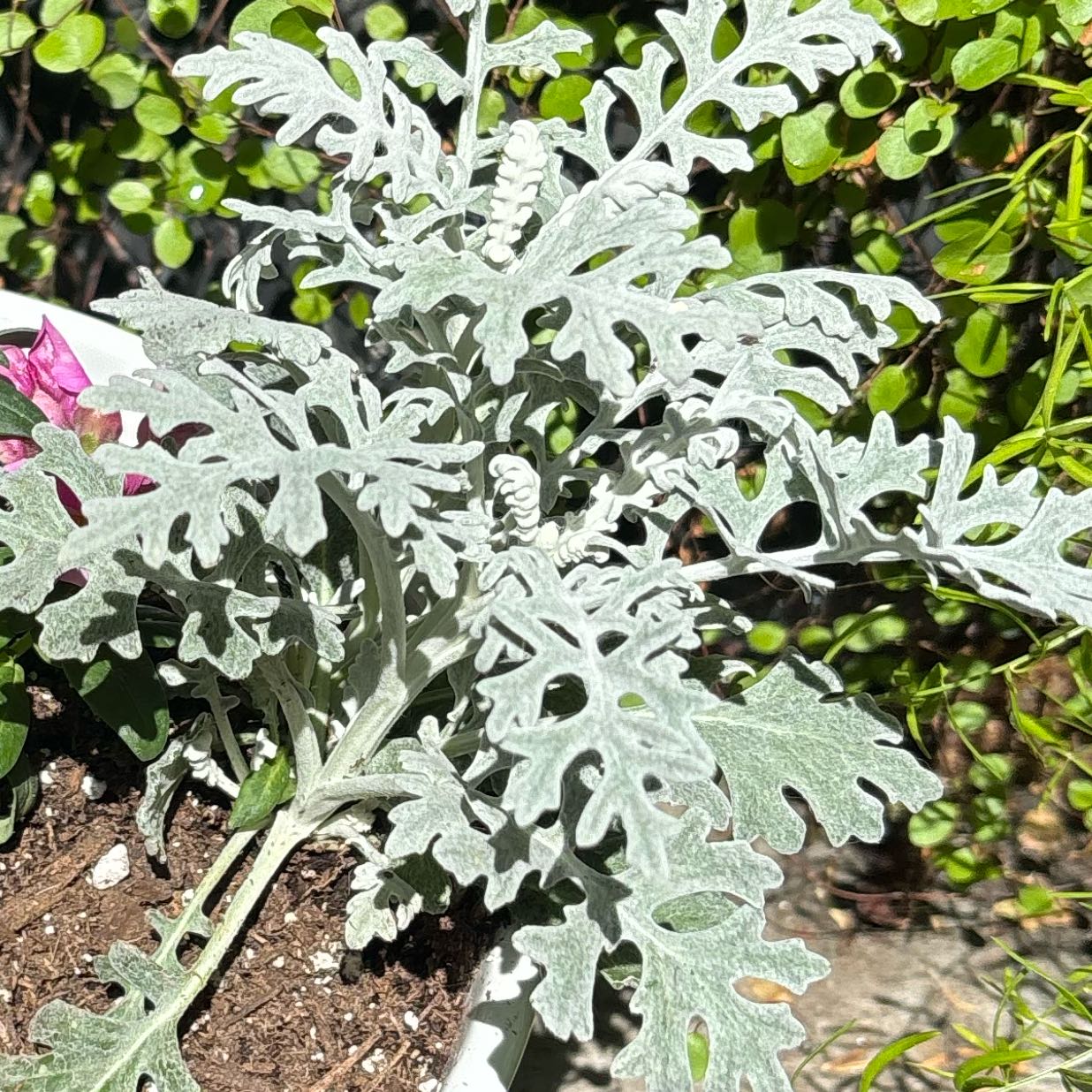
Dusty Miller

How to Prune Dusty Miller

Senecio Cineraria
Reviewed by Kiersten Rankel M.S.
Quick Answer
Prune Dusty Miller in early spring to shape the plant and remove any winter-damaged stems, then pinch stem tips throughout the growing season to keep it compact and full. Remove the small yellow flowers as they appear in summer, since the foliage is the main attraction and flowering makes the plant go floppy and leggy. Dusty Miller is forgiving and recovers well from heavy trimming.

When is the best time to prune?

Dusty Miller is grown primarily for its silver foliage and can be trimmed throughout its growing season, with the most important shaping prune coming in early spring after winter.

US pruning regions map
Pacific
Mar–Aug
Mountain
Apr–Aug
Midwest
Apr–Aug
Northeast
Apr–Aug
Southeast
Mar–Aug
Stay on top of plant care
Get seasonal reminders for watering and fertilizing — personalized for your plants.
Try Greg Free

Why Should I Prune My Dusty Miller?

Dusty Miller is grown for its striking silver-white leaves, not its flowers. Without pruning, it sends up tall stems topped with small yellow flowers that most gardeners find distracting. Once it flowers, the plant puts energy into seeds rather than foliage, and the whole thing tends to flop open and lose its compact mounded shape.

Pinching the stem tips throughout the season prevents this. Simply nip off the growing tip of each stem, cutting just above a pair of leaves. This causes the stem to branch, keeping the plant dense and bushy rather than tall and open.

In early spring, do a more thorough prune by cutting the whole plant back by one-third to one-half. This removes any winter-damaged or leggy growth and resets the plant's shape before the new season's growth begins.

If you see flower buds forming in summer, remove them by cutting the flowering stem back to a healthy set of leaves. The plant will redirect energy back into foliage.

Know Before You Cut

Difficulty Easy
Max removal 1/3 to 1/2 of growth in spring; pinch tips as needed in summer
Growth pattern Mounding foliage plant
Tools Sharp scissors or pruners

What Should I Remove?

Cut back by one-third to one-half in early spring
Pinch stem tips regularly to encourage branching
Remove flower buds and stems as they appear
Trim any stems that are stretching or flopping
Don't let it flower if you want a dense silver mound
Don't prune hard in fall in frost-prone areas
Don't skip pinching or the plant will get leggy

How Do I Prune Step by Step?

1
Do a spring shaping prune
In early spring, cut the entire plant back by one-third to one-half, making cuts just above a healthy set of leaves. Remove any stems that are brown, dead, or very woody.
2
Pinch stem tips every few weeks
Pinch or snip off the last inch or two of each stem tip, just above a leaf pair. Do this throughout the growing season to prevent the plant from stretching upward and losing its mounded form.
3
Remove flower buds before they open
Watch for tall stems with small clusters of yellow buds appearing in midsummer. Snip these stems back to a healthy pair of leaves below the bud cluster as soon as you notice them.
4
Tidy up any flopping or dead stems
Throughout the season, cut back any stems that have flopped open or died back. Dusty Miller rebounds quickly from trimming, so do not hesitate to cut a stem that is spoiling the shape.

Got More Questions?

Should I let my Dusty Miller flower?
Most gardeners remove the flowers to keep the plant's energy in its silvery foliage and its compact shape. The yellow flowers are small and not particularly attractive, and once the plant flowers it tends to flop open. If you enjoy the flowers, go ahead, but expect the foliage to become less full.
My Dusty Miller got very leggy and floppy over the summer. Can I cut it back hard now?
Yes. As long as temperatures are still warm enough for the plant to grow, you can cut it back by one-third to one-half and it will push fresh compact growth. Avoid a hard prune just before first frost in cold climates.
Is Dusty Miller a perennial or annual?
In zones 7-10 it can survive as a short-lived perennial. In colder zones it is grown as an annual and killed by hard frost. Where it overwinters, prune it back in early spring before new growth begins.
The silver leaves on my Dusty Miller look dull. Will pruning help?
Dull foliage is usually caused by low light, overwatering, or age of the plant rather than a pruning issue. That said, cutting back old growth does encourage fresh new silver leaves, which are always brighter than older foliage.
Stay on top of plant care
Get seasonal reminders for watering and fertilizing — personalized for your plants.
Try Greg Free

About This Article

Kiersten Rankel M.S.
Botanical Data Lead at Greg · Plant Scientist
About the Author
Kiersten Rankel holds an M.S. in Ecology & Evolutionary Biology from Tulane University. A certified Louisiana Master Naturalist, she has over a decade of experience in science communication, with research spanning corals, cypress trees, marsh grasses, and more. At Greg, she curates species data and verifies care recommendations against botanical research.
See Kiersten Rankel's full background on LinkedIn.
Editorial Process
Pruning guidance verified against Senecio Cineraria growth data from Greg's botanical database, cross-referenced with USDA hardiness zone data and published horticultural research.
40+ Greg users growing this plant
USDA hardiness zones 7a–10b
Grow plants with confidence