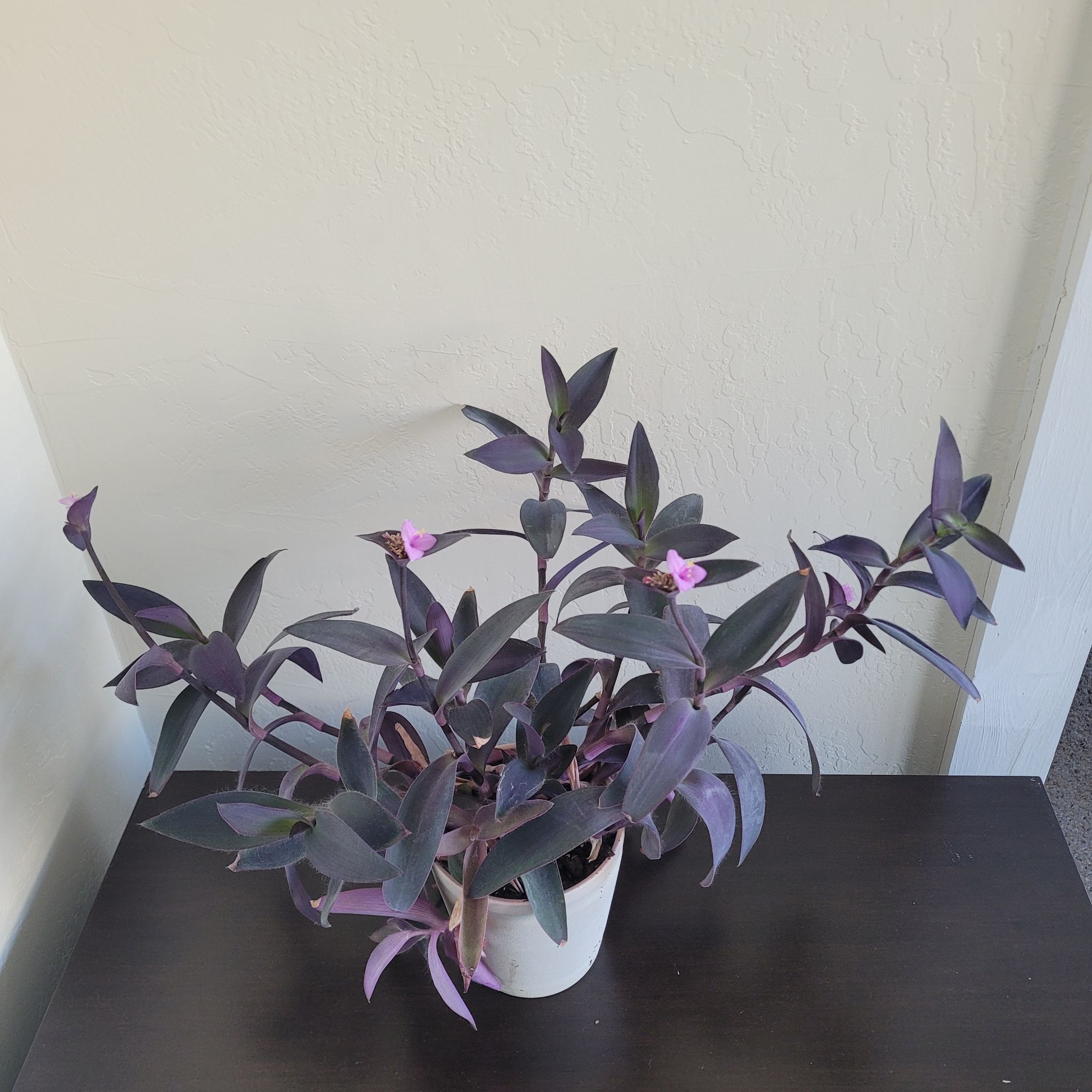
Purple Heart

How to Prune Purple Heart

Tradescantia pallida
Reviewed by Kiersten Rankel M.S.
Quick Answer
Prune Purple Heart in spring by cutting leggy or bare stems back by half to encourage dense, colorful new growth. Regular tip-pinching through the growing season keeps the trailing stems full rather than sparse. Never remove more than half the plant at once.

When is the best time to prune?

Purple Heart grows actively in spring through fall; in frost-free zones it grows year-round and can be pruned any time it gets leggy.

US pruning regions map
Pacific
Mar–Sep
Mountain
May–Aug
Midwest
Apr–Aug
Northeast
Apr–Aug
Southeast
Mar–Oct
Stay on top of plant care
Get seasonal reminders for watering and fertilizing — personalized for your plants.
Try Greg Free

Why Should I Prune My Purple Heart?

Purple Heart (Tradescantia pallida) grows fast and produces long trailing stems that eventually become bare at the base with a tuft of leaves only at the tip. Regular pruning keeps the plant dense and the vivid purple color vibrant, as new growth tends to be the most intensely colored.

The simplest approach is pinching. Pinch or cut the tip of any stem that is getting too long, just above a leaf node. New shoots will emerge from that point, branching the stem and filling out the plant. Do this frequently during spring and summer.

For a harder reset, cut all stems back by about half in early spring. The plant responds quickly, pushing vigorous new shoots from almost every node along the remaining stems. This is also a good time to remove any frost-damaged stems if you're growing it outdoors.

Purple Heart is very forgiving of pruning mistakes. It is a tough plant that bounces back from heavy cutting quickly, especially when growing conditions are good.

Know Before You Cut

Difficulty Easy
Max removal 1/2 of stem length
Growth pattern Trailing perennial
Tools Clean sharp scissors or pruners

What Should I Remove?

Pinch stem tips regularly to encourage branching
Cut all stems back by half in early spring for a fresh start
Remove frost-damaged stems completely in early spring
Take cuttings from pruned stems to root and fill in gaps
Don't remove more than half the plant at one time
Don't cut back in fall when cooler temps slow recovery
Don't leave bare stubby stems with no leaves, they rarely regrow

How Do I Prune Step by Step?

1
Identify leggy or bare stems
Look for stems that have become very long with few leaves along the length, or stems where lower leaves have dropped off leaving bare sections. These are the first to prune.
2
Pinch or cut growing tips
Pinch or cut the tip of each stem just above a leaf node. The plant will branch from that point, producing two or more new shoots. This is best done frequently during the growing season rather than in one big session.
3
Cut bare or frost-damaged stems back hard
For stems that are mostly bare or were damaged by frost, cut back to just above a healthy node with at least one leaf. The plant will regrow from this point within a week or two in warm conditions.
4
Root the cuttings
Purple Heart roots very easily. Drop the removed tip cuttings into a glass of water and they will root in one to two weeks. Use them to fill bare spots in the pot or garden bed.

Got More Questions?

Why is my Purple Heart turning green instead of purple?
The intense purple color develops best in bright light. If your plant is in a dim spot, new growth will be greener. Move it to a brighter location and prune back the green stems to encourage new purple growth.
Can I cut Purple Heart back to the ground?
Yes, especially in spring or if frost damaged the tops. Purple Heart is very resilient and will push new shoots from the roots if cut to the ground. Recovery takes a few weeks but is typically vigorous.
How often should I pinch my Purple Heart?
Every two to four weeks during spring and summer is ideal. The more consistently you pinch, the fuller the plant stays. If you only do it once or twice a year, the plant will get leggy between sessions.
Is Purple Heart safe to handle while pruning?
The sap can cause mild skin irritation in some people. Wearing gloves while pruning is a good precaution, especially if you have sensitive skin. Wash your hands after handling the cut stems.
Stay on top of plant care
Get seasonal reminders for watering and fertilizing — personalized for your plants.
Try Greg Free

About This Article

Kiersten Rankel M.S.
Botanical Data Lead at Greg · Plant Scientist
About the Author
Kiersten Rankel holds an M.S. in Ecology & Evolutionary Biology from Tulane University. A certified Louisiana Master Naturalist, she has over a decade of experience in science communication, with research spanning corals, cypress trees, marsh grasses, and more. At Greg, she curates species data and verifies care recommendations against botanical research.
See Kiersten Rankel's full background on LinkedIn.
Editorial Process
Pruning guidance verified against Tradescantia pallida growth data from Greg's botanical database, cross-referenced with USDA hardiness zone data and published horticultural research.
13,017+ Greg users growing this plant
USDA hardiness zones 7a–11b
Grow plants with confidence