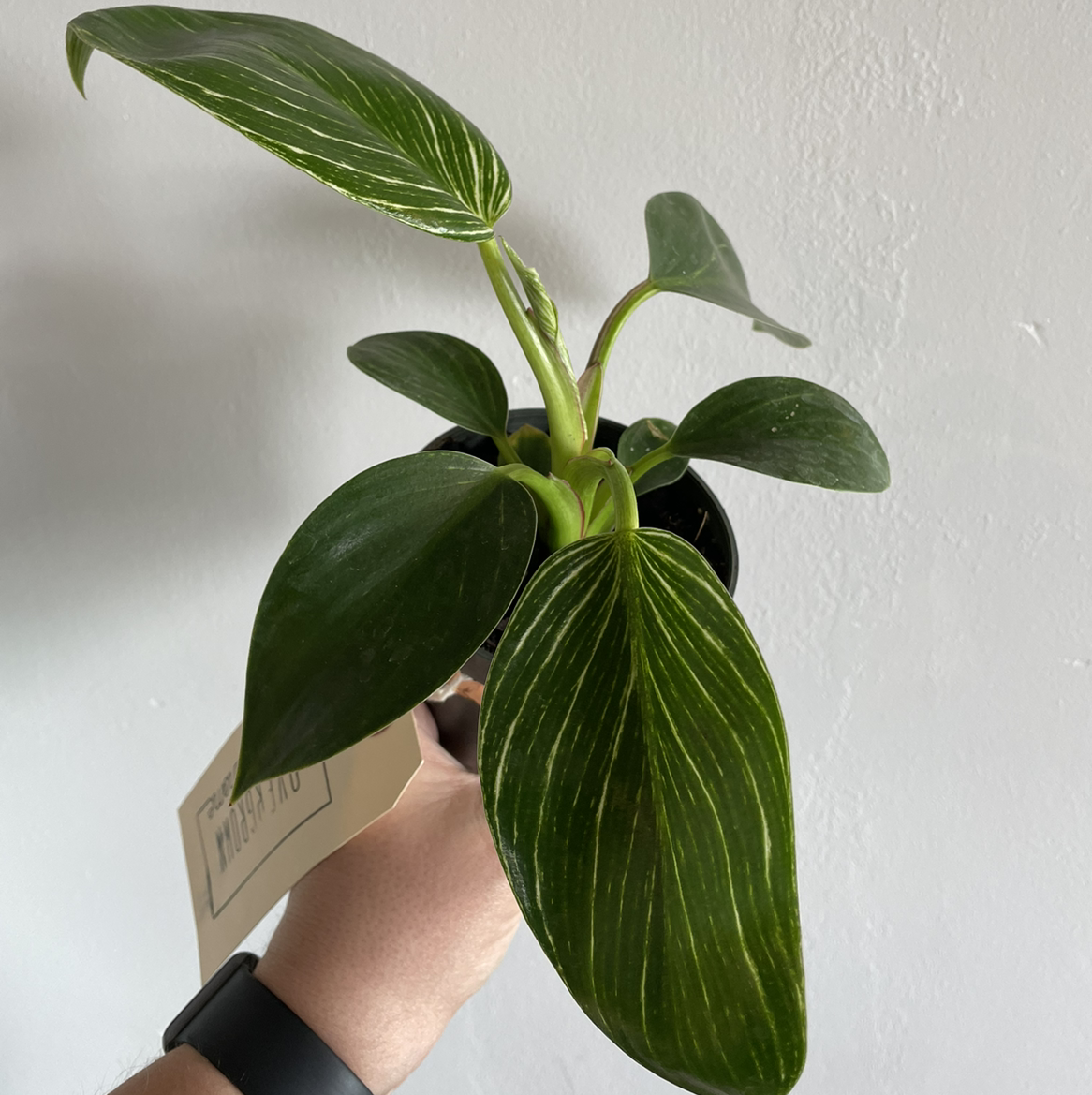
Philodendron Birkin

How to Prune Philodendron Birkin

Philodendron 'Birkin'
Reviewed by Kiersten Rankel M.S.
Quick Answer
Prune Philodendron Birkin in spring through summer, when the plant is actively growing and recovers quickly from cuts. Remove yellow or damaged leaves at their base, and cut back any stems that have grown long and bare. Never remove more than a quarter of the plant's leaves at one time, as Birkin is a moderate grower that needs its foliage to stay healthy.

When is the best time to prune?

As a tropical houseplant, Philodendron Birkin can be pruned year-round but responds best when pruned during active growth in spring and summer.

US pruning regions map
Pacific
Mar–Sep
Mountain
Apr–Aug
Midwest
Apr–Aug
Northeast
Apr–Aug
Southeast
Mar–Sep
Stay on top of plant care
Get seasonal reminders for watering and fertilizing — personalized for your plants.
Try Greg Free

Why Should I Prune My Philodendron Birkin?

Philodendron Birkin is a compact, upright houseplant that mostly takes care of its own shape. Pruning is less about sculpting and more about removing leaves and stems that are no longer healthy or useful to the plant.

Yellow leaves are the most common reason to prune. Remove them by cutting the petiole (the stalk connecting the leaf to the stem) close to the main stem. Leaving yellowed leaves in place does not help the plant and can attract pests or fungal issues.

Birkin occasionally produces a stem that stretches longer than the others, especially in lower light. Cutting that stem back to just above a node, the small bump on the stem where a leaf attaches, encourages a new shoot to branch out from below.

One thing to watch for with Birkin specifically: the plant sometimes reverts, producing leaves that are mostly green with little or no pinstripe patterning. If variegation matters to you, prune off fully reverted stems at the base to encourage the plant to produce new growth with more typical patterning.

Know Before You Cut

Difficulty Easy
Max removal No more than 1/4 of leaves at once
Growth pattern Upright tropical houseplant
Tools Clean pruners or sharp scissors

What Should I Remove?

Remove yellow or damaged leaves at the base of the petiole
Cut back bare or overly long stems to a node
Remove fully reverted all-green stems at the base
Wipe blades with rubbing alcohol before cutting
Don't remove more than a quarter of the leaves at once
Don't cut in winter unless the leaf is diseased or dying
Don't pull leaves off by hand; always use clean scissors

How Do I Prune Step by Step?

1
Inspect the plant before cutting
Look the whole plant over first. Identify yellow leaves, bare leggy stems, or any reverted all-green growth. Plan which cuts to make before touching any tools.
2
Clean your tools
Wipe your pruner blades with rubbing alcohol or a dilute bleach solution. Philodendron sap can transfer disease between plants, so clean tools matter.
3
Remove yellow or damaged leaves
Cut the leaf stalk as close to the main stem as you can without nicking the stem itself. This is the most common and most useful pruning you will do on a Birkin.
4
Cut back long bare stems
If a stem has grown several inches with no leaves, cut it back to just above the last visible node. New growth will emerge from that point within a few weeks.
5
Remove reverted stems if needed
If a stem is producing fully green leaves with no pinstripe patterning, cut it off at the base. This is optional but encourages the plant to put energy into its patterned growth.

Got More Questions?

Can I prune Philodendron Birkin in winter?
You can remove obviously dead or diseased leaves any time of year. For more significant trimming, wait until spring when the plant is growing actively and will recover faster.
My Birkin is losing its pinstripe pattern. Should I prune it?
Yes. Reversion to plain green leaves is common in Birkin. Cutting off the reverted stems at the base encourages the plant to produce new growth that may show the pinstripe pattern again.
What if I accidentally cut off too many leaves?
Move the plant to a warm, bright spot and hold off on fertilizing until you see new growth. Birkin is not fast-growing, so recovery takes patience, usually several weeks.
Can I propagate the stems I cut off?
Yes. Stem cuttings with at least one node can be rooted in water or moist potting mix. Place them in a warm, bright spot and roots should appear within a few weeks.
Stay on top of plant care
Get seasonal reminders for watering and fertilizing — personalized for your plants.
Try Greg Free

About This Article

Kiersten Rankel M.S.
Botanical Data Lead at Greg · Plant Scientist
About the Author
Kiersten Rankel holds an M.S. in Ecology & Evolutionary Biology from Tulane University. A certified Louisiana Master Naturalist, she has over a decade of experience in science communication, with research spanning corals, cypress trees, marsh grasses, and more. At Greg, she curates species data and verifies care recommendations against botanical research.
See Kiersten Rankel's full background on LinkedIn.
Editorial Process
Pruning guidance verified against Philodendron 'Birkin' growth data from Greg's botanical database, cross-referenced with USDA hardiness zone data and published horticultural research.
17,500+ Greg users growing this plant
USDA hardiness zones 10a–12b
Grow plants with confidence