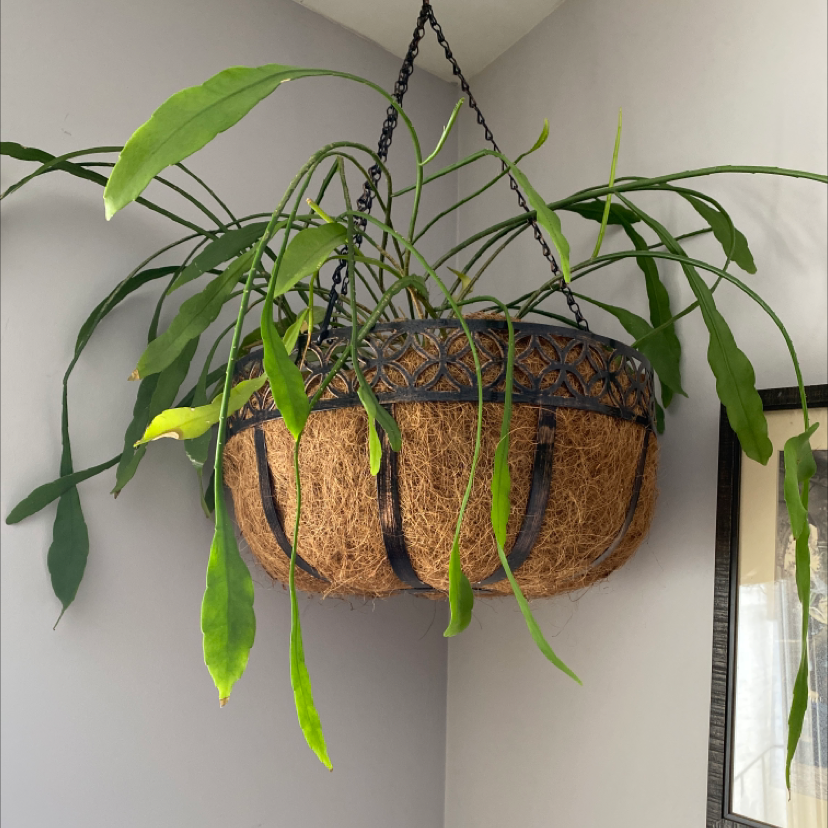
Dutchman's Pipe Cactus

How to Prune Dutchman's Pipe Cactus

Epiphyllum oxypetalum
Reviewed by Kiersten Rankel M.S.
Quick Answer
Prune Dutchman's Pipe Cactus in spring or early summer, after any blooming has finished. Remove dead, shriveled, or broken stem segments back to the nearest healthy joint, and cut back any sections growing in unwanted directions. This is an epiphytic cactus that blooms on its flattened leaf-like stems, so avoid cutting healthy green segments or you will lose potential flower sites for next season.

When is the best time to prune?

Dutchman's Pipe Cactus is a tropical epiphyte with no hard dormancy, so pruning is timed to the natural pause after its spring bloom rather than to outdoor frost dates.

US pruning regions map
Pacific
Apr–Jun
Mountain
May–Jun
Midwest
May–Jun
Northeast
May–Jun
Southeast
Apr–Jun
Stay on top of plant care
Get seasonal reminders for watering and fertilizing — personalized for your plants.
Try Greg Free

Why Should I Prune My Dutchman's Pipe Cactus?

Dutchman's Pipe Cactus grows in a cascading, branching structure of flat, leaf-like stems. Without any pruning, it can grow several feet in all directions and the older stem segments at the base may shrivel and die. Removing dead or dying segments keeps the plant healthy and looking its best.

This is not a cactus that needs heavy pruning. Think of it as targeted removal: dead and shriveled segments come out, very long stems can be shortened after blooming, and crowded sections can be thinned slightly for airflow and light.

The most important timing note is that this plant blooms on its existing mature green stems. Cutting healthy green segments before or during the bloom period removes potential flower buds, which may not be visible until the flower actually opens at night. Prune after the bloom cycle finishes in spring.

Segments you remove can be set aside to dry for a day and then propagated as cuttings, since this species roots readily.

Know Before You Cut

Difficulty Easy
Max removal 1/4 of stems per session
Growth pattern Cascading epiphytic cactus
Tools Clean sharp scissors or pruners

What Should I Remove?

Remove dead, shriveled, or brown stem segments
Cut at the joint between segments
Prune after the spring bloom is finished
Save healthy removed segments for propagation
Don't cut healthy green segments before or during blooming
Don't prune in fall when buds may be forming
Don't remove more than one-quarter of stems in one session

How Do I Prune Step by Step?

1
Wait until after blooming to start
Flowers open at night in spring and last only a single night. Once you have seen the last bloom open and the petals have fallen, it is safe to begin pruning.
2
Identify dead and shriveled segments
Look for stem segments that are wrinkled, brown, or dry all the way through. These will not recover and can be removed.
3
Cut at the segment joint
Find the natural notch or joint between segments and cut there. This leaves a clean, defined cut point and makes it easier for the cut to callus over.
4
Trim stems growing in problem directions
If any stems are growing into walls, furniture, or other plants, cut them back to a joint that points in a better direction. Make the cut at a joint, not mid-segment.
5
Let cut segments dry before discarding or propagating
If you want to propagate, set removed healthy segments on a dry surface for 24 hours before potting. This lets the cut end callus, which reduces the chance of rot.

Got More Questions?

Can I prune Dutchman's Pipe Cactus while it has buds forming?
Avoid it. Buds form on existing mature green stem segments and are often not visible until just before they open at night. Removing segments during bud set means losing flowers you might not even know were coming.
I accidentally broke off a healthy segment. Should I throw it away?
No. Let the broken end dry for a day, then pot it up in well-draining cactus or orchid mix. It should root within a few weeks and grow into a new plant.
My plant has not bloomed in two years. Could pruning be the cause?
Possibly. If healthy green segments were removed, you may have cut off the stems that would have bloomed. Other common reasons for no bloom are too much fertilizer, too little light, or growing conditions that are too warm in winter without a slight cool rest period.
How do I know if a shriveled segment is just thirsty or actually dead?
Gently flex the segment. If it bends without snapping and still has some give, it may recover with watering. If it is crisp and dry all the way through or snaps easily, it is dead and should be removed.
Stay on top of plant care
Get seasonal reminders for watering and fertilizing — personalized for your plants.
Try Greg Free

About This Article

Kiersten Rankel M.S.
Botanical Data Lead at Greg · Plant Scientist
About the Author
Kiersten Rankel holds an M.S. in Ecology & Evolutionary Biology from Tulane University. A certified Louisiana Master Naturalist, she has over a decade of experience in science communication, with research spanning corals, cypress trees, marsh grasses, and more. At Greg, she curates species data and verifies care recommendations against botanical research.
See Kiersten Rankel's full background on LinkedIn.
Editorial Process
Pruning guidance verified against Epiphyllum oxypetalum growth data from Greg's botanical database, cross-referenced with USDA hardiness zone data and published horticultural research.
4,525+ Greg users growing this plant
USDA hardiness zones 10a–11b
Grow plants with confidence